Online Reporter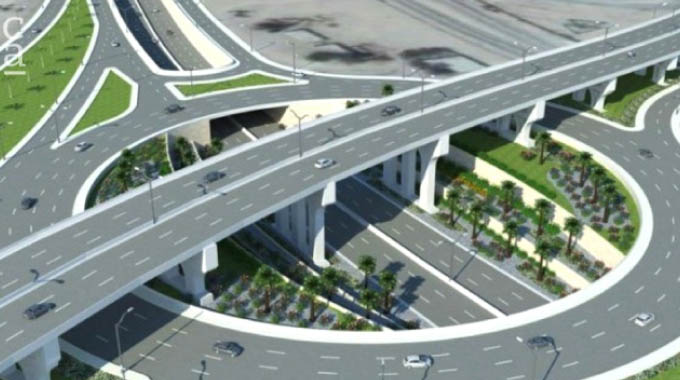
Ranga Mataire
Group Political Editor
THE successful completion of the most complex, and expensive, single example of roadworks engineering in Zimbabwe, the Mbudzi Interchange in southern Harare, shows that Zimbabwean engineers and contractors can now do the work without involving outside consultants or companies.
This is important as the upgrading of the road network, both within cities and along highways, needs continuous investment to create the sort of infrastructure that our modern economy requires.
With the engineering design and implementation now sorted out, the limiting factor will be financing, which must largely be the efficient use of toll fees and vehicle licence fees.
We have seen this in the decision of the Second Republic to reject previous ideas of bringing in a foreign contractor for the major roads upgrade now in progress, especially the main north-south highway from Beitbridge to Chirundu.
There are enough local contractors with the necessary technical equipment and skills to do the work under the supervision of the Ministry of Transport and Infrastructural Development at a more than competitive cost.
The speed of the work has been governed by the financial flows, largely the cash flows from the toll gates on the route.
The Government now has two toll charges, one for roads that have been upgraded or are well advanced in an upgrade and one for roads that still need a lot of work.
Drivers are charged the higher fee when they are already benefiting from the roadworks.
In Harare, the Ministry of Transport and Infrastructural Development is looking at the continuing upgrade of the Beitbridge-Chirundu Highway as it passes through the city, and where the growing highway traffic, which includes international traffic, and the local city traffic through the major industrial area cause serious congestion.
Two of the intersections along the Harare component of the Harare-Masvingo Highway, Simon Mazorodze Road, are now in the design stage, those where Willowvale Road branches off from Simon Mazorodze and that very complex intersection of Simon Mazorodze, Remembrance Drive and Paisley Road where the exceptional levels of stop-start traffic needs almost continuous maintenance of the road surface.
One of the larger expenses at Mbudzi was the need to buy out property owners near the interchange, so there was enough room for the complex system of 15 bridges and the accompanying turn lanes and approach roads.
The original town plan left enough room for a large roundabout, although there had been some development creep, but this was far too little for an interchange.
The proposed interchanges closer to the city centre will probably require more property to be bought out, driving up costs.
There is a well-defined process for compulsory acquisition of property for things like infrastructure with property owners entitled to full compensation for land and buildings, but no premium for being in the way on a road.
Basically a house owner or factory owner can buy something very similar close-by with the compensation money, so they are not out of pocket, but do not make a profit.
This need for enough land for interchanges or even roundabouts must now be factored in where the major main roads intersect in urban areas.
The road reserves set out before the adjoining land is sold off for development need to be adequate for future major roadworks, even if these are not built for the next few decades.
If there is never any need for an interchange then we can have a pleasant little park next to the roundabout, and if it is needed, then the land is available.
Road reserves should, in any case, be made wide enough so that there is enough room for multi-lane roads along the major routes.
This is now routine, but there are still some main roads that are upgrades of what were minor roads 80 or 100 years ago. But even here future costs can he limited if land is reserved now.
This was done years ago along parts of ED Mnangagwa Road in Harare, where the colonial city council warned land owners that they would probably lose a few metres of their front gardens in the future and that the council would not pay for future development on that strip, just for the land.
This is why newer walls are set further back from the road than older walls and why most commercial development does not intrude into that strip.
Part of the planning and commissioned work by the Ministry of Transport and Infrastructural Development is now making sure that future development can be done properly without having to have serious congestion and a lot of compensation paid out.
The dualisation of the Harare-Mazowe Road is such an example.
This is the city end of the Harare-Nyamapanda Highway, which will need upgrading and development in time, but it is also the route into what the masterplans see as a significant satellite city for Harare, one that everyone this time round wants to be done right from the beginning, with the proper greenbelts between Harare and Mazowe development and the proper transport routes in place from the start.
We need more of this advance planning, and this means that the Transport Ministry and the planners in the local authorities and the Ministry of Local Government and Public Works need to collaborate closely to make sure that planning includes the space and routes for the infrastructure and transport corridors.
It makes it much easier to implement and upgrade infrastructure if there is enough space to do this.