Business Reporter
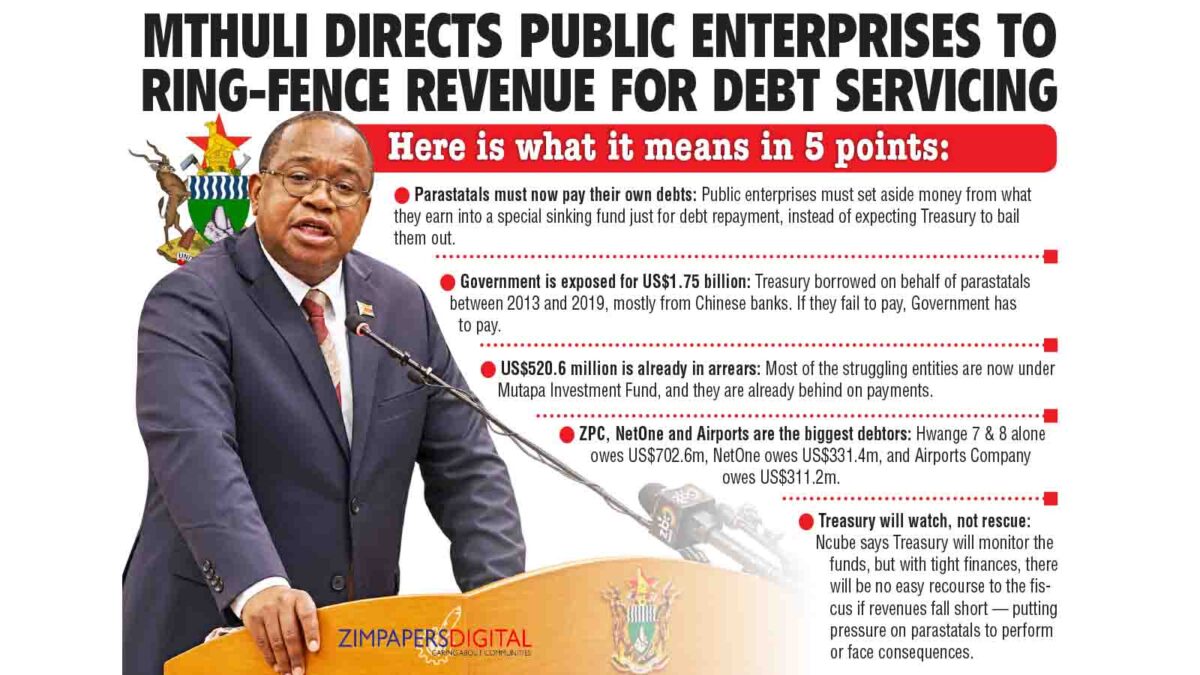
Finance Minister Prof Mthuli Ncube has directed public enterprises to establish dedicated debt servicing sinking funds, with revenues from their operating activities ring-fenced to meet debt service obligations, as Treasury moves to prevent struggling parastatals from turning to the fiscus amid US$1,75 billion in on-lent loan exposure.
Speaking on the latest public debt figures from his ministry, Minister Ncube said the directive comes ‘‘in view of the various challenges affecting public enterprises.’’
‘‘Accordingly, Treasury will continue to monitor the performance of these facilities and their associated sinking funds, so as to avoid recourse to the fiscus, given the prevailing fiscal constraints,’’ he said.
The exposure, recorded at the end of September 2026, is owed mostly to Chinese financial institutions for various investment projects, while total arrears across the listed public entities – the majority now under the Mutapa Investment Fund – reached US$520.6 million.
The Government contracted 10 external facilities between 2013 and 2019 from the Export-Import Bank of China, India Exim Bank and BADEA to finance critical infrastructure projects.
The Zimbabwe Power Company (ZPC), now folded into ZESA (Private) Limited, accounted for the largest share of overall exposure across its power and water projects. The Hwange Thermal Power Station Units 7 and 8 Expansion Project had the highest total exposure at US$702,6 million and the largest total arrears at US$126,6 million.
The Kariba South Hydro Power Station Extension Project carried US$250,9 million in total exposure and US$82,9 million in total arrears, while the ZPC Deka Pumping Station and River Water Intake System recorded US$56 million in total exposure and US$13.7 million in total arrears.
NetOne’s projects together accounted for US$331,4 million in total exposure and US$151.2 million in total arrears. Its Network Expansion Phase 2 Project showed US$225,7 million in total exposure and US$117,5 million in total arrears; the National Mobile Broadband Expansion Project recorded US$72,3 million in total exposure and US$12,2 million in total arrears; and the Network Expansion Phase 1 Project stood at US$33,4 million in total exposure and US$21.5 million in total arrears.
The Airports Company of Zimbabwe recorded US$311,2 million in combined total exposure across two airport projects. The Robert Gabriel Mugabe International Airport Project had US$157,5 million in total exposure and negative total arrears of US$18,3 million, while the Victoria Falls Airport Project carried US$153,7 million in total exposure and US$92,5 million in total arrears.
The TelOne Backbone Network and Broadband Access Project had US$101,1 million in total exposure and US$35,4 million in total arrears. The Small and Medium Enterprises Development Corporation’s US$3 million line of credit recorded US$1,4 million in total exposure and US$100 000 in total arrears.
Minister Ncube’s directive places the burden of debt servicing squarely on the entities themselves, with Treasury positioning itself as a monitor rather than a backstop – a stance that leaves parastatals with limited room to manoeuvre should ring-fenced revenues fall short of obligations.
Given that the loans are under a recourse arrangement, a default allows the lender to seize state assets pledged as collateral.
Economic analyst Mr Malone Gwadu said establishing dedicated debt servicing sinking funds helps prevent future bailout requests from the Treasury by urging public enterprises to build financial buffers to foster self-reliance.
It also presses entities with existing debt to service what they owe rather than fall back on Government support, reinforcing a culture of saving and timely debt repayment.
‘‘It’s a good move, in the sense that it’s pre-empting any potential stress or requests from the Treasurer to bail out the state enterprises by requesting them to be proactive in their operations through setting aside funds in case of any particular events, any stress-related (events), that would make it possible to call on the Treasurer. By way of him requesting that some of the revenues should be put aside, he’s emphasising the need for them to build a culture of saving and a culture of debt servicing.’’
Another economic analyst, Mr Kudakwashe Mugova, said ring-fencing revenue for debt service is a sound discipline measure, but only works when State enterprises generate enough cash. He warned that sub-cost tariffs and local-currency earnings against US dollar obligations simply push arrears onto suppliers, maintenance, and statutory payments.
Mr Mugova added that protecting public finances requires Treasury-controlled escrow accounts, cost-reflective pricing and separating viable entities from those needing debt restructuring.