admin
admin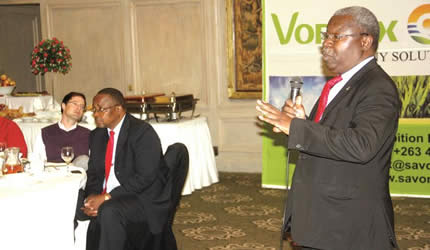
said Government was only awaiting the certificate of incorporation.
“We have registered the company (National Grid Services Company) and we are waiting for the registration certificate,” Mr Mbiriri said.
He said Government was actively engaged in getting the new single electricity buyer up and running, but would not give timelines on the reforms.
Government believes relieving Zesa of its US$400 million debt would make the power generation sector more attractive to investors.
“The intention is to interest private sector capital into generation as well as into distribution. For that to happen, one of the fundamental decision that has been taken is that let’s take the inherited debts that exist in the various (Zesa) companies,” he said.
He said NGSC would remain entirely State-owned in order to appreciate, understand and know what transpires in the provision of power.
The single electricity buyer would initially sell power to another new State entity, Zimbabwe Distribution Company, and thereafter to private distributors.
The measures are part of extensive power sector reforms Government is undertaking to attract private capital to close the yawning gap between demand and supply. The country is currently generating about 1 200 megawatts against the peak demand of about 2 200MW.
Mr Mbiriri was speaking at a stakeholders’ meeting on power sector reforms in Harare yesterday organised by the Zimbabwe Energy Council.
Cabinet recently approved the establishment of the NGSC to oversee transmission to a central pool before selling to bulk distributors.
The gap between generation capacity and demand means capital is required to bridge the supply deficit.
Government says NGSC’s Zesa debt takeover would also see investment going directly to the State-owned power stations, namely Harare, Munyati, Bulawayo and Hwange thermal power stations.
Extension of Hwange and Kariba is planned to last between three to four years from the day of financial closure. Sino-Hydro officials are in the country with a view to finalise the agreement with Government.
Mr Mbiriri said Government would agree to equity capital injection in the thermal power stations, but Kariba will remain State-owned.
Licences being issued to independent power producers would spur private investment in the projects as it would allow IPPs to sign power purchase agreements with large consumers of electricity.
The arrangement would boost investor confidence as they would be assured the projects would be viable to allow them to recoup their investment.
Zesa chairman Mr Simba Mangwengwende said the country was facing deficits due to inefficient generation capacity of old equipment as little investment went into power in the last few decades.
African development’s ZimFund manager Engineer Emmanuel Nzabanita said in unbundling Zesa the country should not privatise distribution, as that would create monopolies. He said Zimbabwe could learn from experiences of Uganda Egypt, Kenya and Ethiopia what to and what not do in power sector reforms.


 Online Reporter