tawandamusarurwa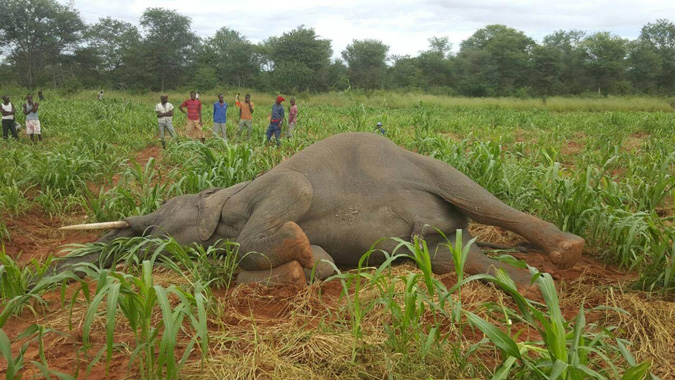
Tinashe Farawo
WITHOUT doubt, 2021 has been one of the bloodiest years in the history of this country as far as human-wildlife conflict is concerned.
Sixty-eight people were killed and more than 70 were injured, while others suffered permanent disabilities, making it difficult for them to fend for their families.
The struggle for communities who share borders with wildlife is real, long and bloody.
Hundreds of cattle, goats and other livestock were lost as wild animals invaded human settlements in desperate searches for food and water.
It has been a disaster for small-scale farmers in Mbire, Hwange, Hurungwe, Bulilima Mangwe and many other parts of the country, as the marauding animals destroyed people’s livelihoods, not to mention their own habitat.
In 2021, the Zimbabwe Parks and Wildlife Management Authority (Zimparks) received more than 2 000 distress calls from communities across the country as compared to an average of 300 between 2015 and 2016.
The long-term solution to this crisis is to translocate the animals from where they have exceeded the ecological carrying capacity to areas where there are densely populated, including other former elephant-range areas across the continent.
However, the Covid-19 pandemic delivered a crushing blow to the translocation of animals in 2020, after the authority had processed 600 permits to translocate elephants and other animals from Save Valley to the northern parts of the country.
There is no doubt the process of translocating animals is expensive and Government cannot afford it considering other competing social and economic needs.
In 2018, the authority – working closely with Save Valley Conservancy and other private players in the wildlife industry – moved 100 elephants from South East Lowveld to Rifa at a cost of nearly US$500 000.
It is important to note that the growing number of animals in most parts of the country is a result of good management practices by the authority under the able leadership of President Mnangagwa.
The wildlife success story cannot go without mentioning the director-general, Dr Fulton Mangwanya, whose good work ethic has resulted in many stakeholders wanting to work with the wildlife management authority.
The translocation of animals from where they are overpopulated to where they are less populated will be truly a beacon of light for the long-term survival of our elephants and other predator species living in the pristine and unspoiled protected areas across the country.
It is of paramount importance to note that the growing population of animals in the country are not an accident, but are a result good management practices.
However, this is creating its own challenges, like increased human-wildlife conflict and destruction of the animals’ own habitat, leading to death due to starvation and loss of bio-diversity.
Moreso, the increased population of animals, especially elephants, has a significant impact on the habitat, and if the populations go unchecked, the animals will threaten the very ecosystem they depend on for survival.
Research has shown that best practices for conservation include reducing the numbers of excess animals through translocation and culling, although the latter has not been practiced for more than 30 years.
The translocation of animals will be done to ease pressure on the ecosystem in our parks, because research has shown that the numbers are ecologically unsustainable, not to mention the bitter experience our vulnerable communities are going through.
Without doubt, the translocation will save the flora and fauna from further damage and minimise loss of life and livelihoods, because the biggest threat to the survival of our wildlife is loss of habitat.
Loss of habitat is a result of overpopulation of animals, especially elephants and, of course, not mentioning the effects of climate change.
Elephants have a tendency of knocking down trees and this has resulted in the destruction of vegetation in the protected areas.
The destruction of vegetation by elephants in wildlife areas is also affecting other animal species; for example, there are certain bird species like vultures which can only breed in certain tree heights and if these trees are knocked down, it means their breeding cycle is affected.
Therefore, the need to translocate animals to areas where the numbers have gone down cannot be overemphasised.
There is no doubt that the translocation of animals from where they are overpopulated to where they are less populated will ease pressure on the ecosystem in our parks.
Needless to say, the translocations will also reduce incidences of human-wildlife conflict, which have already claimed nearly 500 lives over the past five years, with dozens injured and thousands impoverished after their crops were destroyed.
The translocations will also help to re-populate other areas whose populations have depleted due to various reasons.
It is important to note that although culling is still a legal way of managing elephant populations, this method has been avoided at all costs, hence translocations might be exactly what the doctor ordered.
Without doubt, communities bear the brunt of sharing borders with wildlife, hence the need for them to benefit from the resource.
Communities need to see wildlife as an economic opportunity for the creation of employment, not as sources of pain and destruction after losing their loved ones and crops.
Communities are a key player in the fight against poaching and they are a sure way of protecting the animals, hence their involvement.
However, if on a daily basis their crops are destroyed and their relatives killed and injured, they will definitely not alert authorities when there are poachers in the game reserves.
The country will also start witnessing retaliatory killings through poisoning of lions and elephants.
Understandably, they will have absolutely nothing to show.
Translocation of animals is of vital importance to conservation in the country in particular and the region at large.
Most of the country’s main elephant ranges, namely north-west Matabeleland, south-east Lowveld, mid-Zambezi and Sebhungwe have an overabundance of species and it can be a source population for the re-populating or augmentation of several species within the country and beyond.
There are some areas in Zimbabwe that over the years have suffered wildlife losses due to poaching and human-wildlife conflict.
With renewed commitment from Zimparks under the directorship of Dr Mangwanya and his team and its conservation partners, stronger anti-poaching measures are now in place in most protected areas.
This has resulted in only one white rhino and three black rhinos being poached in 2021 from as high as 60 five years ago.
To this end, Zimbabwe is proud to be able to prove that sustainable use of wildlife does indeed create excess animals, which can in turn be used to repopulate de-populated areas.
It is undisputable that the country remains a prime tourism destination not only in the region but globally due to its rich wildlife resource.
Farming in most areas adjacent to protected areas is difficult due to low rainfall and high temperatures which is why it is geographically ideal for wildlife.
Zimbabwe, due to its sound wildlife management policies, remains one of the last large-scale pristine wildlife areas on planet earth.
The country has the capacity to sustain its wildlife for eternity and repopulate other areas where wildlife populations have been diminished.
*Tinashe Farawo is the head of communications at Zimbabwe Parks and Wildlife Management Authority. He can be contacted on [email protected]



 Online Reporter