Tinaye Agere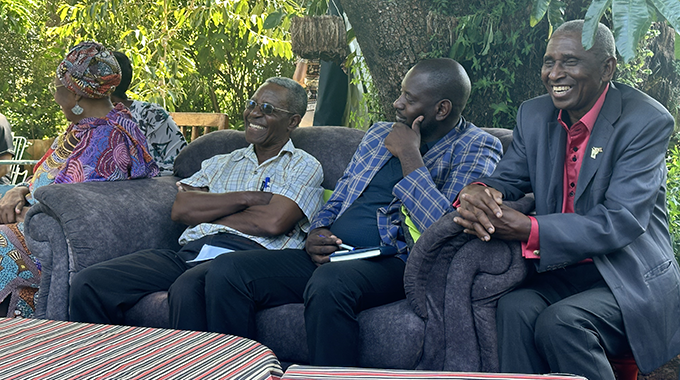
Ray Mawerera
THE mutsikiri tree (Trichilia dregeana) is believed to be sacred.
It is found in the Manicaland area of Eastern Zimbabwe.
It produces red fruit with a black navel.
Legend has it that the fruit (tsikiri) was used by Manyika royalty to extract oil for two major purposes: cooking and skin care.
The fruit are soaked in water until they soften and then squashed by hand and strained.
The filtered juice is used as a vegetable stock for relish or as a skin lotion.
When fully grown, mutsikiri provides cool and shady cover; its high leaves and branches spreading out canopy-like over a large area.
Many an indaba were held under this tree in anticipation of positive outcomes for heavy matters under discussion.
A similar indaba was held in Harare recently, under a similar tree in the lush green gardens of the house of Jim and Sekai Holland.
Aside from their far-reaching civil society work spanning decades, the couple has a proclivity and passion for all things natural and organic.
Within their yard, the visitor will find herbal plants, spices and succulents whose value goes beyond the aesthetic and rich-scented to the medicinally healthy and hygienic: basil, turmeric, tamarind, mint, parsley, sage, rosemary, thyme, blackjack and even snake repellant.
It is a welcoming home, in every sense of the word.
For here, too, are endless pages of historical legacy tales that are only secret because one has not ventured to visit.
The tales are physical — in journals and other documents — and they are oral. Once here, Jim and Sekai are only too willing to share their life journeys and experiences — and their dreams and aspirations.
Topmost of these is the ideal of humanity’s Hunhu/Ubuntu — for all of Zimbabwe and all of Africa.
At the anchor of it all, peace.
It often sounds utopian, when you hear Sekai articulate it with the fiery passion that is a characteristic trait so strong it can be overwhelming.
On this clear, warm Saturday then, the symbolism of the mutsikiri tree comes into sharper focus the more thoughts are thrown, experiences shared and ideas dissected.
It is a rare gathering, an assemblage of nationalists, children of nationalists and their families, freedom fighters for the country’s liberation, academics, lawyers, journalists, students, civil society activists, scientists and a whole variegated list of other professionals.
At points, it appears disorderly brainstorming — something Dr Holland makes no apologies for, with the persuasive reasoning that many great resolutions are made when people speak freely, unimpeded by meeting form and structure.
It is striking that some of the people sitting here are known to have differed strongly on positional matters political and socio-economic.
Yet they are all here, drawn for the purpose of looking ahead and rekindling the spirit of Hunhu/Ubuntu; that principle that argues that a community benefits greatly when its people work together for the greater good, for one survives because of — not despite — the other.
In Africa, family disputes and differences are believed to make people stronger and are therefore looked at as healthy, rather than retrogressive.
Cooking and skin care oil symbolism
Participants spoke about the realities of Zimbabwe’s, nay Africa’s, current condition and the need to take proactive steps to restore the dignity of its people and bring the shine back to Africans. What is brewing in the African pot? Whither Zimbabwe?
How to tackle disruptive foreign influences that threaten the very fabric of basic traditional African humanness?
Enter ZiMPI, the Zimbabwe Peace Building Initiative, which, in partnership with the Government of Zimbabwe, seeks to build architecture and infrastructure “for durable peace with justice for national consensus building”, an ideal set out in its official literature.
“ZiMPI is bringing diverse groups together to deliberate with one another to learn and appreciate our common experiences,” said Sekai Holland.
“Civil society has three functions. The first is to fill in the gaps in development policy and programmes where we find them in our NGO (non-governmental organisation) projects in the communities we work with. The second is to work closely with our policymaking bodies where we have our own projects to properly gap fill together with those bodies. These include traditional leaders (chiefs and headmen) and healers, local government structures at each level we work with, faith-based organisations and so on. The third is, we bring home best practices we find in other parts of our country, from the region and internationally, as we promote our Zimbabwe best practices to our partners at home, in the region and internationally.”
The former senator chairs ZiMPI, which boasts an eminent list of trustees: Dr Audrey Chivaura, Mrs Allyson Ferguson, Right Reverend Dr Chad Gandiya, Mrs Queen Mabena, Muchadeyi Masunda, Mrs Rutendo Munengami, Dr Gregory Powell and Panganai Sithole.
Widespread cover symbolism
Respected legal guru and ZiMPI trustee Much Masunda chaired the deliberations, during which visiting Australian diplomat Associate Professor Ambassador Matthew Neuhaus of the Australian National University (ANU) College of Law in Canberra, Australia, spoke on peacebuilding to an audience as wide and diverse as the various peace imperatives that are prerequisites to growth and development.
Professor Neuhaus would, a few days later, present a lecture at the University of Zimbabwe on “Six Lessons in Peacebuilding – Experiences from the Commonwealth and Beyond”.
The largest single group among the participants under the Hollands’ mutsikiri tree was the family of the late Bishop Abel Muzorewa — a Methodist cleric, leader of the United African National Council (UANC) and Prime Minister of the transitional short-lived Zimbabwe-Rhodesia that preceded negotiations for full independence.
They chronicled Bishop Muzorewa’s contribution to the country’s struggle for freedom and thanked ZiMPI for the peace-building initiatives.
ZANU PF Secretary for Information and Publicity and liberation war veteran Ambassador Christopher Mutsvangwa shared brief historical notes on the journey to Zimbabwe, including the roles of the Chitepos, Sitholes, Muzorewas as well Joshua Nkomo, Robert Mugabe and the current leadership of President Mnangagwa.
The daughter of the late Herbert Chitepo, Zanele Chitepo, sent an emissary with an apology.
Also on the invitation list was the family of the late Ndabaningi Sithole; a representative of the Ministry of Higher and Tertiary Education; Nhaka African Worldview founder/director Bob Dzere; representatives from the Midlands State University (MSU); Commonwealth Lawyers Association; Parents Against Drug Abuse founder/director Thandiwe Ngulube; Joshua Nkomo Legacy Restoration Foundation; and the youthful representatives of The Boy Child Project Partnering The Girl Child Initiative, itself a ZiMPI project focusing on developing future leaders.
Alex “Cde Bruce” Makotore, a former freedom fighter who initiated and founded The Spirit of Kunno Krossa 1976 fellowship group for war veterans to reconnect and motivate each other in the post-war years, gave a light-hearted account directed at the Muzorewa family of how he operated with others in their home area in Zviyambe, to exclamations of amazement at his vivid recollection of specific dates and events.
The relaxed parley under the mutsikiri tree was by no means the first hosted by the Hollands, nor would it be the last.
An earlier gathering this year saw the Turkish Ambassador interacting with a largely war veterans audience working with academics to grapple with studies into Zimbabwe’s history and its spiritual dimensions.
Young people from The Boy Child Project Partnering The Girl Child Initiative were invited to face the elders and glean whatever nuggets they could.
This meeting was chaired by Daniel Zinyama, a protégé of Dr Holland working with the FairGo4Kids linked with the Midlands State University’s National Infrastructure for Peace for National Healing.
Says Holland: “It’s all about our society’s mindset change in appreciating who we are and where the young must take this country, addressing all the challenges resulting from a cruel colonising power strutting in to totally disorganise those they found on the ground.
“This settler colonial power turned everything around for their own benefit as an occupying force on behalf of their own island power, the so-called British Empire … We teach our Boy Child Project Partnering The Girl Child Initiative about these and provide self-empowerment mechanisms accessible to both boys and girls from grassroots up, for their own (future), achieving their own best.”
So successful has the initiative with the young people been that they assumed chairmanship and were elected trustees of the Intercontinental Youth Connect, which recently hosted the SADC Youth Development Council programme in Harare, principally to acknowledge and congratulate President Mnangagwa as incoming SADC chair of the regional bloc.
The council brought together youth delegates from Southern Africa to present projects and resolutions focusing on various sectors and industries, which will be presented at the 44th SADC Summit of Heads of State and Government to be hosted by Zimbabwe in August.


 Online Reporter