Online Reporter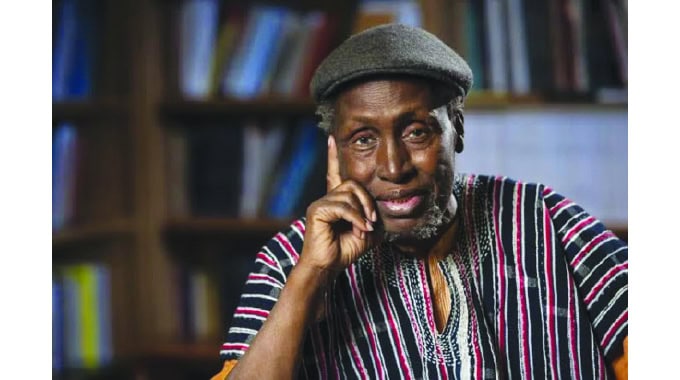
Andrew Chatora-Correspondent
Behold, a great mountain has fallen!
A titan of African Literature, Ngugi wa Thiong’o has passed on. A pioneering writer, who told the African story relentlessly, he critiqued colonialism and the excesses of post-independence governments, with wild abandon.
The inimitable Ngugi, go well, son of the soil!
I am deeply saddened by the passing on of Ngugi wa Thiong’o, a colossal figure and scholar in decolonial thought, literature, and activism.
One of Africa and Kenya’s most celebrated authors, Ngugi wa Thiong’o died last week, aged 87.
The highly regarded writer published his first novel “Weep Not Child” in 1964. He began writing in English, later switching to write primarily in Gikuyu. His works include novels, plays, short stories, and essays, ranging from literary and social criticism to children’s literature. His writing took on colonialism and also faced up to new evils by the post-colonial governments.
Today I mourn and celebrate the passing on of a literary giant and icon. Born in 1938, his writing examines the myriad effects and legacy of colonialism. He was among the pioneering writers to tell the African story. His legacy is immeasurable and far-reaching. Ngugi leaves behind an admirable aspiration and an enduring impact.
“They came at night, in silence, their faces shadowed by masks. Those who spoke the truth or questioned the ways of power were never seen again. Their absence was a warning to the rest, a silence more deafening than words” (Petals of Blood).
This excerpt from Ngugi pretty much typified his writing and why many resonated with his works, myself included. I studied “A Grain of Wheat” at the University of Zimbabwe taught by a Kenyan lecturer, Kimani Gecau, who had been heavily involved in community theatre in Kenya where he directed Ngugi wa Thiong’o’s plays at Kamirithu Community and Educational Centre.
I remain forever fascinated by Ngugi’s representation of his protagonist, Mugo, introduced by a mesmerising first line to the book: ‘‘Mugo felt nervous.’’ Years later, after graduating from the UZ, I was overjoyed to find myself teaching “A Grain of Wheat” to my Advanced Level classes at Sakubva High in Mutare. Earlier, I had also taught “Matigari” at St Matthias Tsonzo High School in Mutasa District, Manicaland Province.
Ngugi’s writing made me sceptical and scathing of the establishment, something which endeared me to my literature pupils. But I only got to know of this, years on when I bumped into some of my erstwhile Tsonzo pupils and interacted with some of them.
We grew up with Ngugi, Achebe, and Mungoshi as our staple literary diet in Zimbabwe.
As a little boy growing up in Dangamvura, Mutare, I ravenously devoured a plethora of Ngugi’s gems, including the classics: “The River Between”, “Devil on The Cross”, “The Trial of Dedan Kimathi”, “Decolonising the Mind”, among others.
I may have been living in Mutare, Zimbabwe, but already I was transported to the world and ridges of Kameno, Makuyu and Nyeri! Who can forget Waiyaki, Mwalimu, the teacher in “The River Between”, Ngugi’s enduring protagonist?
At Dangamvura High School, with my peers, Peter Chemvura and John Sibanda, “Decolonising the Mind” was our go to manual blueprint, which facilitated and fostered our Afrocentric arguments as fiery students of literature at that nascent age.
Though years later, as a writer, I respectfully disagree with Ngugi’s championing of indigenous languages over English or European language’s usage perspective when one writes.
As I have argued consistently, a writer needs to establish themselves first on the international stage before they start dissing English as a medium of writing in favour of their vernacular languages.
You do this, you run the risk of being perpetually on the fringes or being thrown into oblivion.
But more critically, Ngugi had already gained global recognition writing in English when he decided to turn his back on it. So, we can all learn through how contradictory his position was on this.
Besides, much as writers like Ngugi championed the use of indigenous African languages, which they did very well, they still later went on to translate their works into English and other so-called imperialistic languages.
I perceive this action as undermining their argument on sticking to vernacular language in their works. This is not meant to dent Ngugi’s contribution to the debate on the use of African Languages. It is just a difference of opinion and pragmatism on my part as a writer who understands the intricacies and nuances of making it big on the international literary scene – the road to literary stardom. Writing from a self-confessed position as an ambassador of the French language, Alain Mabanckou suggests that advocates of going back to African languages are unwilling to declare their interest.
“Better yet, Ngugi wa Thiong’o’s English language publisher goes so far as to underwrite the publication of some of his books in Kenya but also in his native Kikuyu! So here we have the coloniser coming to the rescue of the colonised’s language!”
Mabanckou’s book, “The Tears of the Black Man”, is scathing and controversial, at times playing the devil’s advocate on the racial question, while essentially beating the “black man” around to take responsibility.
The likes of Ngugi are almost taken up as being guilty by association. Mabanckou lumps their authenticity politics with the superficiality and hypocrisy of Mobutu Sese Seko’s “Zaireanisation.” Ngugi, in fact, fought both Western imperialists and African nationalist rulers throughout his career.
Few points, however, stand out in Mabanckou’s counter-crusade. His argument that: literature is to be merited talent not activism and authenticity politics is mired in ambiguities and undeclared privileges. And, the languages of the coloniser allow Africans, who are, in fact, not a homogenous culture, to interact as different communities. Then, the idea that dealing in African languages requires a working infrastructure, missing in most cases in African countries.
That said, Ngugi excelled in doing what the essayist of, “A Dead End for African Literature,” Obiajunwa Wali saw as the duty of any writer anywhere to test the duty of his language.
For diaspora writers, like me, this undertaking can only be daring. Prolonged disconnect with your mother language means you may ultimately dabble in it with classicist bias whereas the language has, in fact, evolved in your absence.
Dambudzo Marechera confessed to this problem: that his Shona countrymen sounded like foreigners on his return from exile.
Gonzo H. Musengezi also accused Solomon Mutswairo of editing his Shona book with rigid classicism when he came back from exile, crossing out his English-contaminated words for, one assumes, high-minded new Shona coining, which nobody really spoke like.
These are problems that resolve themselves in trial and error, the only path available to a writer.
Then, there is the question of infrastructure – the unquestionably great works of Ayi Kwei Armah and Sankomota guitarist Frank Leepah, for example, are better preserved under big-machine labels, while their “self-published” efforts are largely out of print. Again, one has to doff to the imperfect empire-building of the great Africans as an initiative a future generation may be better resourced to perfect, the vision being all.
Ngugi remains a towering figure in terms of his legacy and contribution as a writer and literature scholar. Such is the mark of a maestro who evokes so many controversies.
But in scenes reminiscent of Mark Anthony’s eulogy at Caesar’s passing on: I am here to mourn the loss of Ngugi!
You fought your race brilliantly. Go well, doyen of African literature. It is an African loss! Yet, it is an African celebration. We mourn the loss of an African giant. Very sad loss. He was a candid and brilliant literate. His works live on as testimony of the gigantic strides and landmarks. He will remain one of my most cherished authors and critics. As writer Charles Onyango says, ‘‘The old lion is gone. But the roar echoes.’’
Rest in peace Mwananchi wa Thiong’o. May your words continue to cast their spell on generations to come!
Andrew Chatora is an award-winning Zimbabwean writer and noted exponent of the African diaspora novel. His forthcoming fifth book “Darkness in Me” offers a poignant, haunting examination of action and consequence, fault and attribution, acceptance and resolution.
For an immersive reading experience, visit Typocrafters Book Shop at Herald House, corner George Silundika Avenue and Sam Nujoma Street in Harare.
Contact: Mercy — 0771537929, Rose — 0776131480, or Leon — 0733100191.