admin
admin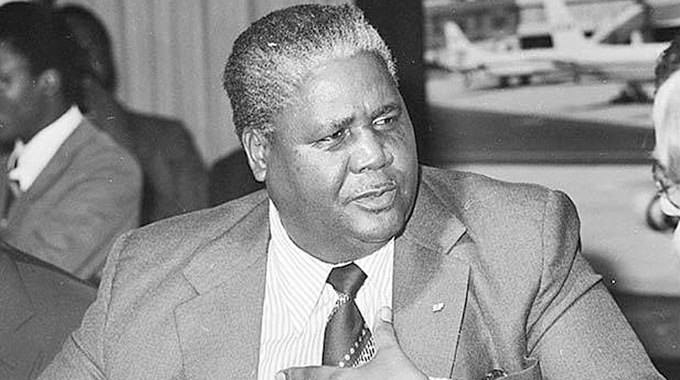
Walter Muchinguri
Snr Researcher & Writer
Zimpapers Knowledge Centre
ZIMBABWEANS celebrated the 41st independence anniversary under the theme: “Together growing our economy for a prosperous, resilient and inclusive society.”
It is a time to reflect on the great role played by the committed and dedicated sons and daughters of the soil, who decided to fight the white oppressors especially nationalists who were pioneers of the revolution.
One of these is Dr Joshua Mqabuko Nyongolo Nkomo, who died in Harare on July 1, 1999 after a long battle with prostate cancer, aged 82.
Dr Nkomo, who was affectionately known as Umdala Wethu, Chibwechitedza or Father Zimbabwe, was buried at the National Heroes Acre on July 5, 1999.
Over the five days, preceding his burial he was mourned by Zimbabweans from all walks of life in apparent recognition of him being a great man who knew no cultural boundaries and for his ideals of peace and harmony regardless of tribe and creed.
Huge crowds turned up to pay their last respects to the great man at Barbourfields Stadium, at his Bulawayo home and at Stodart Hall in Harare.
His status as an icon and colossus of Zimbabwe’s political history was further entrenched after his burial drew almost 100 000 people including foreign dignitaries, the largest crowd ever seen at the national shrine.
At the time of his death, he was survived by his wife Johanna Mafuyana, three children and several grandchildren.
Dr Nkomo was born on June 7, 1917, in Kezi District of Matabeleland.
His father Thomas Nyongolo Letswana Nkomo was a prominent community leader and a lay preacher with the London Missionary Society and had two wives and 10 children.
Dr Nkomo had a slow start to life. He took time to talk and was a shy child and could naturally not keep up with other children, a factor that saw him continuously seeking the comfort of his mother whom he expressed great adoration for in his book “The Story of My Life”.
In his own words, Cde Nkomo admitted that he was mummy’s boy: “I could not keep up with other children and kept running back to my mother. I adored her; I was a mother’s boy. My weakness made me backward in our games and the sport of stick fighting.”
This led to his lack of confidence, which continued in his schooling days at Tsholotsho Government Industrial School when, even though he was coming first from Standard One to Six, would feel that other boys were better than him.
After Standard Six, Dr Nkomo obtained a carpentry certificate from the same school and taught carpentry at Manyame School in Kezi that was run by the London Missionary Society.
He also taught the same subject at Makupa and Izimnyama Schools near Plumtree.
In 1942, Dr Nkomo decided to join Adam’s College in Natal, South Africa to further his studies and rode on the same train with the late Chief Justice Enoch Dumbutshena, who later influenced him to join politics, and Herbert Chitepo.
After his arrival in South Africa, he opted to study for a University Junior Certificate and proceeded to Hofmeyr School of Social Science in Johannesburg where he graduated with a Bachelor of Arts degree in Economics and Social Science in 1949.
It was during this period that he became friends with the late presidents of South Africa and Botswana, Nelson Mandela and Sir Seretse Khama, respectively.
During the same year, he returned home and married Johanna Fuyana (MaFuyana).
He also came face-to-face with the great injustices that were being perpetrated on blacks after witnessing the great differences between salaries that were being paid to blacks and whites doing the same job when he joined the Rhodesia Railways as a welfare officer.
Spurred by the quest to eradicate such injustice and generally poor social conditions that blacks were being submitted to, Dr Nkomo joined the trade union movement and was appointed secretary of the Railway Workers Union in 1951.
A year later, he was elected president of the African National Congress of Southern Rhodesia.
He then used his railway pass to travel throughout the country mobilising the people and also accepted an invitation by the country’s Prime Minister Sir Godfrey Huggins to represent African opinion at the London Conference on the proposed federation of the two Rhodesians and Nyasaland.
He joined Dr Kenneth Kaunda and Hastings Kamuzu Banda who were representing Northern Rhodesia and Nyasaland, respectively.
Dr Nkomo returned home bitterly opposed to the proposals, but could not make an impression due to Europeans’ overwhelming support for the federal concept.
He resigned from the Rhodesia Railways in 1954 and started his own business as an auctioneer and insurance agent in Bulawayo, becoming the first African to do so.
In 1955, he was elected in the Federation of African Worker’s Unions, which inevitably ushered him into politics.
The birth of the federation weakened the ANC and Dr Nkomo set out to rejuvenate the party by incorporating the more radical National Youth League led by George Nyandoro, James Chikerema, Henry Hamadziripi, Edison Sithole and others into the ANC.
The ANC leadership that had hitherto adopted a peaceful means of achieving freedom began considering more radical ways of achieving their goals such as the armed struggle.
Their shift in mindset was influenced by events that were happening in Ghana especially the All Africa People’s Congress that was held in December 1958 and interactions with other liberation movements around the world.
The authorities responded by declaring a state of emergency in 1959 and banned the ANC, while Dr Nkomo was in Egypt. About 500 of its members were subsequently detained.
Dr Nkomo opened an external office in London on the advice of friends from Egypt, with the aim of using it to state the case of Africans in Southern Africa to the outside world, which he did over 18 months.
In 1960, Dr Nkomo became the president of a newly formed party, the National Democratic Party, with Leopold Takawira, Morton Malianga, Ndabaningi Sithole and Robert Mugabe (all late) as executive members.
In 1961, he led the NDP delegation comprising George Silundika, Ndabaningi Sithole and Chitepo to the Southern Rhodesia Constitutional Conference chaired by the then Prime Minister Sir Edgar Whitehead where they rejected the latter’s franchise and representation plans.
Dr Nkomo led the boycott against the elections emanating from that Constitution by escalating civil unrest resulting in the NDP being banned in December 1961.
Dr Nkomo then launched the Zimbabwe African People’s Union, during the same month and placed himself at the helm with the NDP executives retaining their previous posts.
The new party was banned on September 22 the following year, and its leaders were restricted to their rural homes for three months.
Dr Nkomo, who was in Zambia at the time, considered establishing a government in exile to bring pressure on the Organisation of African Unity and the United Nations and other sympathetic bodies to influence political change back at home, but faced resistance from Rev Sithole, Cde Dumbutshena and Tanzanian president Julius Nyerere, who urged him to return to Southern Rhodesia and face the same fate as the other leaders of his party.
He did so in early 1963 and was restricted at his Kezi home and after three months, he flew to New York where he addressed the United Nations Committee.
His idea of forming a government in exile brought to the fore internal disputes that had been simmering in the liberation movement for some time.
In 1963, ZAPU executive members who were left in Dar-es-Salaam, led by Rev Sithole voted to oust Dr Nkomo from his position while he was back home.
Dr Nkomo responded by forming the People’s Caretaker Council, which was essentially ZAPU under a new name.
In August 1963, Rev Sithole and others formed the Zimbabwe African National Union (ZANU) and soon after, there were violent clashes between supporters of the two parties leading to them being banned in 1964.
Dr Nkomo was arrested in April of the same year and sent to Gonakudzingwa Camp and was later taken to other places such as Gwelo (Gweru) Prison and Buffalo Range near Chiredzi during the 10 years that he was incarcerated.
His wife and children, who were under 14 years, were only permitted three monthly visits in 1969.
He made three public appearances during his incarceration. The first was on October 29, 1965 when he was flown to Salisbury to meet the British Prime Minister Harold Wilson on his pre-UDI visit to the country, and secondly, in November 1968 when he was taken to meet the Commonwealth Secretary-General George Thompson.
His final appearance was on February 10, 1972 when he met the Pearce Commission at Nuanetsi.
He was released from prison in 1974 and flown to Zambia where the ANC was experiencing problems due to lack of leadership.
Commenting on his days in prison Dr Nkomo said, “I would be silly to get anything short of majority rule after suffering all those years.”
After the failure of the Victoria Falls Constitutional Conference with Ian Smith and various trips to Malawi, Mozambique, Kenya, Tanzania, London and Salisbury to broker peace, Dr Nkomo decided to escalate the fighting in the country.
On October 9, 1976 ZANU and ZAPU came together under the banner of the Patriotic Front ahead of the Geneva talks that started on October 25.
In the meantime, the war was escalating with Dr Nkomo leading the Zimbabwe People’s Revolutionary Army as the Commander-in-Chief.
In May 1979, Dr Nkomo was conferred with an honorary degree of Law by Morehouse College in Atlanta, Georgia in the United States.
ZANU and ZAPU, represented by their leaders Cde Mugabe and Dr Nkomo respectively, would again attend the all-party talks at Lancaster House in London in December 1979, which resulted in an agreement to a ceasefire and an outline to the independence constitution, which would facilitate the holding of elections.
Dr Nkomo returned home from Zambia on January 13, 1980 and called for reconciliation while claiming the mantle of leadership of the Patriotic Front alliance.
He then started campaigning for elections that were held at the end of February 1980. On March 4, 1980 the election results were released and Dr Nkomo’s PF-ZAPU, won 20 seats against ZANU (PF) 57 seats.
Dr Nkomo then opted for a ministerial post instead of a ceremonial post of president and was appointed Minister of Home Affairs in Prime Minister Robert Mugabe’s new Cabinet.
In 1982, Dr Nkomo and some of his party members were dropped from Government following political disturbances in Matabeleland.
He briefly went into exile in 1984 and returned to participate in the 1985 elections and was elected Member of Parliament for Magwegwe.
In 1987, ZANU (PF) and PF-ZAPU, signed the historic Unity Accord and Dr Nkomo briefly held the post of Senior Minister in the unity government before being elevated to Vice President, a post he held until his death.
In 1998, he received an honorary doctorate in commerce from the National University of Science and Technology.
Dr Nkomo will forever be remembered for his beliefs, the cornerstone of which was the quest for unity and peace among Africans.
In 1970 while in prison he wrote: ” . . . disunity has created an international atmosphere that is not favourable to our cause, especially since the rival groups are in reality fighting for the same things. The only difference has been personalities.”
In 1976 when the Frontline States leaders were trying to form a united front between ZANU and ZAPU, Dr Nkomo said that he was prepared to talk “with whoever the ZANU faction chooses as its leader in an attempt to remove the image of disunity.”
In his autobiography, he also expressed his strong views on unity: “I regard unity as Zimbabwe’s number one priority, the sine qua non of national happiness. I pray and hope that it will be achieved . . . so that Zimbabwe can become one country for one nation, with opportunities, rights and privileges for everybody: white, yellow, black, Zezuru, Karanga, Manyika, Venda, Tonga, Coloured and all.”
A Guide to the Heroes Acre: Some basic facts about Zimbabwe’s heroes and the Heroes Acre.


 Online Reporter