Vusumuzi Dube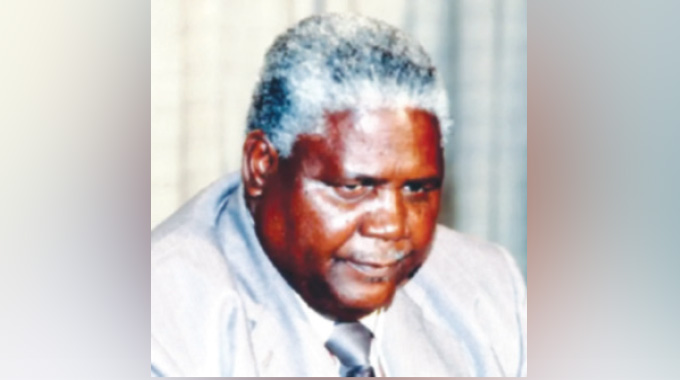
Gibson Mhaka
Zimpapers Politics Hub
IN eulogising the fallen Caesar in the play, “Julius Caesar”, William Shakespeare says of Mark Antony, “The evil that men do lives after them; the good is oft interred with their bones.”
While the quote suggests people are more often remembered for their bad deeds than their good ones, exceptions do sometimes exist.
Founding late Vice President of Zimbabwe, Dr Joshua Mqabuko Nyongolo Nkomo, affectionately known as Father Zimbabwe for his pioneering role in the liberation struggle, serves as a prime example.
His good deeds are not being forgotten, they continue to be celebrated not only in Zimbabwe, but across the Sadc region and the entire continent, a testament to their lasting impact.
Dr Nkomo envisioned a future where the dreams of liberation transcend borders. He spoke of a united Southern Africa, a region bound not by conflict, but by shared history, resources and aspirations.
This was his new fight, the birth of the Southern African Development Community (Sadc).
Dr Nkomo died on July 1, 1999, leaving behind a solid and rich legacy that resonates with the aims of the Sadc.
Founded by countries in southern Africa, Sadc aims to further socio-economic, political, and security cooperation among its member states and foster regional integration for peace, stability, and prosperity.
Coincidentally, Dr Nkomo’s 25th Silver Jubilee Anniversary coincides with Zimbabwe hosting the 44th Sadc summit in August, under the theme “Promoting Innovation to Unlock Opportunities for Sustainable Economic Growth and Development Towards an Industrialised Sadc.”
This theme aligns perfectly with Cde Nkomo’s legacy of advocating for a strong and unified Southern Africa.
This is also a significant moment for Sadc which recognises peace, security and political stability as essential for socioeconomic development.
History has recorded and judged his enormous impact on the people of Zimbabwe and the world as a whole.
His monumental story of the fight for freedom continues to inspire not just Zimbabweans, but all of Africa and the Sadc region.
Born on 7 June, 1917, the veteran African nationalist, Dr Nkomo, died at the age of 82, and was buried at the National Heroes Acre in Harare.
He hailed from humble beginnings. The son of a teacher and preacher for the London Missionary School, he worked as a carpenter in his youth to finance his education in South Africa.
Fuelled by his thirst for knowledge, he obtained a Diploma in Social Science from the Jan Hofmeyr School of Social Science. Returning to his homeland of Rhodesia (now Zimbabwe), he took up employment with then Rhodesia Railways.
True to the nickname Umdala Wethu (Our father), Dr Nkomo was in the thick of the anti-colonial struggle from the 1940s as a railway workers’ union official, to his glorious days as the leader of the nationalist movements.
He joined nationalist politics in the early 1950s and was elected president of the African National Congress (ANC) in Southern Rhodesia, in 1952.
A true pan-Africanist, together with compatriots, Amilcar Cabral, Kwame Nkrumah, Kenneth Kaunda, Julius Nyerere and Samora Machel, he internationalised the liberation struggle, inspiring an entire continent to demand self- determination from colonial rule.
Politicians who worked with him described him as a giant statesman, a mentor, a politician, a strategist, a visionary and most importantly a father not only to his children, but to the revolution that brought about the country Zimbabwe and all that it is.
African solidarity was very critical in the fight for freedom in southern Africa and Dr Nkomo was an ardent advocate of regional unity in dislodging oppressive colonial rule.
His Zipra guerrillas fought from Zambia and the Zanu’s armed wing- Zanla, came from Mozambique in a war that intensified in the late 1970s. This resulted in the Lancaster House conference that paved the way for independence in Zimbabwe in 1980.
Dr Nkomo was also instrumental in achieving peace in post-independent Zimbabwe. He led his political party, PF Zapu, in negotiations for a peace accord which resulted in the unity of his party with the ruling Zanu PF in 1987.
Dr Nkomo’s role as founder and leader of key nationalist revolutionary movements laid the foundation for the armed struggle and underscored his active international campaigns for the liberation of Zimbabwe.
One of the overarching issues in reflecting on Dr Nkomo’s legacy, is his contribution to modern African nationalism in which he emphasised the importance of indigenous people exploiting and utilising their own natural resources.
The late Vice President also had a strong vision anchored on equality for all and a determined drive to develop all parts of the country, which the Second Republic led by President Mnangagwa, has magnified in a big way through his philosophy of “Leaving no one and no place behind”.
He seldom discussed the liberation of Zimbabwe without mentioning in the same breath the country’s economic, social, cultural and political development.
These are the same issues contained in the Sadc Regional Indicative Strategic Development Plan (RISDP 2020-2030) and the Sadc Vision 2050 – two strategic plans which seek to further deepen regional integration and foster development in the southern African region.
The RISDP 2020-2030 operationalises the Sadc Vision 2050, which is a long-term ambition by the bloc that sets out the aspirations of the region until 2050.
Both RISDP 2020-2050 and Vision 2050 provide a guiding framework for implementing Sadc’s regional integration and developmental agenda and programmes for the next 10 years.
By 2050, Sadc is to be an industrialised and integrated region, where citizens equitably benefit from the opportunities of a stable regional market that is commensurate with the African Union’s Accelerated Industrial Development for Africa, Science, Technology, and Innovation Strategy for Africa, African Mining Vision, Boosting Intra-African Trade, and is well integrated into the broader African Continental Free Trade Area.
It also seeks higher levels of peace and stability. This will enable the further prioritisation, pursuit, and achievement of its objectives of socioeconomic development, poverty eradication, and regional integration.
The vision also includes a high quality of life, where citizens are well-educated and enjoy long, healthy, and productive lives. This reinforces the link between economic growth and sustainable human development, ultimately aiming to end poverty in all its forms.
A strong and inclusive human capital base, achieved through enhanced productivity, will empower Sadc citizens to play a pivotal role in the region’s socioeconomic development.
It is clear that these key issues, reflected in the two strategic plans, were also central to Joshua Nkomo’s extraordinary life, shaping him into the revered figure he became.
His unwavering dedication to the cause of African nationalism stemmed from his first-hand experiences of colonial injustice and inequality.
Witnessing the suppression of his own people’s culture, resources, and political rights likely fuelled his determination to fight for self-determination and a more just future for Africa.
As preparations for the 44th Sadc Summit gather momentum, it is important to note that a powerful symbol emerges.
Dr Nkomo, the revered figure of Zimbabwe’s independence struggle, transcends national borders to represent the very essence of Southern African unity.
His legacy should not be confined to Zimbabwe’s history. His unwavering commitment to liberation and his vision for a unified Southern Africa resonate across the region.
His fight for freedom paved the way for regional cooperation, laying the groundwork for Sadc itself.
The forthcoming Sadc Summit should thus serve as a potent reminder of Dr Nkomo’s dream – a dream of Southern Africa where nations choose collaboration over conflict.
Imagine this dream whispered on the wind during the summit, a powerful message urging continued regional cooperation.
By embracing Dr Nkomo’s vision and building upon it, the Sadc Summit can become a catalyst for a more unified, prosperous, and peaceful Southern Africa.
This will be a true testament to his enduring legacy, a legacy not to be recognised just on summit days, but throughout the region’s future.


 Online Reporter