admin
admin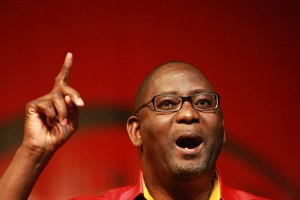
years after the advent of democracy in South Africa, the country still finds itself saddled with the burden of apartheid’s legacy despite efforts to destroy the trappings of racial discrimination and general inequality.
The country recently marked Freedom Day to commemorate the official end of apartheid and the advent of majority rule. Nearing the 20-year mark of independence has not, however, blinded the nation to the fact that serious inequalities created and maintained by apartheid still remain in South Africa.
Perhaps nothing demonstrated this more than the Freedom Day exchange of letters between Gwede Mantashe, secretary-general of the ruling ANC, and rightwing group Afrikanerbond, which the former accused of trying to perpetuate apartheid. Afrikanerbond is the successor to Broederbond, the secret society that framed and oversaw apartheid.
Responding to a letter from Afrikanerbond chairman Piet Vorster to him and President Jacob Zuma, Mantashe said the ANC would never accept that whites will forever own 87 percent of the land and hold 72 percent of managerial posts in business and industry.
‘The Afrikanerbond must be part of finding a solution to this distortion,” he said. Vorster had claimed that some government officials were undermining the constitution and ominously added that this showed “the dark side of majority domination”.
Vorster listed black economic empowerment, affirmative action, property rights, nationalisation, renaming of streets and the issue of national languages as symptoms of the racialisation of post-apartheid South Africa.
However, Mantashe lashed back saying: “We must uphold and defend our constitution to ensure that ideals enshrined therein becomes reality. This cannot be achieved by defending privileges that historically accrued to certain sections of society.”
Mantashe said the Afrikanerbond was presenting its apartheid-based minority as “constitutional rights” and sought to ensure that blacks remained second-class citizens in their own homeland. “(Afrikanerbond believes that) any intervention that seeks to instill confidence among the black majority poses a threat.”
The numbers tell a frightening picture of South Africa today. The country has the most unequal income distribution patterns in the world. Approximately 60 percent of the population earns less than R42 000 per annum (about US$7 000), whereas 2,2 percent of the population – who needless to say are mostly whites – has an income exceeding R360 000 per annum (about US$50 000).
Poverty in South Africa is still largely defined by skin colour, with black people constituting the lowest tier. An average African man earns in the region of R2 400 per month, whilst an average white man earns around R19 000, an income gap of roughly R16 800.
Most white women earn around R9 600 per month, whereas most African women earn R1 200, a gap of R8 400. A total of 90 percent of the people who have no income at all are African, while only 5percent are white. Yet of those who earn in excess of R2,5 million a year, 58 percent are white and 30 percent are African. In other words, 58 percent of those who earn more than R2 million per annum are drawn from 12 percent of the population.
In addition, 56 percent of whites earn no less than R6 000 per month whereas 81 percent of Africans earn no more than R6 000 per month. A study of CEOs’ remuneration packages of the 326 listed companies and parastatals, Philip Theunissen, from a firm of forensic and financial accountants, has revealed that the average basic salary of the CEOs was R2,37 million a year, while the average worker earned R124 457.
CEOs still earn twice as much on average as the president of the country and three times more than cabinet ministers. They earned 10 times more than a director-general in 2009 while they earned 106 times more than a cleaner in the public service for the same year.
Despite the ANC government having implemented a policy of Black Economic Empowerment, blacks make up over 90 percent of the country’s poor.
This is despite the fact that they constitute 79,5 percent of the national population. Part of the BEE policy is the imposition of “employment equity” targets. In terms of this, companies are assessed based on their racial composition.
To attain the “correct” racial balance in a company, the Employment Equity Act allows legal discrimination against white males and, to a lesser extent, white females when appointing staff. Government contracts and a few in the private sector are also preferentially awarded to companies with good BEE ratings.
In September 2006 the Labour Ministry ordered private companies to classify their employees according to race.
The classification was to be done based on a form that every employee had to complete, which used apartheid-era racial categories. On the form the employee had to confirm whether they regarded themselves as white, Indian, Coloured or African.
This controversial move saw some employees refusing to classify themselves saying it was a return to apartheid. In such cases employers were forced in terms of the Employment Equity Act to carry out classification based on the general appearance of those employees who refused to fill the forms.
Another major contentious issue in South Africa today is land ownership. More than 80 percent of farming land remains in the hands of white farmers. This has bred a silent war that is not reported on but whose statistics, should they have applied to a country like Zimbabwe, probably have resulted in a Western military siege on Harare.
A large number of white farmers have been killed since 1994 – roughly 313 per 100 000 annually. While some of these killings are attributable to pure criminality, some seem to stem from a land hunger that is far from being quenched. And even if they are all purely criminal, this serves to highlight the extent of poverty in rural areas. Opponents of land reforms claim it will result in decline of the agricultural sector.
A willing-buyer willing-seller system for land reform is failing – like it failed in Zimbabwe – to improve the tenure imbalances.
In the meantime, the majority blacks continue to eke out miserable existences on unyielding land. The land problem is not in rural areas alone. In Durban shack dwellers have mobilised against city authorities claiming that attempts to desegregate the city are being offset by widespread evictions.
With experts agreeing that there is a strong between poverty and HIV and Aids, the high number of infections and deaths in South Africa are another reminder of apartheid’s legacy. In 1982, the first recorded death from Aids occurred in the country.
Within a decade, the number of recorded Aids cases (overwhelmingly in the black population) had shot up and South Africa today is home to the highest number of people with the virus. The structure of the apartheid economy – which still subsists in many ways today -can be fingered for playing a huge role in this.
For example, the mining sector relied on migrant labour from all over Southern Africa and it actively discouraged couples staying together. Instead, male mine workers resorted to commercial sex workers and the rest is history.
The general poverty stemming from apartheid also leaves women particularly vulnerable to sexual abuse. Education has also remained under strain since 1994, highlighting the obscene extent of inequities in South African society.
According to Cosatu secretary-general Zwelinzima Vavi, of the 1 550 790 South African children who started school in 1998, only 551 940 of them registered for matric classes.
That is a dropout rate of 64 percent. Of these 551 940 who wrote matric exams, only 334 609 (60,6 percent) matriculated and just 109 697 achieved university entrance standards.
So 1 216 181 of the original 1998 intake are left with no qualifications and, given the current rate of unemployment, no jobs, no hope and no future.
“No wonder there is so much crime and other social ills such as the collapse of family values, the spread of HIV/Aids, etc.
“Twelve-year-olds in South Africa perform three times worse than 11-year-olds in Russia when it comes to reading and 16-year-olds in South Africa perform three times worse than 14-year-olds in Cyprus when it comes to mathematics.
“Nevertheless, white South African learners perform in line with the international average in both science and mathematics, which is twice the score of African learners,” Vavi said at the National Union of Metalworkers conference in Johannesburg last year.
Back to healthcare. A black South African female has a 7,2 percent chance of dying in the first year of her life, whereas the white male has a 3 percent chance of dying in the same time. She can expect to live 12 years less than the white male, whereas an average male Swede can expect to live 30 years more than an average black South African female.
Although the country ranks 79th globally in terms of GDP per capita, it ranks 178th in terms of life expectancy, 130th in infant mortality, and 119th in doctors per 1 000 people.
That is South Africa 17 years after the “end” of apartheid. While the country boasts many achievements, not least of which is the successful hosting of the 2010 Fifa Soccer World Cup, the reality on the ground is that like the rainbow itself, the Rainbow Nation has no room for black. – The Southern Times.


 Online Reporter