admin
admin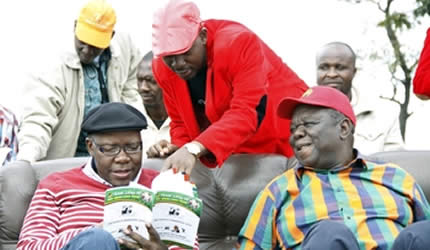
stillborn as no funding will come from the West which is grappling a severe financial crisis, analysts have said. This week one of MDC-T’s chief backers, the United States embarked on huge spending cuts by placing 650 000 civilian workers on unpaid leave.
MDC-T’s 2013 election manifesto which is hinged on its Jobs, Upliftment, Investment, Capital and the Environment (Juice) document largely hinges on foreign aid and investment from the party’s “friends” in Europe and America.
This is in sharp contrast to Zanu-PF’s indigenisation and economic empowerment thrust that seeks to fund expenditure by unlocking value in indigenised and idle assets and monetising those assets.
The Zanu-PF manifesto says value will be created from the 51 percent of assets that will be unlocked from the Indigenisation programme. At least $7,3 bn worth of assets is projected from the indigenisation of 1 138 foreign companies in 12 key sectors of the economy.
Analysts say with Juice, MDC-T appeared oblivious that the US and Europe were reeling from recession that have seen massive job cuts and austerity measures, which have often resulted in street protests by affected employees, the ‘’occupy’’ street phenomenon.
Soon after the formation of the inclusive Government in 2009, MDC-T Mr Morgan Tsvangirai promised civil servants and Zimbabweans in general that he would unlock foreign funds to inject into the local economy. However, his whirlwind tour of Europe and America yielded nothing.
AFP reported on Tuesday that the US department of defence’s civilian employees face lay-offs due to recession.
They face unpaid leave which will slash their pay checks by 20 percent at a time when the US economy is crawling at a modest pace four years after the recession ended.
The pay pinch was expected to have the most immediate impact in areas with a large military presence, such as greater Washington DC, California and Texas.
Defence Secretary Chuck Hagel, according to AFP, announced the furloughs in May as part of the $37 billion cut from the Pentagon’s budget under the federal government’s broad spending reduction, or sequestration, that took effect on March 1.
Also see . . .
The US defence budget took the biggest hit under the $85 billion in cuts through the current fiscal year, a drastic programme implemented after political parties failed to reach a compromise over longer-term deficit reduction.
The cutbacks lower government spending by five percent, and Pentagon spending by about eight percent.
Hagel said he had made the furlough decision “very reluctantly” because of the disruption to workers’ lives and the impact on defence operations.
The furloughs are expected to save approximately $1,8 billion, according to the Pentagon.
The Pentagon already has been forced to reduce spending in a number of areas, including combat training, maintenance and deployments.
The furloughs that began Monday will be done at a rate of one day per week for most civilian personnel.
The International Monetary Fund last month assailed the sharp spending cuts as “excessively rapid and ill-designed.”
Releasing its annual report on the US economy on June 14, the IMF said growth would be only 1,9 percent this year due to the cutbacks, when it had the potential of growing as much as 1,75 percentage points faster.
“A slower pace of deficit reduction would help the recovery at a time when monetary policy has limited room to support it further.”
Economist and businessman, Mr Jonathan Kadzura said Mr Tsvangirai’s utterances that if voted into power he would invite “our rich friends” to invest in Zimbabwe stemmed from ignorance.
“Europe and America are currently grappling with their own economic problems, so for Mr Tsvangirai to bank on financial assistance from such “friends” is ill advised.
“Some countries in Europe have seen unemployment going up to around 33 percent and I do not think they will be willing to pour funds to Zimbabwe when their own economic affairs are not in order,” he said.
Mr Kadzura added that as a country we simply have to be self-reliant while ensuring that all facets of our economy are run transparently and are rid of corruption.
Once this has been achieved, we can then take advantage of our natural resources such as minerals and ensure we do not export them as raw but look at benefaction so that
we can get the best value out of them.
Mr Kadzura also said even countries not under economic sanctions have become too reliant on foreigners to the extent that they cannot run their own economies, a situation that makes them vulnerable to manipulation by those foreign sponsors.
University of Zimbabwe academic Dr Charity Manyeruke said the United States will not avail any funding towards MDC-T to assist them on Juice.
“It is not surprising that they are chopping jobs for their own people and they have not recovered from recession.
“They could not get sponsorship before the Government of National Unity. Voters should not look forward to funding from US since they prioritise their own people before they look beyond their borders.
“America cannot take care of outsiders at the expense of their own people and Juice has been doomed to fail from the onset,” she said.
Midlands State University media studies lecturer Dr Nhamo Mhiripiri echoed the same sentiments and said the MDC-T Juice policy is failing to provide a picture of an improvement of people’s lives both in rural and urban areas.
“When looking at jobs, there is a need to look at rural and agro sectors specifically looking at agribusinesses. It is possible for Zanu-PF because it has worked on that through the land reform programme.
“Zanu-PF’s drive is to decongest urban areas and reverse the rural to urban migration whereas Juice is not addressing that. The MDC needs to look at the bigger picture of the economy rather than to dream and we end up having ghost towns.
“There is a great need for a rational balance as proven by Zanu-PF’s land reform programme which improved lives of those in urban and rural areas at the same time.
“When resuscitating industries, there is a need to look whether we will be able to match competition from countries like China,” Dr Mhiripiri said.
He said companies in the United States have opted to have some of their goods produced in China because they are cheaply produced.
Dr Mhiripiri reiterated that MDC-T is considering foreign investment since they are coming from a working class background which would have an ideological thrust which looks at the party’s founding background which is detrimental to peasants.



 Online Reporter