admin
admin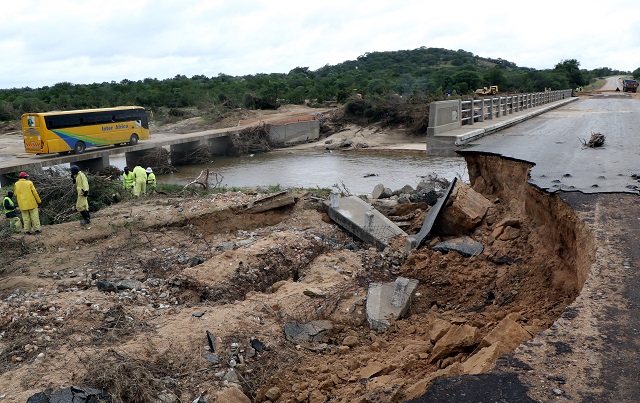

TRAVELLERS from Bulawayo to Mutare via Masvingo and Zvishavane breathed a sigh of relief after the re-opening of the old but small Nkankezi Bridge to buses and heavy vehicles on Thursday after part of the bigger bridge was swept away by floods recently.
The hive of activity that was created following the damage that rendered the 48-year big Nkankezi Bridge completely impassable has since disappeared following the re-opening of the old bridge for use by motorists.
A visit by the Sunday News to the bridge on Friday revealed that the road was now passable by all types of vehicles and it was work in progress as workmen from the Government’s department of roads were working to perfect the area branching off the main road to the small old bridge.
The area was deserted, save for the workmen, there was nothing to suggest that just on Wednesday there were hordes of people intent on business and travelling.
“The old bridge was opened to small vehicles almost a week now. It started operating around last Saturday or Friday if I am not mistaken, but buses and other heavy vehicles were not using it. They were exchanging customers. They only started using it yesterday (Thursday) after we opened space branching off from the main road to avoid collisions and to allow them to turn freely.
“Besides the area is quite marshy and the soil a bit loose when water logged, so we are putting more stones to harden the surface to allow for free movement of people and goods since this is a main road,” said a workman from the department of roads who was on the site who declined to be named.
The workmen said the re-opening of the old bridge was just a stop-gap measure put in place by the Government to allow free movement of people, good and services while resources were being mobilised to repair the damaged bigger road and the bridge.
The small single lane old bridge started working last week but was only open to small vehicles. Buses and other heavy vehicles that were previously disallowed as the department of roads was still working to open more space and harden the marshy surface started using the small bridge on Thursday.
The bridge area that was now referred to as the “border” owing to its impassability by buses and vehicles that were now exchanging customers had seen locals surrounding the area seeing business opportunities as they had quickly turned the bushy area into a real border environment.
Enteprising villagers, with some coming as far as Filabusi, had set up their stalls where they sold an assortment of goodies mainly foodstuffs to the commuters who would have disembarked from buses and crossing to either side of the bridge.
Some have even set up kitchens where they cooked sadza and fresh mealies for sale to travellers who will have disembarked from buses and waiting to connect either side of the bridge.
Airtime and ice-cream vendors were among the villagers who were making brisk business selling various foodstuffs. Villagers, both men and women living close to the bridge were making a living helping travellers carrying their luggage while young children were using wheelbarrows to ferry luggage across the bridge for a negotiable fee.
The bushy area was no longer sleepy as the villagers would keep a night vigil for the cross border Brooklyn buses that exchanged cross border traders at the bridge from South Africa to Zvishavane that would have come from Beitbridge via Gwanda.
Both travellers and motorists expressed gratitude for the initiative saying it saves them time and money as the hassle of waiting and being taken advantage of was no longer there. They, however, expressed concern over the low level of the small old bridge they said could easily overflow if the river got in flood.
“This bridge is a bit low. It can easily get submerged in the event that the river is in flood. It is also a single lane and there are no give way signs on either side so it needs sober drivers or else there will be accidents.
“But our main worry is that the bigger bridge will take years to be repaired as the Government will sit back and relax as long as the small bridge is working. We have seen it elsewhere bridges that were swept by Cyclone Eline have still not been repaired. We have no guarantee that this one will be treated with urgency,” said a motorist Mr Nyasha Hove of Mberengwa.
Minister of Transport and Infrastructure Development Dr Joram Gumbo said last week that Government was working on repairing the bridges that were swept by the recent Cyclone Dineo related floods. He said priority was going to be given to major bridges and roads that were damaged by the rains saying the Nkankezi Bridge was among those that were top of the list.
“We have more bridges that were swept by the rains but some are small ones of-course. We have a number in the Midlands and Masvingo provinces. We do not want people to suffer because in such situations some unscrupulous operators take advantage and make people pay with an arm and a leg. Besides, our thrust to enhance communication and infrastructure has been threatened but we will not allow ourselves to sit back and relax when things are this bad,” said Dr Gumbo.
He admitted, however, that despite the historical amounts of rainfall received this year in the country most of the roads were old and crying out loud for resurfacing while most of their bridges have outlived their lifespan.
“Most of the country’s roads are in bad state. Most tarred roads have outlived their 20-25 years lifespan. Some now have more than 60 years without being renovated or resurfaced as a result the tarmac layer becomes so thin that potholes can easily form and spread,” Minister Gumbo added.
The Minister added that the Zimbabwe Defence Forces would be deployed soon to erect temporary bridges to allow passage of vehicles in areas where major bridges were no longer passable. He said most of the country’s dust roads particularly those that were recently graded have now been transformed into small streams isolating a lot of areas from the rest of the country.
Dr Gumbo said it was unfortunate that the damaged bridges have in most circumstances created a internal border-like scenarios where buses could no longer cross to the other side but exchange clients while goods could no longer be transported timeously. He said he was optimistic that money to repair the damaged bridges and roads was going to be made available in time before more damages were recorded.
Information obtained by the Sunday News indicates that the Nkankezi Bridge is on route 509 and was built in 1969 by the department of roads. The type of structure is RC beams and slab and is on chainage 172.4 km along Masvingo – Mbalabala. It has two spans measuring 18.5 metres and one span measuring 18.7 metres. The department of roads is still the responsible authority. It could not, however, not be established when the small old bridge was constructed, but authorities it deemed fit for use by motorists.



 Online Reporter