admin
admin
Reason Wafawarova on Thursday
THE media, the legislature and the general public in Zimbabwe are all stirring the waters on the hot topic of corruption, and we must, for the sake of the country, hope that any remedies to be undertaken by the country’s authorities are not carried out in a nonchalant manner.
It is an understatement to state that Zimbabweans are infuriated in the extreme over the corruption expose involving Government enterprises and local authorities. By their nature, politicians are very sensitive to public opinion and whenever people are as angry as are Zimbabweans right now, the reaction from politicians is appeasement.
While the idea of control and regulation of salaries in the public sector is most welcome, the recent announcement that salaries in parastatals and local authorities will be capped at $6 000 per month will need some interrogation, even when given the fact that the measure is only interim.
Essentially corruption is an act carried out with the intent to give some advantage inconsistent with official duty and the rights of others. It includes payroll fraud, bribery, unethical conduct, corrupt contractual agreements and so on and so forth.
Without a thorough study of the causes of corruption in Zimbabwe, a mere people-pleasing salary cap like recently announced by the Finance Minister would appear like a knee jerk measure carried out in some kind of misguided vindictiveness.
We will look at the causes of corruption shortly, but it is quite telling that one of the most known causes of corruption are salary caps, especially those on the lower side of the scale.
The recently published salary perks of CEOs of public owned enterprises reveal that most of the CEOs enjoyed usurious allowances that were tacitly arranged to evade tax. This of course was before the corruption expose.
Although the causes of corruption are many and complex, we may have to select a few of these to try and make analysis of what could be obtaining in Zimbabwe.
When a country experiences an emergence of a political elite that believes in interest-oriented rather than nation-oriented policies and programmes, the scenario becomes in itself a cause for corruption.
There is little doubt that President Mugabe is a Marxist trained nation-oriented politician.
But the assumption that President Mugabe’s Cabinet is made up of nation-oriented politicians dying to see the country develop for the better of everyone would be an absolutely foolish one as things stand right now.
In fact the entire Zimbabwean political landscape is infested with some egregiously selfish characters that believe politics is the simplest way of acquiring wealth. The escalation in self-aggrandisement politics during the tenure of the Zanu-PF-MDC inclusive Government between 2009 and 2013 sadly revealed the unquestionable unison between the country’s rival politicians when it comes to corruption.
Rushing to redress corruption challenges through knee-jerk solutions like the announcing of one size fit all salary caps, when the politicians under whose noses the egregious payroll corruption was taking place are still in charge of ministerial portfolios elsewhere is an act in dishonesty, and can even be described as popular futility.
Unless we come to that point where nation-oriented values and policies are the guiding criterion in the make up of a Zimbabwean politician we must ready ourselves to live under the grip of graft for a very long time.
We belong to a country where a whole opposition political party openly thrives on interest-driven donations from the country’s former colonisers, and the politicians making up the party leadership are openly unashamed of their conduct. When money overrides morality, ethics and values within our political alternative we must mourn the fate of democracy.
At the height of the ruin caused by the illegally imposed Western sanctions, Zimbabwe experienced a lot of artificial scarcity created by people with malevolent intentions and the devastating result was a thoroughly wrecked economy. This is the time the CEOs of our public enterprises created around themselves luxurious cushions we are discovering as astounding corruption today — years after our presiding politicians assumedly did not see anything untoward.
Whether the thieving CEOs feigned innocence and righteousness for all these years, or the presiding ministers simply did not know what was going on, the conclusion is the same — gross incompetence on the part of the presiding ministers, or at the worst complicity.
The value system and ethical qualities of the people who administer our country have drastically changed for the worse in recent years and our old ideas of morality, service and honesty are now regarded as anachronistic. The “I am not bothered” comment attributed to suspended ZBC CEO Happison Muchechetere clearly shows the mentality smiting the minds of our administrators today.
Muchechetere passed this comment after being asked what he thought of his suspension over an irregularly awarded salary.
It is not a stray observation to put it across that there has been a level of tolerance towards corruption by our ordinary people and that until lately there has been a complete lack of intense public outcry against corruption, as well as the absence of a strong public forum to oppose corruption. This is what availed unabated opportunity for unscrupulous characters plundering our country remorselessly today and they are just too many.
Alienation and neglect of the masses, coupled with poor and declining economic infrastructure also leads to high corruption tendencies among the elites. As the economy of Zimbabwe increasingly declined after 2000, corruption just became endemic in both the public and private sectors.
We had a highly inflationary economy in the decade preceding 2010, and low salaries in the public sector led to officials resorting to the route of corruption. Vendors and rank marshals ended up earning more than most Government officials, and we had many cases of high school teachers abandoning the classroom to be street vendors in Harare.
That environment indisputably contributed significantly as a cause of corruption, especially for those that remained in the unrewarding jobs.
Complex laws and procedures in the public service also resulted in corruption escalating in such departments as Registry and Licensing. It should not be too complicated to book for a driving test or to apply for a passport, but sometimes so many complexities are conveniently created in order to manufacture desperation on the part of applicants — that way creating an opportunity for corrupt officials to solicit for bribes.
Perhaps corruption is always at its peak during election time. We have industry often funding politicians to meet the high costs of electioneering, ultimately to seek personal favours. The politicians in turn bribe the voters, particularly those slogging for two meals a day.
Unless we address these causes in a comprehensive and exhaustive manner, we cannot hope to eradicate corruption by throwing at it emotional remedies like salary caps, or some such slipshod measures. Yes the Government needed to be seen to be stopping the bleeding in its enterprises, but you deal with the wound in stopping the bleeding, not with blood.
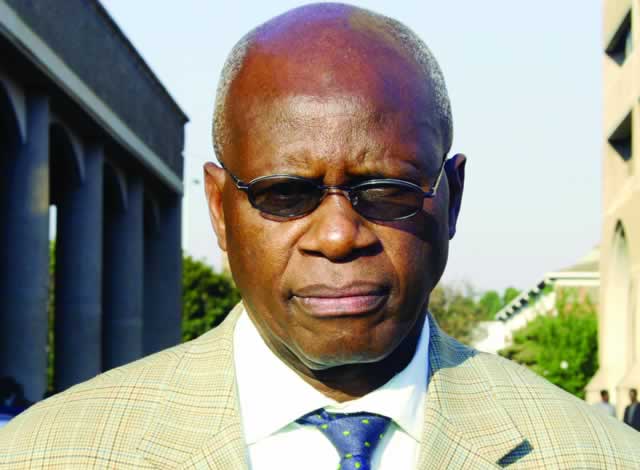
Minister Patrick Chinamasa is an ardent reader of this column by his own admission, and I hope more comprehensive measures in dealing with the scourge of corruption are coming after the popular but kooky salary cap, especially one done in a one size fit all fashion as seems to be the case in point.
Corruption is a cancer, which every patriotic Zimbabwean must strive to cure. We had our opposition politicians preaching unbridled determination to eradicate corruption, and we loved it.
But no sooner had the MDC-T settled in Government than we began to hear of stinking corrupt activities in local government and elsewhere, including in the then Prime Minister’s office — then occupied by Morgan Tsvangirai.
Most of our people are money-oriented and materialistic, and that is largely human nature. We always want to think money coming into our pockets is a good thing and money going out of our pockets is a bad thing. We are seldom concerned about how money enters or exists our pockets.
This is why institutional accountability must not only be established, but must also be uncompromisingly enforced. We need fool proof laws that will not allow discretion by politicians and bureaucrats. Our Anti-Corruption Commission must not only be adequately funded, but must be fully independent so much that its decisions are only contestable in a court of law, not subject to the opinion of any politician, regardless of the loftiness of the office they hold.
Our people must be empowered and allowed to recall errant politicians without any politicised complications allowed to hurdle their way. Responsiveness, accountability, and transparency are a must for a corruption free society, or at least one with negligible amounts of the scourge.
Our bureaucracy must not be an extension of the repressive arm of corrupt elites. Rather it must be citizen friendly, accountable, ethical and transparent. We cannot have a police force that is openly synonymous with bribes. We cannot have employment officers who sell jobs to the highest bidders, wantonly disregarding the virtue of merit.
We cannot have such a corrupt corporate sector that is so padded that all transactions are limited to the inner circle of corporate bigwigs — shutting out everyone else regardless of their capacity or potential.
We cannot second-guess that corruption is an intractable problem. Like diabetes, it can only be controlled, but cannot be totally eliminated. It would be naïve to believe that corruption can be rooted out completely at all levels, but what is possible is to contain it within liveable limits.
We need honest and dedicated persons in public life, not some of the crooks pretending to be serious politicians today. We also need independently run accountability institutions in our economy, because only with these can we dream of successfully taming the pandemic of corruption.
Needless to say, corruption has corroded our economy badly. It has worsened our image in the international market and has adversely affected investment pathways.
While corruption is admittedly a global problem that all countries have to confront in one way or the other, we must understand that the solutions to corruption challenges can only be home grown.
Our opposition politicians are not keen on solving the problem of corruption, but are more preoccupied with using corruption to taint their rivals in the ruling party, and that is why the punch line is Mugabe must take all the blame.
It would be encouraging if removing one politician for the other were a panacea to the scourge of corruption. Sadly the political solution to corruption has in the past worsened the practice instead of combating it. Corruption is an economic problem that requires economic solutions.
Zimbabwe we are one and together we will overcome. It is homeland or death!
REASON WAFAWAROVA is a political writer based in SYDNEY, Australia.


 Online Reporter