

 Online Reporter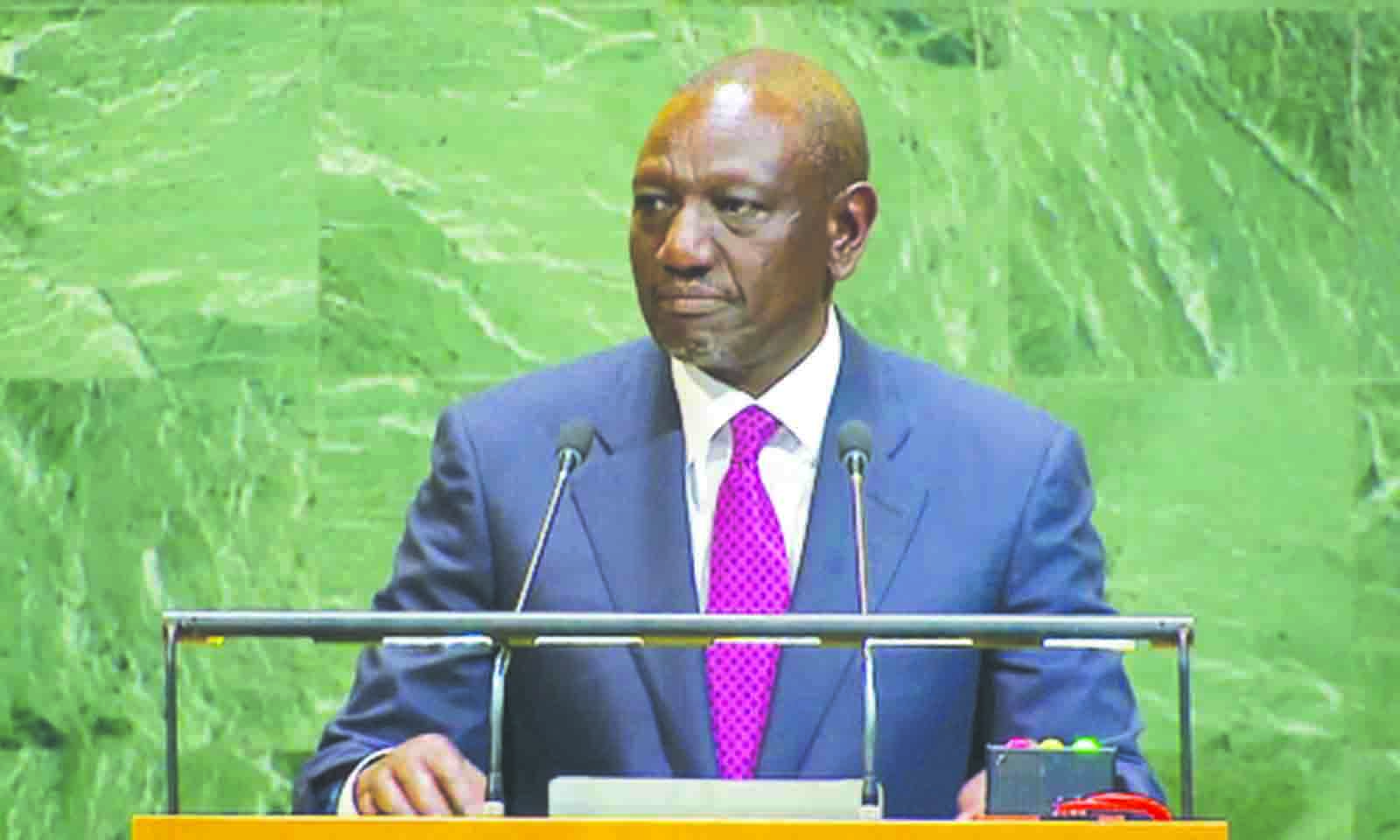
Richard Muponde
Zimpapers Politics Hub
AFRICA has reached a defining, non-negotiable moment in its long struggle for recognition within the architecture of global governance, forcefully asserting the principle, “nothing for us without us”.
The continent is unequivocally demanding a permanent seat in the United Nations Security Council, arguing that the time for structural marginalisation is over.
The UNSC is the supreme decision-making body of the “Global Club of Nations” called the United Nations, formed after World War II. It makes critical world decisions and wields veto powers against the consensus of the rest of the world.
When Kenya’s President William Ruto took to the podium at the United Nations General Assembly last weekend, his words resonated far beyond the walls of New York.
He was not simply delivering a speech; he was issuing a demand that is decades overdue. In his words, “You cannot claim to be the United Nations while disregarding the voices of fifty-four nations, it is impossible. Africa will no longer remain on the margins of global governance while decisions on peace, security, and development are made without our perspectives and our voice.
“Excluding Africa is not only unacceptable, unfair, and grossly unjust, it undermines the very credibility of this organisation.
“Africa dominates much of the Security Council’s agenda, provides some of the largest contingents of UN peacekeepers, and bears the heaviest costs of instability. Yet, we remain the only continent without a permanent seat.”
These powerful remarks represent both a moral challenge and a stark political reminder: the time for Africa’s permanent representation in the UNSC is not tomorrow, but now.
The UNSC remains the most powerful organ of the UN, tasked with maintaining international peace and security.
It is the body where wars are legitimised, peacekeeping missions are authorised, and sanctions are enforced.
Yet, despite Africa’s overwhelming representation on the Council’s agenda, the continent is denied any meaningful role in shaping these decisive global outcomes.
Africa is confined to rotational, non-permanent membership without veto powers, meaning that even on matters that directly affect its countries, it has no decisive say.
This structural marginalisation is not accidental; it is a reflection of a post-World War II order designed without Africa in mind, cementing inequalities that have persisted for nearly eight decades.
It is a profound irony that while the UNSC often convenes on issues from the Democratic Republic of Congo, Sudan, Somalia, or the Sahel, the very people affected remain spectators to discussions about their destiny.
President Ruto’s call is not an isolated cry. It echoes a lineage of African leaders who understood that Africa’s dignity and sovereignty could never be fully realised without a voice at the highest level of global decision-making.
The late president Robert Mugabe, in his many addresses to the UN, was uncompromising on this issue.
He repeatedly stressed that Africa could not continue to be treated as a junior partner in global governance when its resources, people and security dominated international debate.
Under Zimbabwe’s Second Republic, President Mnangagwa has sustained the same demand, emphasising that a fair and inclusive global order cannot emerge while Africa is excluded from the Council’s permanent membership.
These leaders, and many others before them, made it clear that the question of Africa’s place in the UNSC is not just about representation, it is about justice, equality, and the recognition of Africa’s growing role in global affairs.
The West, which still dominates the UNSC through its three permanent members, the United States, the United Kingdom, and France, has consistently manipulated the body to serve its strategic interests. Time and again, the Council has been used to legitimise wars that destabilised entire regions under the guise of international security.
The 2003 invasion of Iraq stands out as a glaring example. Despite global opposition and a lack of clear evidence of weapons of mass destruction, the war proceeded under Western pressure, leaving behind a shattered nation, millions displaced, and the rise of extremist groups such as ISIS.
Similarly, the NATO-led intervention in Libya in 2011, authorised under UNSC Resolution 1973 ostensibly to protect civilians, quickly morphed into regime change. The aftermath has been catastrophic: the collapse of state institutions, endless civil war, and Libya’s transformation into a hub for human trafficking and terrorism.
In both cases, Africa bore the consequences without having had a Veto to challenge or redirect the decisions.
This selective application of international law exposes how Africa’s absence from permanent membership leaves it vulnerable to external manipulation and exploitation. Securing a permanent seat for Africa would bring much-needed checks and balances to the current global order.
It would ensure that decisions about African conflicts and resources are not made without African participation.
At a time when competition over Africa’s resources has intensified, with the Global North and Global South both seeking access, Africa’s representation in the UNSC would serve as a safeguard against exploitation.
The Global North, historically exploitative, continues to dictate terms through institutions it dominates, while the Global South, represented by countries such as China, India, Brazil, and Russia, has shown greater willingness to engage Africa on the basis of mutual respect and partnership.
With a permanent seat, Africa would be able to tilt the balance, resist the neocolonial tendencies of the North, and consolidate its alliances in the South-South cooperation framework.
President Ruto’s demand that the time is not for tomorrow, but now cannot be overstated.
The world has changed dramatically since 1945, yet the UNSC remains frozen in a reality that no longer exists.
Africa today has a population of nearly 1,5 billion people, making it the fastest-growing demographic region in the world.
By 2050, Africa is projected to account for a quarter of the world’s population and a significant share of its labour force and consumer market.
To exclude such a vast segment of humanity from the UNSC is to deny the legitimacy of the very institution tasked with global governance. The time for Africa’s permanent seat has, in fact, reached its “best before date.”
To continue postponing it risks entrenching a legitimacy crisis for the UN itself.
Moreover, Africa’s case is strengthened by the support of its allies, particularly Russia and China, both permanent members of the Council.
These powers, which have consistently advocated for a more multipolar world order, are well-positioned to champion Africa’s claim. With the rise of BRICS and the expansion of South-South cooperation, the alignment between Africa, Eurasia, and other developing regions has created a powerful coalition capable of challenging Western dominance.
Rallying this coalition to push aggressively for Africa’s permanent representation would not only benefit Africa but also democratise global governance in a way that reflects the realities of the twenty-first century.
President Ruto’s words at UNGA were both timely and historic. Africa cannot continue to carry the burden of instability, contribute troops to peacekeeping, and provide resources to the world, only to be denied a seat at the decision-making table. His declaration that “Africa will no longer remain on the margins of global governance while decisions on peace, security, and development are made without our perspectives and our voice” is a statement of principle and a definitive call to action.
It is a reminder that nothing for Africa should ever be decided without Africa. The demand is not for tomorrow, not for the next decade, but for today.
The credibility of the United Nations depends on it. The time for Africa’s permanent seat in the UNSC is NOW. Not tomorrow. Not in the distant future but NOW.



