admin
admin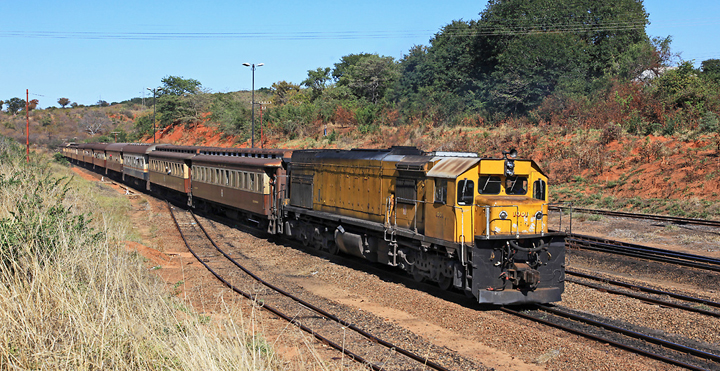
Banks on $450m rescue package under negotiations
Prosper Ndlovu Business Editor
THE National Railways of Zimbabwe (NRZ) faces a real threat of collapse in the face of a growing negative net capital and ballooning operating losses, Parliament heard on Wednesday.
A report presented before the August House by the Public Accounts Committee chaired by Paurina Mpariwa (MP), after examining NRZ accounts, shows the giant parastatal is in dire straits — weighed down by poor business performance, an ageing fleet and dilapidated railway infrastructure as well as arrears running into millions of dollars to different creditors.
Presenting the findings, Mpariwa said while the report covers the company’s accounts for the year ended December 31, 2011, the challenges facing NRZ continue to persist.
She said NRZ operations had been deteriorating for years due to lack of recapitalisation.
“Both the rail infrastructure and the wagons have outlived their planned lifespan resulting in huge maintenance costs and the requirement for high manning levels.
“With such high inbuilt costs, it means NRZ would therefore; charge more for its transportation services to a level where it can’t compete with other modes of transportation such as road, hence the depressed business levels experienced over the years,” said Mpariwa.
“Given the current depressed economic environment, the committee concluded that it will be very difficult to attract a foreign investor to partner with NRZ under the public/private partnership.”
She said the committee stressed the strategic importance of a rail system to the development of the country’s economy and recommended urgent steps to rescue the troubled firm.
“The audit observed a negative net working capital position and the company continued to incur operating losses. The government, therefore, does not have many options but to recapitalise NRZ if it were to continue as a going concern,” Mpariwa added.
NRZ requires up to $700 million to restore normal operations and is banking on a $450 million rescue package being negotiated by the government and the Development Bank of Southern Africa.
Mpariwa said in 2011 the current liabilities of NRZ exceeded current assets by almost $17 million.
She said net loss incurred worsened from about $24 million in 2010 to $46 million in 2011 resulting in the company accumulating losses of up to $105.5 million.
The committee, Mpariwa said, expressed concern at the continued existence of the company as a going concern given such a weak financial position.
Substantial financial injection by the government to recapitalise the company would be the major solution to the company’s perennial woes, the committee recommended.
The giant parastatal is struggling to meet its salary bill, service loans, meet statutory obligations to the National Social Security Authority (NSSA), Zimbabwe Revenue Authority (Zimra), the Environmental Management Authority (EMA) and also the medical insurance for its workers.
The committee registered concern at the low production as a result of an ageing infrastructure which has outlived its planned lifespan of 25 years.
Most of the company’s equipment was purchased in the 1960s and the latest around 1989.
“Such old equipment experiences frequent breakdowns hence high maintenance costs. Because the technology is too old and to a greater extent entails manual processes, it also requires high labour manning levels hence an unsustainable wage bill. Against such background, it became obvious that NRZ was operating below the break-even point,” said Mpariwa.
To break even, the company needs to move five million tonnes in terms of volumes that require rail transportation.
However, tonnage had considerably gone down from as high as 9.6 million tonnes that was moved annually during the turn of the millennium, to as low as 2.6 million tonnes in 2009. Some slight improvements were recorded in 2013 when NRZ moved about 3.71 tonnes.
Out of about 70 diesel locomotives, only 25 were operational while 15 electrical locomotives were not in use following decommissioning of the Harare-Gweru section after electric cables were vandalised.
Out of 73 shunting locomotives, 35 were still serviceable but were 45 years old, which is way beyond the lifespan of 25 years.
Mpariwa said the rail infrastructure needed total replacement as well as the signal system, which has seen the company resort to a manual system for operating trains.
At the time (2011) NRZ had 6,520 workers, which resulted in a monthly salary bill of about $6.1 million, accounting for 67 percent of the monthly revenue.
“At the time of hearing the evidence, management informed the committee that the company had accumulated $55 million in salary arrears, covering a period of nine months,” said Mpariwa.
According to the report, Zimra alone was owed $43,478 million in PAYE and VAT taxes, NSSA $4,1 million, RailMed $1,2 million and $1,6 million for Standard Development Levy.


 Online Reporter