Chronicle Editor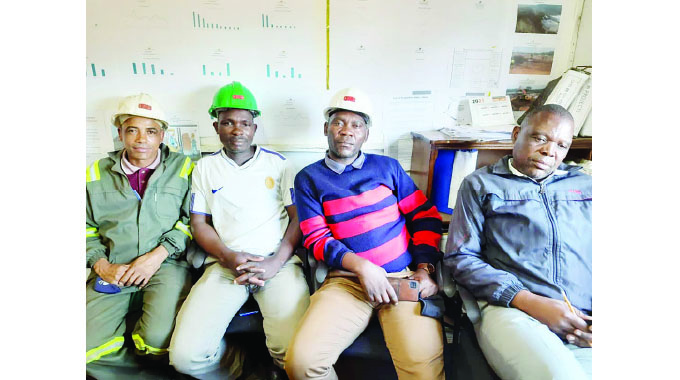
Yoliswa Dube-Moyo, Matabeleland South Bureau Chief
IT took a whole lot of stamina to balance oneself down a 240-metre-deep shaft using a hoisting rope attached to a harness.
The hoist down to meet with death was not for the faint-hearted as there were splatters of blood and human bones along the way.
After receiving a distress call of an accident at Bucks Mine in Colleen Bawn that had left seven miners dead, the 13-men Vubachikwe Mine rescue team rose to the challenge and emerged heroes, unscathed.
The miners plunged to their death after hoisting ropes to a skip bringing them up the 240-metre-deep shaft snapped 15 metres from the surface.
Sources said the skip they were in dragged the miners to the bottom of the shaft.
Rescue workers spent over 72 hours trying to pump out water from the underground mine in order to retrieve the bodies of the miners who were trapped underwater.
Some of the retrieved bodies had been badly injured with skin peeling off due to prolonged exposure to water.
Chronicle caught up with some of the rescue team members at their base in Vubachikwe to discuss the ins and out of the rescue team and its operations.
“When we arrived at Bucks Mine, there were a few people, the mood was sombre.
Everyone was devastated, it was tense.
We were there to assist the situation, if not, we would then abort the situation because according to our training, we’re not supposed to endanger anyone.
We did a 360-degree inspection of the area after being updated on what had happened,” said Mr Noah Moyo, the team trainer who was coordinating operations.
He said there was an old man who had managed to access the area on the night of the accident and the information he had relayed was not good.
“There were no survivors and there was water.
He had seen some blood scattered all over, bones and hard hats all over going down so there was no way we could expect a survivor.
There was no way we could’ve abandoned the situation at that point,” he said.
Mr Cleopas Karima, the team captain said after assessing the situation, they had to assess the underground scenario.
“We went on to assess the underground situation like what the old man had told us.
His name is Austin Sibanda.
After we got his information, it was also wise for us to assess the underground situation.
Myself and some brigade’s men went down to assess the underground scenario.
From what we saw, it was obvious there were no survivors.
There were some bones along the way up to the lowest level.
We could see human body parts on the platform on Level 7.
Our mission was to search and rescue.
Further down, we could see some overalls which showed that there were people in the water.
There was no option but to pump water from underground so that we could see what was happening.
“We also tried to measure the level of the water by dipping a 15mm polyhose and estimated that it was roughly six metres deep.
We installed a pump but faced challenges because all the polyhoses along the pumping line were damaged so we had to install a pumping line so that we could start pumping water.
We installed the pumping line from Level 8 which was the bottom pumping level to Level 5.
We installed another pumping line from Level 4 to the surface.
We started pumping water on Sunday around 10PM and gave ourselves 24 hours of pumping water,” said Mr Karima.
Some of the brigade’s men were underground from Sunday to Tuesday as they had to monitor the pump and communicate with those on the surface.
“We had to go up and down the shaft trying to monitor the movement of water.
By Monday at 10PM, the pump had pumped 2 metres and there was 6 metres of pumping remaining.
We continued to pump until Monday midnight, that’s when we saw the first body.
There was no resting in-between.
We were just rotating among ourselves.
If one man got tired, we would switch him with another.
The pumping was continuous so we were not resting,” said Mr Karima.
What kept the men going was the desire to see results.
“When we started the mission, everyone was very eager to see the achievement.
Everyone was saying guys, let’s push on until we finish.
I still remember at some point the inspectors said no guys, you’ve been working for 24 hours, you better rest and continue the next day.
Everyone said no.
Everybody was eager to see the results.
Everybody was eager to finish.
Some of the guys went down on Sunday up to Tuesday morning, they didn’t come up.
Food was being served underground.
People were eating in that kind of a scenario,” said Mr Karima.
“We were using a pipe to communicate.
We tried to introduce our own communication method; in modern shafts we use communication radios and communicate straight to surface.
But in this situation, it seems it was not user friendly so we had to use the pipes.
We would have someone at certain intervals who would be shouting the message to the person above or below them,” said Mr Karima.
One of the team members, Mr Mandigo Maguchu said the Vumbachikwe Mine rescue team is trained to help in any situation outside their mine.
“We can handle any situation and we’re not limited to mine accidents.
We also help those involved in road traffic accidents and so forth.
When they are not rescuing those in need, the brigade’s men are engaged in various occupations.
Mr Moyo and Mr Karima are mine captains, Mr Kudakwashe Mpofu is a fitter and turner and I’m a mine surveyor.
We also have metallurgists, geologists and other professionals in different departments.
We’re all first aid members and attend to casualties,” said Mr Maguchu.
He said the brigade’s men are selected to join the team from different departments such that various skills are brought to a rescue situation.
“At Bucks Mine, the fitter assessed the hoist, he’s also the one who installed the G-string mechanism that ensured team members were not trapped or injured along the way.
The miners in the team know how to deal with gases, assess the platforms and install the pumps.
We’ve got every skill that could be needed in a rescue mission,” said Mr Maguchu.
While the brigade’s men are trained to rescue, the burden on their family members was heavy as they were away from home for days.
He said the devastated relatives of the trapped miners ignited something in them to fight till the end.
“We could see how much faith they had in us so abandoning the mission was not an option.
They were in so much pain and desperate just to see a body of a husband, father, brother, son or uncle.
So, we couldn’t walk away from the situation,” said Mr Moyo.
Another brigade’s man, Mr Kudakwashe Mpofu said as a trained rescue team, it was not possible to walk away from the situation, no matter how bad it was.
He said once the first body came up, the relatives started to have faith in their operation.
The Vumbachikwe Mine rescue team undergoes regular retraining exercises where they continually sharpen their skills.
“We also do physical training and a simulation of things that one may come across underground.
You have to be fit and be prepared for any accident.
We do physical training three times a week.
Sometimes we run, on other days we lift weights and, on some days, we do first aid,” said Mr Moyo.
As a parting shot, the brigade’s men encouraged mine operators to follow safety regulations and conduct regular risk assessments.
“Hoisting ropes are supposed to undergo regular strength tests and all equipment must be commissioned by the mines inspectorate before operations begin,” said Mr Mpofu.
– @Yolisswa.


 Online Reporter