Online Reporter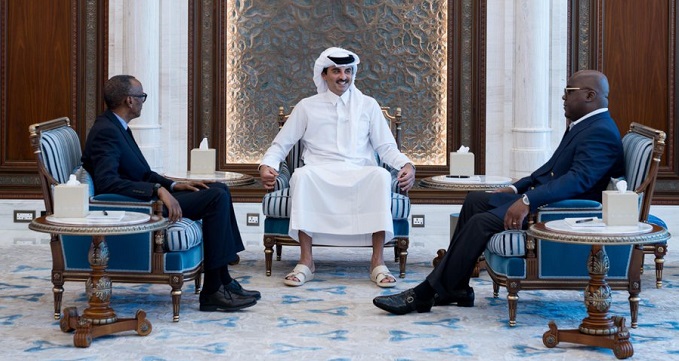
THE mini world war in the Democratic Republic of Congo (DRC) — which appeared intractable before recent assiduous diplomatic efforts, not least from President ED and William Ruto (as leaders of regional blocs SADC and the EAC, respectively), who unprecedentedly convened historic joint meetings of the two bodies — now seems to be coming to an end.
Bishop Lazi would prefer to call it a mini world war because of the sheer number of protagonists from all over the world that were now using the eastern DRC as a theatre of war and political intrigue.
You have Burundi, whose troops were deployed as part of the EAC regional force; Uganda, which is also actively involved as it tries to eliminate a Ugandan militia (Allied Democratic Forces) with links to the Islamic State jihadist group; and Rwanda, perhaps the major player, accused of sponsoring the predominantly Kinyarwanda-speaking M23 insurgents that are fighting the Armed Forces of the Democratic Republic of Congo (FARDC).
Added to this complex mix are a motley of militia groups such as the FDLR, which was founded by perpetrators of the 1994 Genocide against the Tutsi in Rwanda; the Wazalendo, which is a coalition of irregular forces and groups believed to be allied to the FARDC in the fight against M23 rebels.
There is also the United Nations Organisation Stabilisation Mission in the DRC (MONUSCO).
And, until recently, there were also SADC troops from Tanzania, Malawi and South Africa.
This is not all.
Also in on the action were European mercenaries and Belgian troops.
So, essentially, there was a potpourri of armed belligerents on the prowl in the eastern DRC, which could not have been a good thing for unarmed and defenceless ordinary Congolese who found themselves caught up in this conflagration.
While the regional meetings convened by SADC and EAC managed bring the two main protagonists in the conflict — DRC’s Felix Tshisekedi and Rwanda’s Paul Kagame — together, the two leaders, however, could not bear sitting in the same room.
Equally, the novel but wise decision by the inaugural February 8 joint meeting of the blocs to also include M23 in the discussions was becoming increasingly elusive as the rebel group kept on giving excuses as to why it could not engage.
A scheduled pivotal meeting between the DRC and insurgents in Luanda on March 18 that came after intense diplomatic engagements, for example, spectacularly collapsed at the 11th hour after the latter pulled out, citing sanctions that were slapped on senior members of the group by the European Union on March 17.
But on the day of the abortive talks, Qatar announced it had managed the almost impossible feat of hosting a face-to-face meeting between Tshisekedi and Kagame in Doha, which was attended by Sheikh Tamim bin Hamad Al Thani (the emir of Qatar).
At the Doha indaba, the two African leaders reportedly “reaffirmed the commitment of all parties to an immediate and unconditional ceasefire”, as had been agreed at the SADC-EAC summit.
Six days later, on March 24, Angolan President João Lourenço, who had been named mediator in the conflict by the African Union (AU), announced his withdrawal from the role, but not before Luanda had hinted there were forces from outside the region that were actively trying to scupper the talks.He has since been replaced by Togo’s President Faure Gnassingbe.
Further, on March 28, Qatar went a step further by not only hosting a second round of talks between the DRC and Rwanda, but meeting representatives of the M23 as well.
A thoroughly transactional Trump administration in Washington, which is foraging the world as it tries to stem America’s decline, has joined the fray after Tshisekedi dangled the thing that the US is seeking the most — minerals, themselves the reason the DRC finds itself in perpetual conflict.
This is eerily similar to the minerals deal that was clinched by the US in Ukraine, where Volodymyr Zelensky was viciously arm-twisted to cede the country’s mineral wealth to guarantee protection against Russia’s war machine.
France, too, has joined the mediation efforts. Kikikiki.
As Bishop Lazarus writes this, there is a flurry of diplomatic activity behind the scenes meant to ensure that, in line with the Luanda-Nairobi peace process, as reiterated by SADC and EAC, at least a modicum of normalcy starts returning to the beleaguered eastern DRC.
The Bishop hopes and prays that the gratuitous and unconscionable violence, most of which has been borne by ordinary Congolese, will finally come to an end.
A small peninsular of considerable political heft
In all this, it is, however, the convening power of Qatar — a tiny Arab peninsular — that has piqued Bishop Lazi’s interest the most. This country of about 3,1 million people, of which only an estimated 300 000 count themselves as Qataris, has exercised considerable diplomatic heft in mediating conflicts, particularly in the Middle East and Africa.Its efforts have been notable in countries such as Yemen, Lebanon, Sudan, Ukraine, Afghanistan and Gaza.
At one time during the ongoing conflict between Israel and Hamas, it was the key mediator in trying to have hostages held by Hamas released.
The crux of the matter, however, is that Qatar earned this lofty role neither because it is a consummate problem-solver nor skilled interlocutor, but simply because it has deep pockets.
With a gross domestic product (GDP) of an estimated US$213 billion, Qatar, buoyed by its fabulous oil and gas riches, has the world’s highest GDP per capita.
Naturally, it, therefore, has the wherewithal to host talks and offer financial services for peace.
So, its economic might translates into its diplomatic clout.
Clearly, folks, it is the dichotomy between the rich and the poor that shapes and defines global power dynamics, with the rich ruling over the poor and the borrowers being slaves to lenders.
This is precisely the reason poor Africa, despite being home to over one billion souls, does not have a seat at the table in global politics.
Proverbs 22:4-7 says: “Humility is the fear of the Lord; its wages are riches and honour and life. In the paths of the wicked are snares and pitfalls, but those who would preserve their life stay far from them. Start children off on the way they should go, and even when they are old they will not turn from it. The rich rule over the poor, and the borrower is slave to the lender.”
Little wonder that Africa’s call to have two permanent seats on the United Nations Security Council with all rights and privileges, including veto power — as encapsulated by the Ezulwini Consensus passed by African leaders in Eswatini in 2005 — remains unheeded.
The richer we get, the more our voices will be projected and the more leverage and power we will have.
And this is why economic development as well as economic diplomacy have become the zeitgeist in the current epoch under the Second Republic led by ED, which has decidedly prioritised economics over politics.
Despite the vicissitudes of climate change and rising global uncertainty, we are well on course, with the economy forecast to grow by 6 percent this year.
Various mega projects, some of which are already coming online, such as steel manufacturing in Manhize and the US$3,6 billion Palm River Energy Metallurgical Special Economic Zone project in Beitbridge, give hope that economic growth will only accelerate.
But we have a long way to go.
Let us not be distracted by political sideshows and keep our eyes on the ultimate prize — prosperity.
This is the path travelled by countries such as Singapore, China and Qatar.
We have all the resources that we need for success.As Africans, only economic clout will give us the much-needed political might.
Bishop out!


 Online Reporter