Chronicle Editor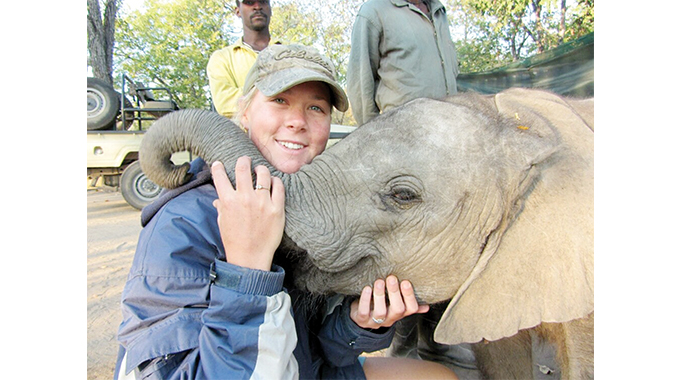
Mashudu Netsianda, Senior Reporter
WITH free-flowing hair and skin tanned by years spent hunting under the glare of the African sun, Ms Tanya Blake (32) has etched a place for herself as an icon in the story of safari hunting in Zimbabwe.
Her natural curiosity, the love of nature, bush life and a strong passion for wildlife drove her into professional hunting, an industry largely dominated by men.
Ms Blake, who is based in Bulawayo, is the only female professional hunter (PH) in the country. In fact, she is the fourth female professional hunter ever to emerge in Zimbabwe and when she qualified in 2014, it was 30 years since the last female hunter qualified in the country.
Ms Blake’s journey was not a walk in the park. Being a woman, she faced typecasting largely because society is still adjusting to the emergence of women in the field of professional hunting.
She has hunted the length and breadth of Zimbabwe as a freelance professional hunter and enjoys the challenge and the thrill.
For Ms Blake, no great adventure stands out more prominently than the hunting safari. The encounters with dangerous game, spending time in the bush and sleeping in tents is what she enjoys most.
By virtue of being a professional hunter and conservationist, Ms Blake believes she is a great custodian of African wildlife.
Growing up at a farm, which was surrounded by wildlife, Ms Blake developed a passion for wildlife at a tender age.
She started her hunting career as a young girl shooting small game on her family’s ranch and later learning about tracking and big-game hunting.
However, it was no easy feat for Ms Blake to attain her professional hunter’s licence. Being a professional hunter is not a title which is easily earned, it comes through hunting prowess and success.
It is a title bestowed on the men and women who guide and organise hunting expeditions all over the world. Its tradition can be traced back almost a century to R J Cunningham, who was former American President Theodore Roosevelt’s professional hunter on his famous safari of 1909-1910.
The tradition is continued today by countless men and women who guide visiting sportsmen and tourists on hunting safaris throughout the world, especially in Africa.

“Having grown up on a farm and in a very strong hunting orientated family, it has always been my dream to leave school and go straight into the bush and study towards attaining a professional hunter’s licence. However, my parents were strict in the sense that they wanted me to pursue a career path which was more academic,” said Ms Blake.
She enrolled for a nine months secretarial course and half-way through her first job, she quit to fulfil her childhood dream.
“I finally got into a photographic job in Mana Pools at a good reputable company. My dream was to go straight into a hunting camp, but being a woman, it was somehow difficult to convince safari operators to give me a chance largely because it’s a male-dominated industry,” said Ms Blake.
“The general societal perception is that male hunters are allowed to have complex personalities while female hunters are often summed up by hackneyed stereotypes that undermine their capabilities.”
In 2009, she began her gruelling journey towards attaining a professional hunter’s licence.
“For one to get a hunting licence, you basically have to first go through an advanced medical aid course before writing a learner’s examination. The course covers issues on habits and habitats (flora and fauna), ballistics, general information about Zimbabwe, the rules and regulations governing wildlife in the country,” said Ms Blake.
“After passing these initial stages, you are then awarded a learners’ certificate, which makes you eligible to work as a leaner professional guide. At this stage you may then apply to a hunting camp or photographic area to become an apprentice depending on the field you wish to pursue.”
Ms Blake said for one to get a professional hunter’s licence in Zimbabwe after attaining a learners’ licence, they should have worked not less than two years under one safari operating company.
Being a woman, it was not easy for her to find a company that was willing to take her for apprenticeship.
“It was a mammoth task for me to secure apprenticeship after I got my learners’ certificate. I applied to several safari companies and there were very few that would respond. I remember at one time, my dad would even apply on my behalf and companies would offer me apprenticeship but, the moment I showed up and they discovered that it was a woman, they would start coming up with all sorts of excuses,” she said.
“I eventually found very good people and went into the photographic sector where I spent two-and-half years of apprenticeship under the guidance of two fully qualified professional hunters. During the apprenticeship, the candidate must shoot at least four dangerous game, including a buffalo or elephant and some cats.”
Ms Blake said in Africa, Zimbabwe has arguably the most stringent hunters licence requirements with candidates undergoing extensive training and testing.
Professional hunters are licensed by Zimparks and applicants must be a Zimbabwean citizen or permanent resident aged 18 years and above.
Before attending the licence proficiency test, the candidate must obtain an advanced First Aid certificate and attend a shooting test which is conducted by Zimparks and the Zimbabwe Sport Shooting Federation.
Ms Blake said during the shooting test there were 40 candidates and she came second.
“We were a class of 40 candidates in the shooting test and I came second. After the shooting test, we got into oral examination, which for me was the hardest of them all,” she said.
“I walked into the examination room where there were 18 people comprising six PHs and 12 Zimparks officials.
There were several trophies in that room, a book of skins and they ask you lots of questions around that and I was nervous.”
Ms Blake managed to get through to the next stage of practicals, which involved 10 days of safari hunting with examiners.
“During the practicals, you have to shoot a buffalo or elephant. The examiners will make you track the animal, skin it and you have to put the entire camp for them, feed them, give them drinks and basically treat them like a client,” she said.
“It’s gruelling and tough exercise both physically and emotionally, but the biggest reward obviously is that you have to get through it for you to be issued with a full professional hunter or guide licence.”
Ms Blake got her full professional hunter’s licence in October 2014.
“As a PH, you assume complete responsibility for the safari, which includes the safety of the clients and crew. You must also be able to organise a camp, fix a broken vehicle, judge the horns of an antelope at more than 300 yards and be familiar with all manner of firearms,” she said.
Ms Blake uses a .416 Rigby, which she inherited from her grandfather who was also a great hunter.
“The gun has a lot of history attached to it. My grandfather was a great hunter and this was before there was a professional hunting licensing system. The gun was passed to my dad and when the results were out after I had qualified as professional hunter, the permit was changed into my name,” she said.
“As a bush person you get to see the most incredible things, getting much closer to the animals without being a disturbance to them. Zimbabwe is unique in that we have national parks where you can get extremely close to the wildlife, which is not the case with a lot of other countries.”
The general perception about hunters is that they are anti-conservationists, especially after the famous Cecil the Lion incident.
“As hunters, animals are our assets because it’s not just about the money, it’s about creating a habitat for them where they can survive for the next generation. We have sincere love and respect for wildlife more than enough to look after them in a way that people may not even understand,” said Ms Blake.
“Our common goal as hunters is to educate people about protecting the wildlife because it’s such a huge generation of funds for Africa. If all animals die in Africa what will tourist come to see? Visitors come to our country not to just see Victoria Falls and those unique rocks at Matopos, but they also want to see our giraffe, lions and elephants.”
The major highlight of her career was when she hunted and killed an old and mature male leopard after long hours of sweat and tears.
“One of my greatest achievement was last year in October when my client and I were able to harvest one of the oldest leopards in Zimbabwe in a very long time. It was an incredible safari taken by a client and we loved every bit of it fully taking in all the flora and fauna that we were in,” she said. — @mashnets



 Online Reporter