admin
admin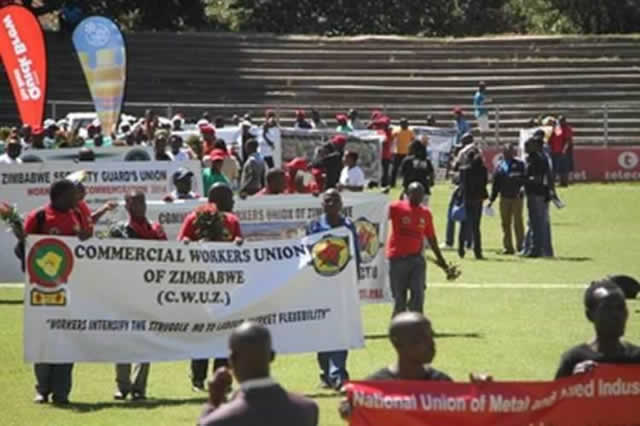
I

In two weeks’ time Zimbabwean workers will join billions of other workers across the world in commemorating International Workers’ Day, also known as Worker’s Day in Zimbabwe and other countries. In Zimbabwe most workers used to converge at different centres throughout the country to reflect on working conditions and others issues affecting them such as salaries and wages before the celebrations were hijacked by opposition political seeking to get political gain.
Now only labour unions affiliated to the opposition parties converge to recognise the day while most workers choose to commemorate the day from their homes.
In Zimbabwe most workers converge at different centres throughout the country to reflect on working conditions and others issues affecting them such as salaries and wages.
The day, which is a holiday in most parts of the world, is a celebration of labourers and the working classes that is promoted by the international labour movement, anarchists, socialists, and communists.
The date was chosen for International Workers’ Day by the Second International to commemorate the Haymarket affair, which occurred in Chicago on 4 May, 1886.
This day has its origins in the labour union movement, specifically the eight-hour day movement, which advocated eight hours for work, eight hours for recreation, and eight hours for rest.
Being a traditional European spring celebration, May Day is a national public holiday in many countries, but in only some of those countries it is celebrated specifically as “Labour Day” or “International Workers’ Day”.
Some countries celebrate the day on other dates significant to them, such as the United States, which celebrates Labour Day on the first Monday of September.
Beginning in the late 19th century, as the trade union and labour movements grew, a variety of days were chosen by trade unionists as a day to celebrate labour.
May 1 was chosen to be International Workers’ Day in order to commemorate the May 4, 1886 Haymarket affair in Chicago.
The police were trying to disperse a public assembly during a general strike for the eight-hour workday, when an unidentified person threw a bomb at the police.
The police responded by firing on the workers, killing four demonstrators.
In 1889, a meeting in Paris was held by the first congress of the Second International, following a proposal by Raymond Lavigne which called for international demonstrations on the 1890 anniversary of the Chicago protests.
May Day was formally recognised as an annual event at the International’s second congress in 1891.
Subsequently, the May Day Riots of 1894 occurred.
In 1904, the International Socialist Conference meeting in Amsterdam called on “all Social Democratic Party organisations and trade unions of all countries to demonstrate energetically on the First of May for the legal establishment of the 8-hour day, for the class demands of the proletariat, and for universal peace.”
The congress made it “mandatory upon the proletarian organisations of all countries to stop work on 1 May, wherever it is possible without injury to the workers.”
Across the globe, labour activists sought to make May Day an official holiday to honour labour and many countries have done so.
May Day has been an important official holiday in countries such as the People’s Republic of China , North Korea, Cuba and the former Soviet Union. May Day celebrations typically feature elaborate popular and military parades in these countries.
In 1955, the Catholic Church dedicated May 1 to “Saint Joseph the Worker”. Saint Joseph is for the Church the patron saint of workers and craftsmen (among others).
During the Cold War, May Day became the occasion for large military parades in Red Square by the Soviet Union and attended by the top leaders of the Kremlin, especially the Politburo, a top Lenin’s Tomb. It became an enduring symbol of that period. — Wikipedia.



 Online Reporter