

 admin
admin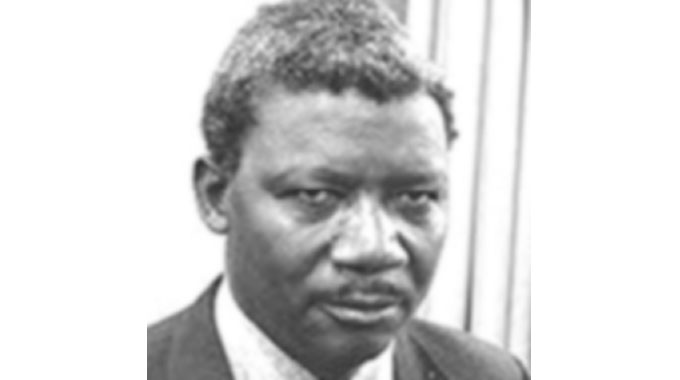
Walter Muchinguri
Senior Writer & Researcher
(Zimpapers Knowledge Centre)
ZIMBABWEANS will on April 18 celebrate 41 years of Independence from colonial rule that came after a protracted liberation struggle waged by gallant sons and daughters, some of whom lost their lives in the process.
Some of these gallant sons and daughters have been declared national heroes and heroines and are interred at the National Heroes Acre, while others are buried at provincial and district heroes’ shrines.
One of the country’s most eminent sons and hero who died in the war and whose remains are at the National Shrine is the Chairman of the Zimbabwe African National Union (ZANU), Cde Herbert Wiltshire Pfumandini Chitepo.
Cde Chitepo died on March 18, 1975 in Lusaka, Zambia, when a bomb planted on his car shattered the morning at 150 Muramba Road in Chilenje South.
This was after his fiery language and his role in developing Zanu’s new military strategy inevitably made him a target for assassination by the Rhodesian regime. Cde Chitepo and Silas Shamiso, one of his bodyguards, were killed instantly. Sadat Kufamadzuba, his other bodyguard, was injured. Although his murderer remains unidentified, Rhodesian author Peter Stiff says that a former British SAS soldier, Hugh Hind, was responsible.
Cde Chitepo was born in Mutasa District, Manicaland Province on June 15, 1923 — the year that the British South Africa Company, a legacy of Cecil John Rhodes, lost its grip on the country they called Southern Rhodesia.
Cde Chitepo was the first black citizen of Rhodesia to become a barrister. He was educated at St David’s Mission School, Bonda, St Augustine’s School, Penhalonga, and then at Adams College, Natal, South Africa, where he qualified as a teacher in 1945.
This was where he met his wife Victoria a heroine who was also interred at the national shrine. After teaching for a year, he resumed his studies to graduate with a BA degree from Fort Hare University College in 1949. In 1954, Cde Chitepo became the then Rhodesia’s first black lawyer. On returning to Rhodesia in 1954, he practised as a lawyer and defended African nationalists such as Ndabaningi Sithole.
In 1961, he served as legal adviser to the late Father Zimbabwe, Dr Joshua Nkomo, founder of the Zimbabwe African People’s Union (ZAPU), at the Southern Rhodesia Constitutional Conference in London.
During the same year (1961) he was also appointed to the Board of Governors of Bernard Mizeki College along with Sir W.C.R. Honey and Sir Robert Tredgold.
In May 1962, ZAPU was banned because of militarism and Cde Chitepo was persuaded to go into voluntary exile to escape possible detention. He became Tanzania’s first African Director of Public Prosecutions. The Sithole and Nkomo factions of ZAPU split apart in July 1963. Dr Nkomo’s supporters founded the PCC-ZAPU and favoured a more militaristic approach. At Zanu’s first congress in Gweru in 1964, Cde Chitepo was elected in absentia as national chairman. He held this post until December 7, 1974 when the Lusaka Accord was signed.
In 1966, Cde Chitepo decided to leave his prestigious job in Tanzania and move to Zambia to devote himself full-time to reorganising the party and beginning the armed struggle in earnest. It was a decision that separated him from some of his contemporaries in academic institutions and in comfortable jobs who had decided not join nationalistic politics. It was also a role that radicalised his views.
Under the guidance of Cde Chitepo as Zanu’s most senior leader, the party shaped its military wing, the Zimbabwe African National Liberation Army (ZANLA), under the command of national hero Cde Josiah Magama Tongogara. Both Zanu and Zapu chose to leave the country and reorganise and form military armies outside Rhodesia, although they chose different countries to set up their base.
ZAPU based itself in Zambia where it organised ZIPRA (the Zimbabwe People’s Revolutionary Army.) They allied with the Soviet Union and organised a vanguard of highly trained soldiers.
ZANU, however, moved into Tanzania and then to Mozambique and set up ZANLA, which concentrated more on mobilising the masses in the countryside in a guerrilla warfare method that was pioneered by the Chinese.
In January 1966 Cde Chitepo resigned as Director of Public Prosecutions and moved to Zambia to concentrate on the armed struggle. He toured world capitals canvassing for support for ZANU and for the enforcement of total economic sanctions against Rhodesia.
With his friendly disposition, he was very effective and earned international recognition and respect for ZANU.
Rev Sithole and others prepared a comprehensive document giving powers to Cde Chitepo to lead ZANU while Rev Sithole was in detention and specifically authorising him to carry out the armed struggle. Accordingly, Cde Chitepo with assistance from the military supremo Cde Tongogara, organised and planned successful guerrilla warfare attacks and underground activities in Rhodesia from 1966 onwards.
In 1972, he co-ordinated war operations with FRELIMO and opened up the north-eastern region of Zimbabwe as a new and effective war frontier.
Cde Chitepo was reburied at the National Heroes Acre on August 11, 1981.
In the country’s history of the liberation struggle, Cde Chitepo is known for insisting that the only language the Rhodesian prime minister Ian Smith would understand was violence. “Zimbabwe was taken from us through bloodshed. Only bloodshed — a bloody Chimurenga, involving four and half million of us can restore Zimbabwe to its owners.
Full article on herald.co.zw
“We have tried to correct this tragic error by politicising and mobilising the people before mounting any attacks against the enemy. After politicising our people, it became easier for them to co-operate with us and to identify with our programme,” Chitepo was quoted as saying in one of his speeches.
When he addressed the Sixth Pan-African Congress in Dar es Salaam in 1974, he proposed a global strategy against imperialism: “By cutting off the tentacles of imperialism to the periphery, we will deprive the white working class in capitalist countries of their high standards of living they have enjoyed because of the super profits that the multi-national corporations reaped in under-developed countries.
“It is only when the exploited working class of both black and white realise that they have a common enemy, a common oppressor and a common exploiter that they will unite and jointly seek to overthrow the capitalist system. This is our global strategy against capitalism, racism and imperialism,” Chitepo was also quoted as saying.
Such was the fearless, intelligent man that the country lost. He will forever be remembered for his revolutionary ethos. He did not have to, especially with his professional qualifications and oratory skills. He could have worked in different countries, living a lavish lifestyle with his family, but he chose the ultimate — to sacrifice his all for Zimbabwe’s independence and self-determination.
Cde Chitepo was a strong proponent of the distribution of land and on his return from a trip to Australia in 1973, he put it succinctly: “I could go into the whole theories of discrimination in legislation, in residency, in economic opportunities, in education. I could go into that, but I will restrict myself to the question of land because I think this is very basic. To us the essence of exploitation, the essence of white domination, is domination over land. That is the real issue.”
In recognition for the important role that Cde Chitepo played, the Great Zimbabwe University in Masvingo named its law school after the eminent nationalist, the Herbert Chitepo Law School.
According to information on the GZU website, “the Herbert Chitepo Law School offers state of the art teaching and learning facilities. Besides a unique and stunning Moot Court theatre, the School has lecture rooms that are adorned with air conditioners, chalk-less white boards and projector screens. Students at the School have access to Wi-Fi.
“Graduates from the Herbert Chitepo Law School are expected to uphold the basic principles of human justice, democracy and rule of law which Advocate Chitepo stood for.”
Zanu-PF also runs the Herbert Chitepo Ideological College in his honour. The college teaches members about the party’s ideology. It is also meant to educate its members on party policy and the route that the party should take.
Cde Chitepo’s immense contribution in the nationalistic movement and the liberation struggle is unquestionable. Have they been honoured well enough? Do the gestures done so far capture the vision he had for a better Zimbabwe when he left the good life to concentrate on the armed struggle?
It is time that conversations about our heroes shift focus and delve into the major issues that led them to take up arms and fight the settler colonialists. One of those issues is wealth creation and sharing.
They are our heroes and our legacy!



 Online Reporter