Sukulwenkosi Dube-Matutu [email protected]
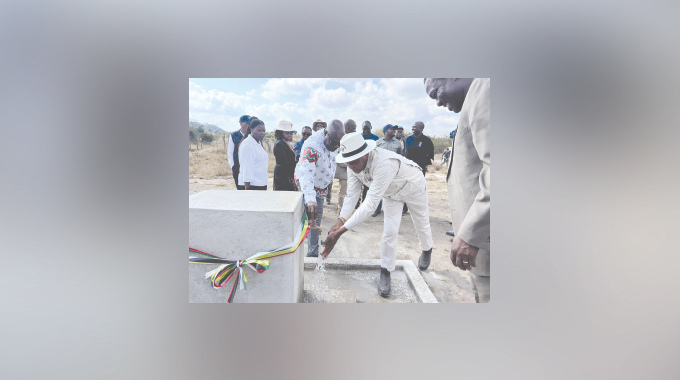
OVER 400 households in Wanezi, Insiza District, have benefitted from two solarised piped water schemes established following the rehabilitation of Wanezi Dam.
The 1 700-megalitre dam was rehabilitated under the Climate Adaptation Water and Energy Project (Cawep), funded by the United Kingdom Government and implemented by the United Nations Development Programme (UNDP) in partnership with Government departments.
The rehabilitation of the dam has ushered in significant development within the Wanezi community, improving access to clean water and renewable energy for domestic, commercial and agricultural use.
Before the project, villagers faced persistent challenges in accessing water for household consumption and livestock.
Women and girls often spent hours queuing at a limited number of boreholes, which would occasionally run dry, while livestock owners were forced to drive their animals for more than five kilometres in search of water.
The Tsetsi B piped water scheme is benefiting 150 households, while the Nyezi piped water scheme is serving 250 households. A total of 28 communal taps have been installed, reducing the distance villagers travel to collect water to less than 500 metres.
A villager, Ms Prudence Nkomo, said improved access to water had transformed daily life in the area.
“We used to spend hours at the borehole as it would sometimes run out of water. This piped water scheme has brought much relief to us as we used to walk for a long distance to get water from the borehole.
“This was laborious and we would lose out on valuable time just to get water. These challenges are now a thing of the past as we now can access water from taps. We have several taps that are dotted around our village and they can serve our entire community,” she said.
Mr Alfred Siziba said the improved water supply had enhanced access to water for livestock and would support the establishment of horticultural projects.
He said the community was planning to establish small-scale gardens focused on horticultural production.
Mr Siziba said reliable water supplies would stimulate economic activity in the area while strengthening food and nutrition security.
“We plan to establish horticulture gardens, which will ensure that we have income. We will sell some of the produce while the rest we will eat at our homes and this helps meet dietary needs. With improved access to water, our animals will perform well and this is crucial for our income. Our animals have to be in good condition so that we can sell them at good prices,” he said.
Wanezi village head Mr Desire Dube said the piped water schemes would help ensure sustained access to clean and safe water for residents.
He said it was encouraging to see communities benefiting from the rehabilitation of Wanezi Dam, which was once a key source of livelihoods in the area.
Mr Dube said the community had waited many years for the dam to be rehabilitated until the Government, under the Second Republic, acted to restore the critical infrastructure.
UNDP engineer Mr Louise Makurumure said the rehabilitation of the dam had also improved water access at Wanezi High School and Shamba Primary School. He said that under Cawep, a 30-hectare irrigation scheme had been established in the Wanezi area, while the Wanezi River Bridge had also been constructed. The bridge provides access for learners travelling to Wanezi High School and Shamba Primary School, connects villagers to Skuta Business Centre and links farmers operating at the newly established Wanezi Irrigation Scheme to markets.
“The two solarised community borehole piped water schemes have a piping distance of 14,3km and 28 water points have been established, which are distributed across the two villages. This intervention has helped reduce the distance walked by villagers to collect water to less than 500 metres,” he said.
Wanezi Dam, once a major source of livelihoods for farmers, was severely damaged by Cyclone Dineo in 2017, leaving villagers struggling to access reliable water supplies. Constructed in 1952, the rehabilitated dam is expected to transform the Wanezi community into a productive green belt while supporting sustainable agriculture and rural development.
– @DubeMatutu