Online Reporter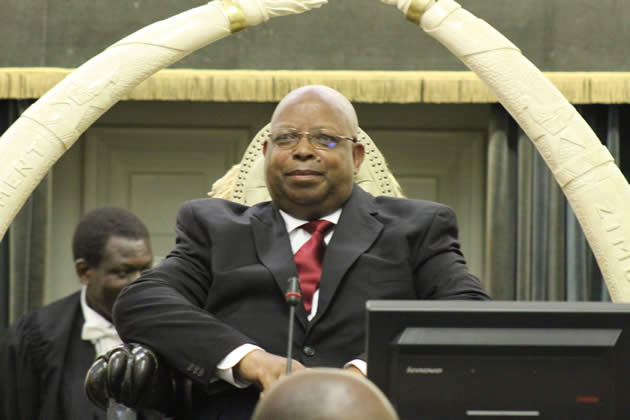
Farirai Machivenyika
Senior Reporter
PARLIAMENT has a constitutional mandate in its oversight of budgetary processes that gives parliamentarians the legal authority to demand answers from the Executive on how public resources are being utilised for the public’s benefit, Speaker of Parliament, Advocate Jacob Mudenda has said.
He made the remarks in Bulawayo during a capacity-building workshop on the country’s public finance management framework for parliamentarians drawn from the Parliament’s Public Accounts Committee and that of Budget, Finance and Investment Promotion that ended on Monday.
“The role of Parliament in Budget oversight is not a matter of political convenience, executive benevolence or sheer happenstance,” he said.
“It is a constitutional mandate that forms the very juridical foundation of the budgetary processes. The Constitution does not just permit you to scrutinise public expenditure. It commands you to do so because you must ensure that public resources are expended on programmes designed to improve the livelihoods of the citizenry with greatest equity.
“In fact, the Constitution speaks with crystalline clarity. Section 119(3) states that “…all institutions and agencies of the State and Government at every level are accountable to Parliament”.”
He said the Constitution also provided for principles of public financial management which should act as the guide for Parliamentary oversight on how public funds ought to be used for the sake of democratic accountability. “Together, these constitutional provisions create a comprehensive legal architecture that gives Select Committees the moral and legal authority to question, to probe, and to demand appropriate responses that engender the public trust arising from total satisfaction that the public purse passes the test of highest probity,” Advocate Mudenda said.
“Additionally, the Public Finance Management Act bolsters the above earlier quoted constitutional provisions by practically guiding Select Committees to exercise financial oversight soundly.”
He added that the budget was an economic management tool used by Government to transform people’s aspirations into reality and also used to influence the behaviour of economic players in the private sector for them to contribute towards the achievement of the national development agenda.
“Central to fulfilling your constitutional obligation is the ability to conduct Budget analysis. It entails looking at the spending framework from the lens of the poor, the women, the children and persons living with disabilities, with the objective of prioritising the stout revenue inflows and the public expenditure in ways that are socially equitable,” he said.