admin
admin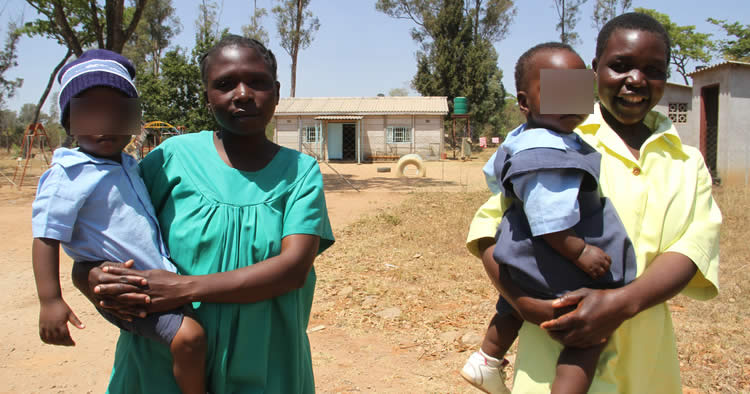
Harmony Agere Extra Reporter
At two years, Tanatswa Sibanda (not her real name) has not known any other world except inside the walls of a prison. When her mother was sentenced to jail for culpable homicide, after killing her husband — Tanatswa’s father — she was some months late into her pregnancy. Now that the mother is coming to the end of her prison term, Tanatswa will have the double tragedy of adapting to the outside, “normal” world and coming to a home without a father. And she will never get to know him.
Crying with her lean arms stretched to reach out to one of her tutors, Tanatswa produced an agonising mourn that reached out to the heart and the terrified gaze on her face even touched her tutors, as they tried in vain to cheer her up.
“She must have been terrified by the cameras and the flashes,” remarked a social worker at Chikurubi Female Prison, “she is not used to seeing men around her and that must have frightened her.”
Nonetheless, even with her chicks drenched in tears, Tanatswa still looked marvellous and innocent as any other child in the world. Indeed, Tanatswa is not used to having men around her. She was born in prison after her mother, Angela Muropa (not her real name to protect the daughter) (35), was incarcerated for culpable murder.
Tanatswa has been sharing a prison cell with her mother ever since she was born.
Although attending pre-school has provided Tanatswa an almost normal childhood, when other children return home to their families at the end of the day, she returns to the cells where prison conditions await her.
She is not the only one in this situation, there are 13 other minors growing behind bars as their mothers are serving various sentences for various offences at Chikurubi Female Prison. Countrywide, 32 children are spending time in custody along with their mothers. A majority of these children are aged between four months and two years.
While the figure is low and appear manageable, the Zimbabwe Prisons and Correctional Services (ZPCS) says “just one baby in prison is one too many”.
It is the moral development of the children which worries prison authorities and social experts the most as they say prison life may have negative effect on children, after they leave the environs of the prison.
“Children born to inmate mothers sometimes exhibit behaviour which is a bit different to that of children from outside,” said Tinashe Handirevi one of the tutors at the pre-school. “Children learn by observing and sometimes you see them imitating what they see in the cells. Also some of them struggle to adapt to new situations, probably why she (Tanatswa) was crying like that.”
However, despite all the negative aspects of social life that the children may be exposed to in prison, the mothers say they have little option but to keep them inside as they want to bond with them. For some, it is because they have no relatives to give the babies to.
Tanatswa’s mother, about to complete her sentence, says she will not give up on Tanatswa until the day she is set free.
“I gave birth to this child in this prison, I kept her because she was too young and she survived on nothing but breast milk. None my relatives offered to assist with the baby, but it is fine now because I am about to be released.
“I am not worried about her physical and moral development because we are being treated well here. There is no chance that they will pick up negative behaviour because we live in cells set aside for mothers.”
But there has to be regrets: “My husband died after I poured boiling water on him so there is no longer a father figure for my child.”
Another inmate mother who is in remand facing murder charges, Rosemary Chimuti, said most of them are not worried about the health of their children since there is a clinic at the correctional facility.
“There is a clinic and if a child is ill they are given medicine, there is also a high level of hygiene in our quarters to ensure that there will not be any outbreaks of diseases,” she said. “Most of the children in here are still being breast-fed so we don’t have to worry about their food. For those who are no longer being breast-fed, they have porridge and other meals provided by the authorities.”
Rosemary’s son, Tarisai (not his real name) and other children born to inmates attend pre-school for free. There are no children over two years old in the cells as they are sent to homes if no-one adopts them by this age.
As if out of coincidence, almost half of the inmate mothers were convicted on murder-related charges.
For Maidei Makore, who is serving a 10 year jail sentence for drowning her first child, it has been a traumatic life, somehow. Her husband was refusing paternity of their child and chased her away from the matrimonial home. And she was not readily welcomed back by her parents, upon which she thought of suicide as a solution.
After drowning her one-and-half-year-old daughter, she drank poison. But did not die. This saw her being arraigned before the courts — and as fate would have it, she was pregnant at the same time. She then gave birth in prison.
And in newly found motherly love, she said she is going to give up her child for adoption even if her relatives do not take the child.
Though admitting that raising a child in prison was not easy, most of the mothers said they are happy with the way they were being treated. The motherhood tasks are made easier with the help of senior inmates who take care of the babies while the mothers go to work in the fields.
Whilst the mothers might be content with the manner with which their children are being raised, ZPCS public relations officer, Chief Superintendent Elizabeth Banda, said the service needs assistance in providing for the babies.
“In comparison with previous years, this year’s figures are lower. However just one baby in prison is one too many,” she said. “Children are found in prison for a variety of reasons. Some are born in prison, whilst other accompany their mothers when the mothers are sentenced, and separation at that tender age is unimaginable. Yet others cannot be left in the custody of friends and relatives because they are shunned due to their mothers’ criminality.”
Chief Sup Banda said the ZPCS has been working with a number of organisations to ensure that the number of children in prisons is kept at minimal. One such non-governmental organisation, Yields of Love Trust (YOLT), said it is currently running a campaign, Adopt a Child in Prison, to assist minors who are living in custody with their mothers.
YOLT spokesperson, Ms Fungai Mapurisa, said children who live with their mothers in prison have “a false start to life. What this campaign entails is to partner with companies so that they provide assistance to children living in prison,” she said.
“This campaign has been running for a number of months now and it is one of our core businesses as a trust. The work we are doing as a trust is to mobilise support from companies as well as donors to provide the children with food, clothing or any other form of assistance.
“So adopting the child means the companies can take care of everything that the child requires so that they do not have a false start to life.”
Ms Mapurisa said the trust also assists pregnant mothers in prison. “We also do prison visits where we interact with the female inmates and give them counselling. We also work closely with expecting mothers in prison.”
There are, however, no treats like being taken to the lunar park or enjoying candies for Melody and other children growing behind bars.


 Online Reporter