admin
admin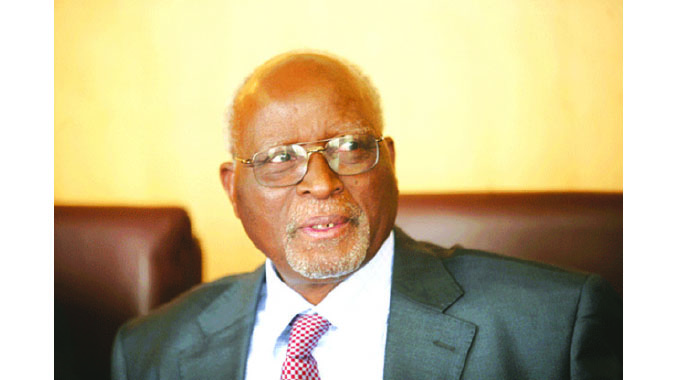
Walter Muchinguri-Senior Researcher & Writer Zimpapers Knowledge Centre
ON January 17, 2013 the nation lost an icon who always preached peace and was known as a peacemaker, veteran nationalist and Vice President Dr John Landa Nkomo.
Cde Nkomo passed on in the early hours of Thursday January 17, 2013 at St Anne’s Hospital in Harare following a long battle with cancer.
He was 79.
His favourite clarion call was: “Peace begins with me, peace begins with you, peace begins with all of us.”
The late former President Robert Mugabe shed some light into how the title of peacemaker came about while addressing mourners at Dr Nkomo’s Milton Park residence after his death.
“When we formed the inclusive Government he came and asked: ‘What am I supposed to do?’
“I told him that you would be a peacemaker. We want peace in the country and you will help formulate the organ that would bring peace and reconciliation.”
He chaired the Organ of National Healing, Reconciliation and Integration from 2009 up to the time of his death. Commenting of his father’s title as the peacemaker, his son Jabulani told mourners: “I believe that the title of peacemaker suits my father very well because this was a subject that was close to his heart.
“Naturally, the nation would link his gospel of peace with his role as the chairman of the Organ of National Healing, Reconciliation and Integration, but it is important to highlight that away from national business, my father always advocated for peace as well as unity among members of the Nkomo family. He was a man of peace.”
In his address during Cde Nkomo’s burial, his brother and former Water Resources Management and Development Minister in the Government of National Unity Samuel Sipepa Nkomo also revealed another attribute of the late national hero, describing him as a no nonsense man, which earned him the nickname “Bomber”.
“Those who grew up with him did not become fools because he did not tolerate nonsense. That is why his nickname was Bomber,” he said.
Cde John Landa Nkomo was born in the then Gwayi Reserve (present day Tsholotsho) District of Matabeleland North Province on August 22, 1934.
He was the third born and eldest son of Lufele and Macichi (maDube) Nkomo in a family of four girls (Edna, Esther, Jester and Constance) and five boys (Phillip, Samuel, Jacob and Caleb).
Tradition says that Cde Nkomo’s great grandfather, Mbowane, was honoured as the custodian of some of the legendary King Mzilikazi’s children.
Cde Nkomo attended Manqe Primary School where he did his Standard 1 and 2 before proceeding to St Nanian’s Primary School for Standard 3 and 4 and then Solusi Mission School for Standard 5 and 6.
In 1953, he moved to Bulawayo where he did private studies for the Junior Certificate in Education, which he attained in 1955 while working as a stores assistant at a clothing factory.
He trained and qualified as a teacher in Lower Gwelo (Gweru) in 1958 and he joined the African National Congress in the same year.
His experiences while studying for a Certificate in Teacher education helped him to appreciate the inequalities embedded in colonial Southern Rhodesia’s socio-economic milieu.
He also experienced racial segregation and observed how native Africans that fought for the Queen during the Second World War were abused at the end of the war, despite their sacrifices.
Cde John Nkomo also witnessed the merciless eviction of the Nyamandhlovu community from their fertile land by the Rhodesian settler who created a new settlement for them in Tsholotsho that was arid and infested with ‘umkhawuzane’, a highly poisonous shrub to both humans and animals.
The relocation resulted in many people losing their livestock and Cde John Nkomo’s father had to rely on the local San community to manage the situation.
In 1961, Cde John Nkomo married Georgina Ngwenya and they were blessed with six children: Jabulani, Mzamo, Samkeliso, Sikhumbuzo (deceased), Zamile and Thabo (deceased).
The oppressive system pushed him to join organised politics and offer resistance in the form of civic and trade union activism at local, national and international levels early in his working career.
His new found passion made him cut short his teaching career at Tshitatshawa School in Tsholotsho after he clashed with the missionaries. He moved to Nkulumane Government Primary School in Mpopoma, Bulawayo and joined the African Teacher’s Association.
His quest for equality and civil justice saw him becoming one of the founder members and first secretary of the radical Bulawayo Residents Association (BURA) in 1963 and was also actively involved in the Clothing and Garments Workers’ Union.
This signalled his rise up the political ladder to the high echelons of the liberation movement. Cde John Nkomo was not one to seek easy solutions or self-aggrandisement but was committed to the liberation struggle and through personal sacrifice, he became one of the leading torch-bearers in the fight for independence from Britain.
His determination to achieve this goal saw him being detained and restricted at various prisons such as the notorious Gonakudzingwa Detention Camp, where he studied for his Ordinary and Advanced Levels of the General Certificate of Education.
In 1958, Cde Nkomo and others established the Southern Rhodesia African National Congress and after it was banned the following year, he remained active in the youth wings of its successor parties, the National Democratic Party, which pre-dated the Zimbabwe African People’s Union, and the People’s Caretaker Council.
In 1965, he was involved in an altercation with the Native Commissioner for Tsholotsho and was incarcerated at Khami Prison for two weeks. The following year, he spent a month in various prisons due to his political activism before he was sent to Gonakudzingwa where he spent two and a half years.
In 1971, Cde John Nkomo, joined the African National Council and was initially appointed Secretary for Education before rising to the post of Deputy Secretary General in 1973.Three years later he was involved in the formation of the Patriotic Front, which incorporated ZAPU and the Zimbabwe African National Union and their military wings the Zimbabwe People’s Revolutionary Army and the Zimbabwe African National Liberation Army, respectively.
Full article www.herald.co.zw
He became a member of Zapu’s central committee and that of the Zimbabwe People’s Revolutionary Council.
From 1975 up to 1980 Cde John Nkomo served as ZAPU’s Secretary for Administration at the party’s headquarters in Lusaka, Zambia.
He maintained this role after independence until 1985.
At the height of the liberation struggle, Cde John Nkomo, survived a blast from a parcel bomb that claimed the life of ZAPU’s second vice president Cde Jason Ziyaphapha Moyo. He sustained injuries that affected his health for the rest of his life.
Diplomatically, Cde John Nkomo was part of the Patriotic Front delegation led by Dr Joshua Mqabuko Nkomo that attended the Geneva and Malta Conferences in 1976 and 1977, respectively.
He and his contemporaries championed and articulated the intricacies of the country’s liberation war at various fora such as the United Nations Committee of Twenty Four, the UN’s De-colonisation Sub-Committee, the Organisation of African Unity, the Non-Aligned Movement and the Frontline States.
This helped him during his career to master the art of diplomacy that he then deployed skilfully to resolve political stand-offs.
In 1980, he was elected Member of Parliament and served Government in various Ministerial portfolios. From 1981 to 1982 he was the Deputy Minister of Industry and Energy before he moved to the Prime Minister’s Office as Minister of State between 1982 to 1984.
Cde Nkomo was part of the PF-ZAPU delegation that was appointed by Dr Nkomo to attend the unity talks with ZANU (PF).
He exhibited his unique contribution to nation-building and national unity by being the voice of reason during the negotiations, which was instrumental in the two parties agreeing to unite resulting the December 22, 1987 Unity Accord and the birth of ZANU-PF.
Between 1988 and 1999 Cde John Nkomo, served the party as a Central Committee and Politburo member before he landed the national chairman’s post, which he served for five years before he was re-elected for another five-year-term at the Fourth National People’s Congress in December 2004.
As chairman, he transformed the party into an effective machinery that was able to defend the country’s hard-won independence and sovereignty during the third Chimurenga.
He also instilled a sense of discipline in the conduct of the party’s affairs as provided for in Article 10 of the Party’s Constitution.
In 1988 he was appointed Labour, Manpower, Planning and Social Welfare Minister during which he worked hard to foster tripartite relations between the Government, employers and employees.
One of his biggest successes was the setting up of the country’s National Social Security Scheme under the auspices of the National Social Security Authority.
At the same time, he also spearheaded the formation of the Zimbabwe War Veterans Association and the Zimbabwe Political Ex-Detainees and Restrictees Association.
In 1993, he was elected to the presidency of the 80th Session of the International Labour Conference (ILC), which served as the tripartite international parliament on labour issues involving member states of the International Labour Organisation.
In 1994, Cde Nkomo was elected chairman of the ILO’s executive organ, the governing body that makes decisions on ILO policy, deciding on the ILC agenda, adopting the draft work programme and budget for submission to the ILC as well as electing the director general of the ILO.
As chairman, he presided over the committees on Freedom of Association, Finance and Administration, Legal Issues and International Labour Standards, Employment and Social Policy, Sectorial and Technical meetings and related issues.
Other committees included Technical Co-operation, Working Party of Social Dimensions of Globalisation and the Sub-Committee on Multi-national Enterprises.
He was also involved in the preparations for the World Social Summit, which was held in Copenhagen, Denmark in 1995.
In 1995 Cde John Nkomo was appointed Minister of Local Government, Rural and Urban Development and continued to lead the Ministry after it was restructured to Local Government and National Housing until 1999.
During his tenure, he was influential in the introduction of both the Rural District and Urban Council’s Acts.
The acts entailed the widening of democratic space through the decentralisation of local governance structures, including the introduction of executive mayorships across the country to manage urban centres, which marked a new and effective approach to local governance.
The innovative reform process brought people closer to their local governance leadership as they were now responsible for their election thus, eliminating this alienation and mystification of local governance structures reminiscent of the old colonial order.
Cde John Nkomo spearheaded the enactment of the Traditional Leader’s Act, which resulted in the active participation of chiefs and other traditional leaders in civic matters.
From 2000 to 2002 Cde John Nkomo was the Minister of Home Affairs and thereafter he moved to Office of the President and Cabinet, as Minister of Special Affairs from 2002 to 2005 during which time he was responsible for lands, land reform and resettlement from 2003 to 2005.
In 2005 Cde John Nkomo was elected Speaker of Parliament, a post he held until 2008. After the March 2008 harmonised elections, he was appointed non-constituency Senator in August 2008 and in February 2009, he was appointed Minister of State in the Office of the President and Cabinet responsible for the Organ of National Healing, Reconciliation and Integration.
Following the death of Vice President Dr Joseph Wilfred Msika in August 2009, Cde John Nkomo was elected to Second Secretary and Vice President of ZANU-PF at the party’s Fifth National People’s Congress and was subsequently sworn in as the country’s Vice President in December 2009.
Cde John Nkomo, continued chairing the Organ of National Healing, Reconciliation and Integration. He also chaired the Development Trust of Zimbabwe that was founded by the late Vice President Dr Joshua Nkomo as a vehicle for economically empowering the majority of Zimbabweans.
He also chaired the Zimbabwe Health Care Trust, which was established to oversee the operations of Ekusileni Medical Centre (EMC) in Bulawayo. He was a founder member and patron of the Matabeleland Zambezi Water Trust.
He single-handedly sponsored the construction of the Landa John Nkomo Secondary School in Manqe, Tsholotsho as part of his efforts to empower rural children.
The school opened in July 2012. Speaking during the official opening of the school, the late former President Mugabe, applauded Cde Nkomo for establishing the school, the first of its kind in the remote district of Tsholotsho.
Cde Mugabe said Cde Nkomo’s desire to establish a state-of-the-art rural secondary school was inspired by the goals of the liberation struggle and a desire to uplift the livelihoods of the people.
In 2007 Solusi University awarded Cde Nkomo an honorary doctorate degree in Business Administration and Development in recognition of his sterling commitment and contribution to the country’s development.
After his death, Cde Mugabe described Cde John Nkomo as a real revolutionary, fighter for freedom, a friend of the people and lover of children who would be sorely missed by the nation.
At the time of his death he was survived by his mother Macichi maDube, several children and grandchildren.
Sources:
• A Guide to the Heroes Acre: Some basic facts about Zimbabwe’s heroes acre. (2019) Ministry of Information, Publicity and Broadcasting Services.
• The Herald archival content


 Online Reporter