Online Reporter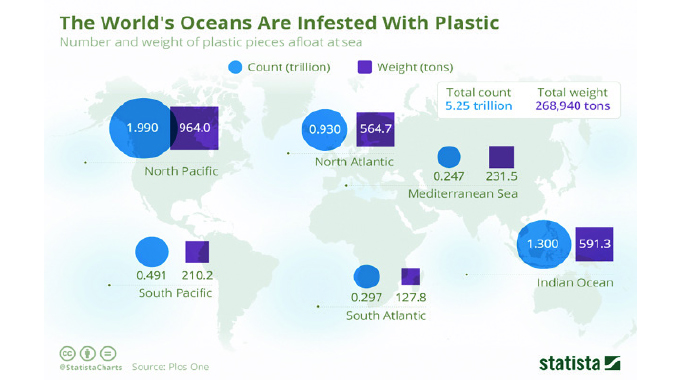
Stewart Lawrence
In recent years, heart-rending images of dead or dying sea mammals and fish, their stomachs stuffed with plastic, have shocked citizens around the globe.
Reports indicate that the amount of plastic dumped into the world’s oceans has tripled over the past decade alone.
And unlike oil spills, which can be remedied with extensive and costly clean-up efforts, there is no obvious solution to plastic “spills”.
Typically, the plastic is discarded on shore and then slowly makes its way into rivers and streams that feed the world’s largest bodies of water. Plastic is not biodegradable and because so much of it is translucent, it’s not easy to detect.
Even sea creatures often cannot distinguish plastic from their favorite prey. In the end, tens of thousands of aquatic creatures – maybe more – die every year from consuming plastics of various kinds.
It’s not hard to figure out why plastics have come to pose such a threat. First, modern industry is relying increasingly on plastics in consumer products like liquid containers, dishes, cups, straws and utensils.
Other products formerly made of wood, glass or metal are being substituted with plastic. Plastic bags and plastic packaging are ubiquitous. Even many construction and other heavy-duty products – including piping, roofing, insulation and basic building blocks – have increasingly shifted to plastic.
Ironically, some of this transition stems from a desire to reduce reliance on paper products and to preserve trees.
Moreover, plastic packaging prevents food contamination and can improve food safety. However, by switching to plastic, a new and dangerous environmental threat has emerged.
A look at the numbers is frightening. Roughly half of all plastics production – half! – has occurred since the new millennium. Moreover, during the past ten years about 60 percent of all the plastics produced either went to landfill or have been dumped in the natural environment.
One source notes: “At current rates there will be more plastic than fish in the ocean by 2050 by weight, much of it in the form of small particles, ingestible by wildlife and very difficult to remove.”
The rapidly rising volume of plastics might not be such a huge problem if there were effective waste management.
The average person in the US and Western Europe consumes five times the amount of plastic as the average person in Asia. However, waste management systems in Asia are practically non-existent. The biggest culprit is China, followed by Indonesia, Vietnam, Philippines, and Sri Lanka. In fact, China, at 1.3-3.5 million metric tonnes, dwarfs the next five countries combined.
How pervasive is the plastics threat? An estimated 60 percent of all sea birds and 100 percent of all sea turtles have ingested plastic. While some fish species are more affected than others, a 2021 study found that 386 of the 555 species studied – about two-thirds – had ingested plastic.
Plastic disrupts sea animal digestive systems and high levels of consumption can cause choking, suffocation and death. Fish can also lose mobility and begin to starve, thinking they have consumed food sources that are actually plastic. Predators that consume those fish also become contaminated; over time, the entire ocean food chain is affected.
Chemicals from plastic can also degrade the quality of coral reefs where 25 percent of aquatic species live, and which help sustain the delicate balance of the seas. The presence of plastic increases the likelihood of coral disease from a low of 4 percent to a whopping 89 percent, according to one recent study.
It is not just the quality of sea life that is affected. Recent research indicates that human consumers that buy and eat fish are also likely contaminated by smaller plastic microbes that are toxic.
For example, one study estimates that 25 percent of the fish sold in markets in California contain microplastics.
In an article published in Scientific Reports, the scholars concluded, “The widespread distribution of micro-plastics in aquatic bodies has subsequently contaminated a diverse range of aquatic biota, including those sold for human consumption such as shellfish and mussels. Therefore, seafood products could be a major route of human exposure to microplastics.”
The Environmental Protection Agency periodically releases advisories to warn consumers when fish get contaminated with chemicals in local US waters.
However, a growing share of US seafood – as much as 85 percent, depending on the region – now comes from foreign waters, which the EPA does not monitor. In fact, only a small fraction of imported fish is tested for contaminants.
And fish may not be the only source of human contamination. The most recent studies have found microplastics and nanoplastics, which are even smaller, in fruits and vegetables, water bottles, cosmetics and household dust.
As a result, American consumers may be far more vulnerable to plastic contamination – and a wide range of plastic-related health risks, including cardiovascular disease – than they realise.
To be sure, the current science on human exposure to toxins in consumed microplastics is still in its infancy. To date, most of the concern about consumed seafood has focused on toxic chemicals like mercury, where the risk is unusually high for specific fish species (and pregnant women and children).
However, an estimated 210 of the 383 fish species that are known to ingest plastic – about 55 percent – are consumed commercially, which means the microplastic health risk exposure to humans could be far more widespread.
While alarmism based on the current evidence is unwarranted, the need for more advanced research on plastic chemical contamination of humans from fish and other foods is indeed urgent.
Finally, it’s worth mentioning the visual blight caused by plastic waste, especially on some of the world’s most premier beach locations.
One of the most notorious waste-scarred areas is Kamilo Point off the Big Island of Hawaii. The North coast of Oahu is another badly blighted area. Because these areas are highly concentrated, the negative visual impact is augmented, but also localised.
Within Hawaii, these plastic waste beach dumps are hard to ignore and are beginning to affect tourism.
A study by the National Oceanic and Atmospheric Administration found that doubling the amount of marine debris on beaches in tourism-dependent communities in Orange County, California had resulted in a loss of $414 million tourism dollars spent, and a decrease of nearly 4 300 jobs. What can be done? Experts have outlined four areas of potential intervention – some at the source, in production, others, in plastic waste management, which may be more feasible politically, though less effective. They include:
Switch from plastics to bioplastics. Only 4 percent of plastic is made from corn and other vegetables that are biodegradable. In theory, this percentage should be much higher.
However, bioplastics have been shown to release a high level of methane, a greenhouse gas 23 times more powerful than carbon dioxide — which means increased reliance on bioplastics may worsen the climate change problem. In addition, the land required to grow bioplastics cuts into food production, and could contribute to the global food crisis. Despite these real and potential risks, sustainable bioplastics alternatives do exist – the automotive industry is already applying them to upholstery, carpeting, vehicle hoods and other exterior components, for example – and they should be pursued further.
Reduce the manufacture and use of some kinds of plastic. Above all, “single-use” plastic – plastic that cannot be recycled and typically ends up in landfill and the oceans – should be eliminated.
Some 60 countries have introduced bans or imposed fees on single-use production. In the US, there are piecemeal bans by states and cities on plastic bags and drinking straws.
Ideally, all states and the nation as a whole – would impose an outright ban on single-use plastic. A more comprehensive ban on plastic may not be feasible for a host of reasons. However, environmental groups like Greenpeace, are calling for a strong treaty that will cut plastic production by at least 75 percent by 2040.
Stewart Lawrence is a long-time Washington, DC-based policy consultant. He can be reached at [email protected].