Chronicle Editor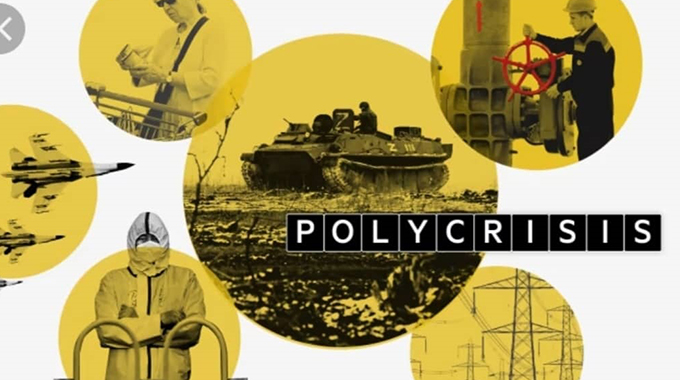
Simbarashe Murima, Correspondent
The world appears cleaved by a string of interwoven and conjunctural crises caused by political, environmental, social, economic, as well as technological problems that have led to a global polycrisis.
I recently read about Athos Salomé, a Brazilian parapsychologist, also known as the ‘Living Nostradamus’, who through his visions and prophecies, is famous for being accurate in foreseeing events that we have so far witnessed such as the coronavirus pandemic, Elon Musk’s Twitter (now X) purchase, Queen Elizabeth’s passing and others.
He predicted a potential war between China and the United States, stating that ‘two significant events’ could lead to ‘escalations’. Now I ponder; if this comes true, it will be unsettling to understand where the world is headed.
The threats of polycrisis are a growing complex crisis and an exclusive phenomenon of contemporary modernity which describes the multifaceted web of problems the world is facing now.

What is Polycrisis
In Greek prefixes, poly means ‘several ’ or ‘many’, thus suggesting multiplicity.
A crisis is described as an unexpected event or string of difficult situations.
According to online sources, the term “polycrisis” originated in the 1970s, but it cropped up during the discussion at the World Economic Forum’s Annual Meeting that took place in Davos, in 2023.
Fascinatingly, polycrisis was made popular by Adam Tooze, a historian, who used it to explain the convergence of multiple crises, and how these crises interconnect and aggravate one another to create an intensified effect.
In this context, polycrisis defines or characterises the sudden occurrence of several devastating events or crises such as pandemics, the Ukraine-Russia war, threats of World War III, climate change, geopolitical confrontations, cyclones, drought, poverty, etc that coincide and become more severe than the other.
In my view, polycrisis is an occurrence of multiple crises that arise and lead to the creation of another huge crisis that further distresses humankind.
Polycrisis phenomenon in present-day society
Interestingly, polycrisis seems to have a research gap value for scholars/researchers, policymakers, and the public in general. Still, it is important to note that contemporary crises are not new, but the world continues knotted in a lot of these detrimental interlocking crises.
Polycrisis also known as meta-crisis or permacrisis in some academic circles is swollen by major changes and developments in the global ‘organic’ crisis (political and economic), social, and environmental risks landscape.
Similarly, this also includes the growing pressure on the rise of anti-immigrant politics, militarisation, rising inflation, and climate change impacts.
These crises have created an intersolidarity of challenges and converged to shape a unique, undefined, and impatient era.
To improve comprehension of polycrisis, I will illustrate using an example of the Israel-Hamas and the Ukraine-Russia wars which augmented another dimension to swelling geopolitical conflicts that have dethroned the hopes that global war will be non-existent, that great power war is superseded, and that the use of nuclear armaments is unthinkable.
This state of war has squeezed the humanitarian needs, the energy and cost of living crisis, human displacement, and agricultural production which increased food prices globally.
The conflict worsened the need for food in most African countries severely affecting the poorest and most marginalised populations.
Another classic specimen of polycrisis are the effects of climate change which have driven the hunger crisis and food prices to soar in Africa due to temperature variations and weather patterns that have led to devastating floods, wildfires, drought, and famine in many areas on the continent.
Furthermore, the ceaseless violence in Khartoum, Kordofan, and Darfur exacerbate the Sudan humanitarian crisis, particularly among women and girls
This, however, is another distinct polycrisis outcome with accelerated risks of gender-based violence, child marriages, and women trafficking leading to increased HIV/Aids infections, the amplified cycle of poverty, and gender discrimination that reinforces inequality.
The thrust of this article was to implant a deeper understanding of the polycrisis neologism concept to engender novel awareness about the present crisis linkage predicaments the world is facing.
Crises connect and intensify one another and climate change, refugee catastrophe, and the imminent war conflict traumata will surely afflict the likelihood of humanity today.
*Simbarashe Murima (PhDc) writes in his capacity as an education, tourism and hospitality expert in Namibia, Zimbabwe, and South Africa.



 Online Reporter