

 Online Reporter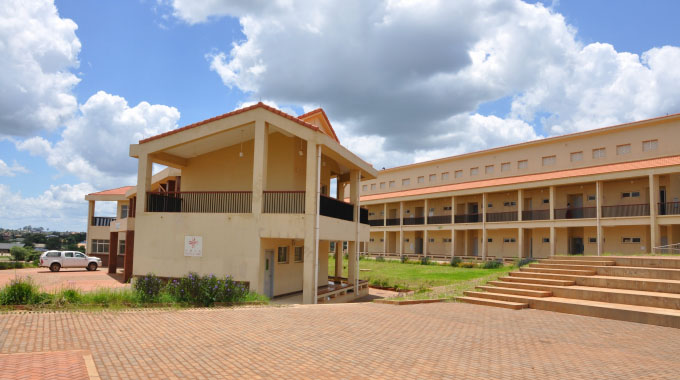
Tichaona Zindoga
Sixteen-year-old Munashe Shiri (not his real name), a resident of Hatcliffe in the capital Harare, is looking into the future with brightness and hope.
This year, he completed his Ordinary Level and at this crucial point in his fledgling career, he sees new possibilities that could shape him and his community.
Munashe wants to pursue further education in China when he completes secondary education in two years’ time and pursue a career in science. Not only that, he also feels that in China, he can turn his passion and hobby — martial arts — into something greater.
The young man is enrolled at the Zimbabwe-China Friendship High School, an institution built by the Government of China at a cost of US$2 million in 2017 and has an enrolment of over 900 drawn from the high-density neighbourhood in northern Harare.
Similarly, another Chinese funded school in Bindura, Mashonaland Central Province, has opened horizons for learners not just with conventional education, including emphasis on science, technology, engineering and maths, but also exposure to cultural exchange programmes.
Education stands as a key area of cooperation, with even greater prospects as Zimbabwe and China implement their next economic blueprints, the National Development Strategy 2 (NDS2) and China’s 15th Five Year Plan.
Over the years, China and Zimbabwe have built a comprehensive educational partnership characterised by robust exchanges, scholarship programmes, and inter-university collaboration. China has also contributed to the construction and upgrading of primary and secondary schools, university facilities, and the provision of high-tech equipment in Zimbabwe.
In 2025, Chinese Ambassador to Zimbabwe, Mr Zhou Ding, spearheaded efforts by China to improve cooperation in the sector. Perhaps more importantly, he outlined the theoretical base and journey in education that China has taken in terms of its own modernisation path.
This offers solid lessons for Zimbabwe.
During a conference in July 2025, Ambassador Zhou took stakeholders through the journey to become the world’s largest education system.
He explained that when the People’s Republic of China was founded in 1949, eight out of 10 people could not read or write. The gross enrolment rate in higher education was only 0,26 percent.
“This severe educational deficit created a fundamental constraint on our national progress,” he explained. “China existed as an impoverished agrarian society, devoid of the essential industrial foundations needed for economic survival.”
Fast forward to today: China has built the world’s largest education system.
The higher education gross enrolment rate reached 60,2 percent. More than 250 million people have university degrees. The completion rate of nine-year compulsory education was nearly 96 percent. China has been the world’s largest manufacturing country in terms of output for 15 consecutive years, ranking first globally in the production of over 220 industrial products.
China’s “new trio” — new energy vehicles, lithium batteries, photovoltaic products — are leading global markets.
How did this occur in just 76 years?
According to Ambassador Zhou, three fundamental principles have proven decisive — principles that may hold particular significance for Zimbabwe’s own development journey. First, China had a solid foundation of a strategic vision espoused by the governing Communist Party of China (CPC), whose continued leadership has ensured strategic continuity and pragmatic governance.
Since the 1950s, education and industry development have been at the centre of all its five-year plans and this policy continuity has allowed us to adapt to changing national needs, maintain focus on long-term objectives, and achieve cumulative progress across generations.
China has also made what Ambassador Zhou called “uncompromising” investment in human capital, which has seen China allocate over four percent of gross domestic product to the public education fund over 10 years, with unwavering commitment to equitable and quality education.
The results have been remarkable: today, China has managed to ensure that all its 2 895 county-level regions are covered by quality compulsory education in a balanced way.
China’s National College Entrance Examination also known as the Gaokao, a highly competitive programme, serves as a vital pathway — selecting talent, enabling social mobility, and upholding fairness for over 100 million students.
China’s education system integrates education, science and technology, and talent as the foundational support for modernisation. It prioritises self-reliance and self-strengthening, focusing on cultivating high-quality, homegrown talent, and accelerating breakthroughs in core technologies.
Today, China is the world’s second-largest investor in research and development. It is home to the world’s largest pool of research personnel, and holds over four million valid invention patents. Its technological advancement is measured not just by scale, but by its positive impact on people’s lives.
High-speed railway, e-commerce, mobile payment, and shared economy — called “new Four Great Inventions” — have changed how 1,4 billion Chinese live.
Simultaneously, youth innovation thrives, with scientific talent growing visibly younger. Over 70 percent of our scientific workforce is now under 39. The team behind DeepSeek, a high-performance, open-source AI model developed by Chinese innovators, is 75 percent from the post-90s generation.
The core team of the BeiDou Navigation Satellite System (BDS) averages 36 years old.
Meanwhile, China attaches great importance to Industry-Academia-Research Integration. Ideas in a lab become products on a shelf.
For instance, Shenzhen-based DJI, a global drone leader, established joint university labs for core research and development and partnered with vocational colleges to launch specialised programmes like
“Drone Application Technology”, cultivating skilled personnel.
Now they command 70 percent of the global consumer drone market.
At the same time, China’s industrial strategy evolved pragmatically: from prioritising heavy industry in the 1950s-70s, to focusing on export-oriented labour-intensive manufacturing in the 1980s-2000s, and now decisively shifting towards innovation-driven high-quality development.
This phased approach, supported by targeted policies, has enabled China to develop strategic sectors, master core technologies, and move to high-value manufacturing.
Education, shaping the future of young people, is the solid foundation that China has made to support these successes.
Further, China has made sure that education is accessible and relevant and life-long to all.
In a speech at the National Education Conference in September 2018, President Xi Jinping said: “We should make education available to every individual throughout their life . . . guarantee equal access to education, trying to make good education to everyone regardless of gender, region, and ethnicity, and whether they are rich or poor or from an urban or rural area.”
Best globally
In 2012, an article on the BBC website posed whether China was the world’s “cleverest country”, highlighting results from the Programme for International Student Assessment, which measure pupils’ skills in reading, numeracy and science.
The findings from the programme, now an international benchmark, indicated that “China has an education system that is overtaking many Western countries”.
As indeed it has. Various indicators such as the PISA performance, the huge pool of STEM workforce and world-class universities, have shown China as the leading education nation.
In November 2025, Mark Levine, a university professor, wrote a powerful article on why he thought China has the best education system globally, and how it has just managed to have more top-ranking universities. This is tied to the country’s overall economic success.
Wrote Levine: “China’s emphasis on STEM education has become a powerful catalyst for real-world progress, moving beyond theoretical instruction to generate tangible improvements that benefit people’s lives.
“From high-speed rail systems that connect the country within hours, to electric vehicles leading global markets, and AI technologies transforming fields such as healthcare and agriculture, these achievements all stem from China’s sustained commitment to building a robust STEM education ecosystem aimed at elevating living standards.”
China has become a successful nation on the basis of solid policies. There is a need for greater collaboration, with countries like Zimbabwe taking vital lessons to ensure success of their modernisation programmes.
As part of its educational openness, China has established educational co-operation and exchange relations with about 190 countries, and forged agreements with 58 countries on mutual recognition of qualifications and academic degrees in higher education.
Students from 53 African countries are studying in China. More than half are studying STEM subjects, agriculture and medicine.
China and Zimbabwe have forged a holistic educational partnership: constructing primary and secondary schools, establishing university facilities, awarding government scholarships, and fostering university-to-university partnerships.
Beyond academia, in the past two decades, China’s capacity-building initiatives have equipped over 6 000 Zimbabwean officials and professionals with advanced management and technical skills.
Zimbabwe has overhauled its education system beginning with basic education under the Education 5.0 framework. It will need to take lessons from China and partner the Asian giant for a holistic and strategic co-operation.


 Bongani Ndlovu