Online Reporter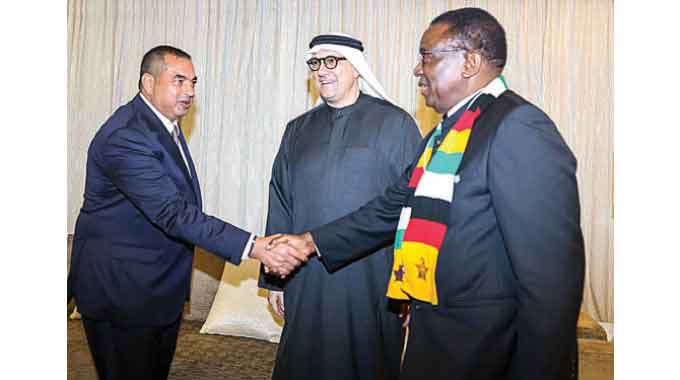
Nduduzo Tshuma in DUBAI, United Arab Emirates
A GLOBAL renewable energy giant has expressed interest in investing in Zimbabwe’s electricity sector, a move that could reduce the country’s power costs, improve industrial competitiveness and lower the cost of doing business.
The country’s rising economic activity has widened the power supply gap, making such investments critical to sustaining growth.
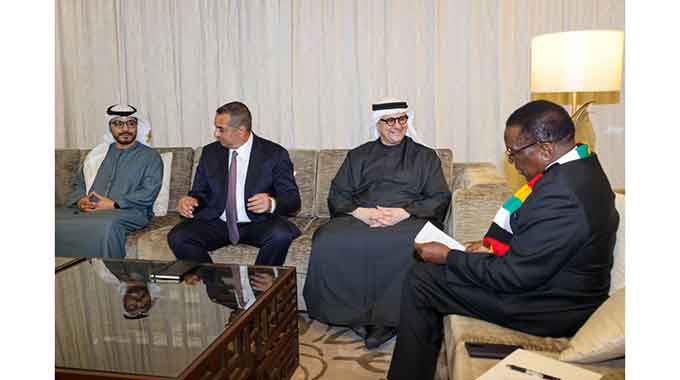
President Mnangagwa yesterday met a delegation from Masdar Abu Dhabi Renewable Energy Company, led by chief executive officer Mr Mohamed Jameel Al Ramahi, on the sidelines of the ongoing World Governments Summit, signalling growing international confidence in the country’s “open for business” thrust under the Second Republic.
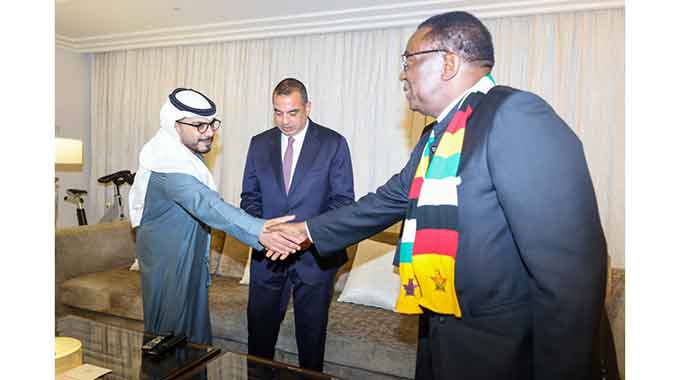
On the sidelines of the Summit, President Mnangagwa, who is in Dubai intensifying efforts to attract foreign direct investment, has lined up a series of high-level engagements aimed at unlocking new investment flows into Zimbabwe.
A conglomerate of the UAE’s three energy champions — Mubadala, ADNOC and TAQA — Masdar has developed projects in more than 40 countries across six continents, with a combined capacity of over 65GW.
The energy giant also expressed willingness to support the upgrading of Zimbabwe’s transmission infrastructure, which plays a strategic role in the Southern African Power Pool (SAPP), headquartered in Harare.
Speaking after the engagement, Finance, Economic Development and Investment Promotion Minister Professor Mthuli Ncube said Masdar had visited the President to formally convey its desire to invest in large-scale renewable energy projects, particularly solar power.
He said the company’s interest was anchored on Zimbabwe’s vast solar potential and the Government’s policy framework supporting independent power producers.
“They specialise mainly in solar power investments, so they are keen to come to Zimbabwe and take a look at the opportunities that are available. We will be inviting them officially to come over, look around and see how they can invest in this sector,” said Prof Ncube.
He said Masdar was particularly interested in deploying integrated solar and battery storage systems, a technology that ensures continuous power supply even during periods without sunshine.
“They say they will be able to give us cheaper power than what we are currently consuming. The average tariff for us is about 16US cents per kilowatt hour, and they claim that they can do better than that,” he said.
Prof Ncube added that Government would extend the full suite of investment incentives to support such projects, including bankable power purchase agreements, Government guarantees and access to foreign currency.
He said the Masdar engagement was a tangible outcome of Zimbabwe’s participation at the World Governments Summit. “This is one of the outcomes of being here at the World Governments Summit, meeting investors and showcasing that Zimbabwe is open for business and rich with opportunities,” said Prof Ncube.
“Zimbabwe is growing, and that growth is creating a power supply gap. We need that gap to be closed. We talk about Hwange Units 7 and 8, and now we need Hwange 9 and 10 in the coal sector, which should then be complemented and eventually supplanted by renewable energy investments such as what Masdar is proposing.”
Prof Ncube said increased power generation was central to job creation, industrial growth and the attainment of Vision 2030. “More power means more growth and more jobs. That is what is really needed as an enabler for sustainable economic growth, as we move towards our Vision 2030 of becoming an upper-middle-income economy,” he said.
Mr Al Ramahi described the meeting with President Mnangagwa as encouraging. He said President Mnangagwa had emphasised the importance of investment in Zimbabwe and the Government’s commitment to supporting large-scale renewable energy projects.
“It is an honour to meet the President here in Dubai during the World Governments Summit hosted by the United Arab Emirates,” said Mr Al Ramahi. “Masdar is a global leader in renewable energy, and through our platform, Infinity Power, we are one of the major players in renewable energy across Africa. His Excellency welcomed us and explained the importance of investing in your great country, Zimbabwe,” said Mr Al Ramahi.
“Masdar and its subsidiary, Infinity Power, are working closely with the Government of Zimbabwe to invest in large-scale renewable energy in the country, with the support of the Government and under the leadership of the President and his Government.”
Mr Al Ramahi said Masdar was keen to deploy capital swiftly, positioning Zimbabwe as both a beneficiary and a regional hub for clean energy.
“We look forward to visiting Zimbabwe soon and deploying capital to decarbonise the system and provide sustainable, competitive renewable energy into Zimbabwe, and of course, using Zimbabwe as a hub for the region as well,” he said.
While acknowledging that the partnership was at an early stage, Mr Al Ramahi expressed strong confidence in its potential.
“We are at the beginning of a journey, but we strongly believe in Zimbabwe, and we are keen to deploy as much capital as possible into the country.”