

 Online Reporter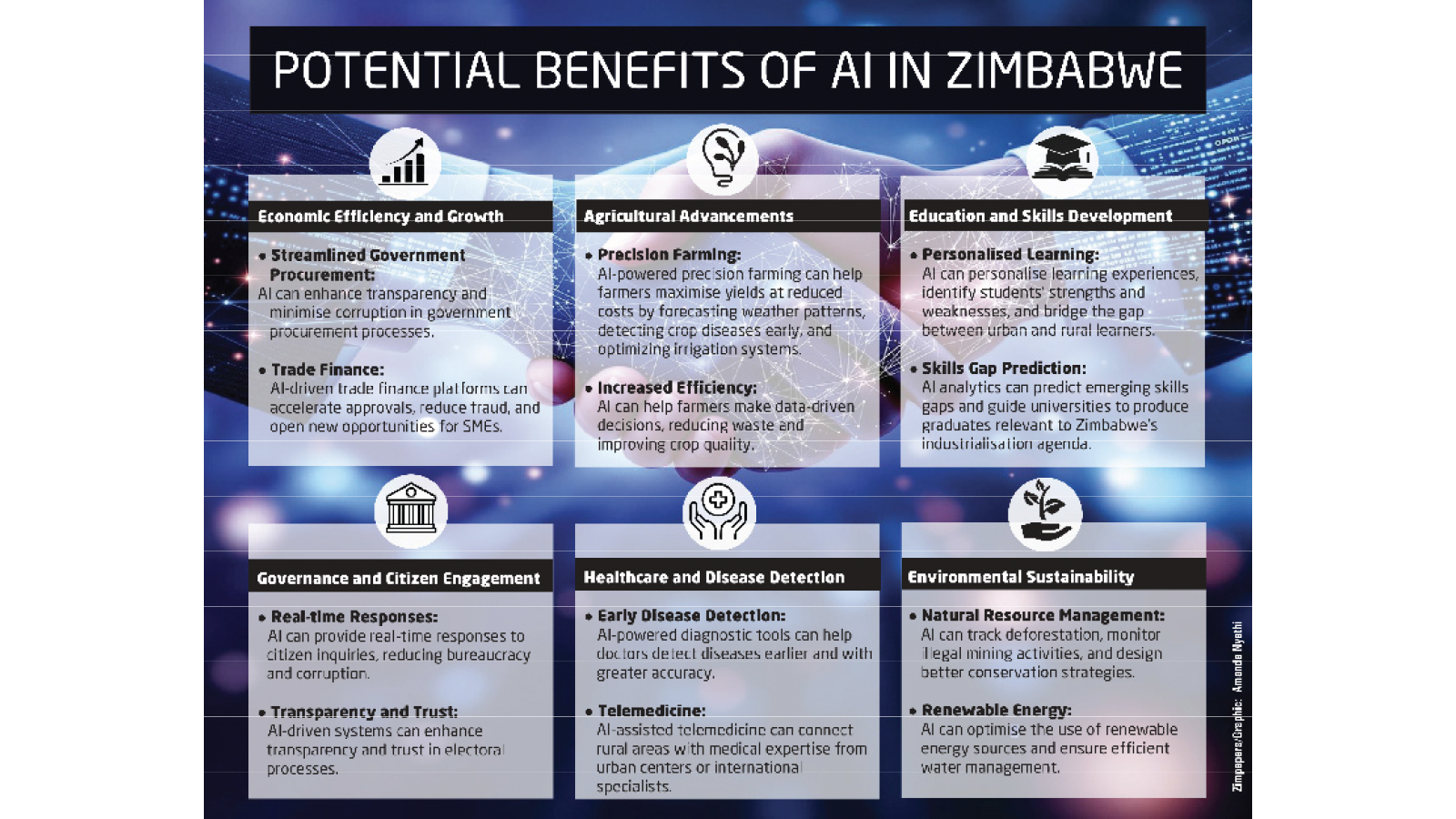
Jimmy Murwira
Artificial Intelligence is no longer just a buzzword; it has become the defining technology of the 21st century, reshaping economies, redefining governance, and rewriting the rules of global competition.
For Zimbabwe, embracing AI is not a matter of choice, but a strategic necessity. In an era where digital transformation is powering economic acceleration, the integration of AI into government systems and national development strategies could position Zimbabwe as a leader in Africa’s technological renaissance.
The Second Republic, under President Mnangagwa, has consistently advanced the mantra of “leaving no one and no place behind.”
This philosophy, coupled with Vision 2030 and the drive towards an upper middle-income economy provides the perfect framework to adopt AI in ways that are both inclusive and transformative.
AI has the potential to boost efficiency in governance, expand opportunities in trade and finance, improve service delivery in education and health, strengthen political decision-making, and even contribute to environmental sustainability.
One of the most immediate benefits of AI in Zimbabwe’s economy lies in improving efficiency.
AI-powered systems can streamline Government procurement processes, enhance transparency and minimise corruption, a challenge that has historically slowed progress.
Already, Zimbabwe has introduced the Electronic Government Procurement (e-GP) system, and layering AI onto this platform could allow for predictive analytics, risk detection and real-time monitoring of contracts.
In the financial sector, AI-driven trade finance platforms can accelerate approvals, reduce fraud and open new opportunities for small and medium enterprises (SMEs).
By automating loan assessments and credit scoring, banks could extend credit to previously underserved entrepreneurs, thereby boosting industrialisation and job creation.
Zimbabwe’s agricultural sector, which is central to its economy, can also benefit immensely. AI can be used to forecast weather patterns, detect crop diseases early, and optimise irrigation systems.
Precision farming, powered by drones and AI analytics, would allow farmers to maximise yields at reduced costs. This aligns with the Second Republic’s agricultural recovery programmes, which have already increased national food security.
Ultimately, AI could play a central role in achieving the ambitious US$12 billion mining industry goal and expanding Zimbabwe’s participation in regional and global trade.
No society can harness AI without an educated population capable of innovating and adapting. Zimbabwe has long prided itself on high literacy levels, and the next frontier is integrating digital literacy and AI training into the education system. By embedding AI in classrooms through smart learning platforms, AI tutors, and digital labs, the Government can ensure that students are not only consumers of technology but creators of it.
AI-powered tools can also personalise learning experiences, identifying students’ strengths and weaknesses in real time. This could reduce dropout rates, improve pass rates, and ensure that no student is left behind, particularly in rural communities.
Zimbabwe’s new community digital centres provide a ready platform for AI-enabled education, bridging the gap between urban and rural learners.
Furthermore, AI can assist the Ministry of Higher and Tertiary Education in aligning curricula with industry needs. With labour markets evolving rapidly, AI analytics can predict emerging skills gaps and guide universities to produce graduates relevant to Zimbabwe’s industrialisation agenda.
AI offers unique tools for strengthening governance and political leadership. Predictive analytics can help policymakers anticipate social and economic challenges before they escalate. For instance, AI can analyse data on inflation trends, population movements, or climate shocks, enabling government to design proactive policies.
In electoral processes, AI-driven systems can enhance transparency and trust by improving voter registration, securing election databases, and detecting irregularities. By adopting AI responsibly, Zimbabwe can build stronger democratic institutions while reinforcing the Second Republic’s reputation for modern, data-driven governance.
Moreover, AI can strengthen citizen engagement. Chatbots powered by AI can provide real-time responses to citizen inquiries on public services, reducing bureaucracy and cutting down on corruption. This would help close the gap between government and citizens, reinforcing the inclusivity principle of the Second Republic.
Zimbabwe’s health sector stands to gain significantly from AI integration. AI-powered diagnostic tools can help doctors detect diseases earlier and with greater accuracy.
In rural areas where specialist doctors are scarce, AI-assisted telemedicine can connect villagers with medical expertise from urban centres or even international specialists. Public health surveillance is another area where AI can be transformative. By analysing large datasets, AI can detect disease outbreaks early, enabling faster response and preventing loss of life. This is particularly crucial in combating malaria, cholera, or even potential future pandemics.
On a broader social scale, AI can also be used to design smarter cities in Zimbabwe. By improving traffic management, energy use, and waste management, AI can make urban areas more liveable, efficient, and environmentally friendly.
Zimbabwe’s rich biodiversity and natural resources are both an opportunity and a responsibility. AI can play a critical role in managing these assets sustainably. For example, satellite-based AI systems can track deforestation in real time, monitor illegal mining activities, and help design better conservation strategies.
In the energy sector, AI can optimise the use of renewable energy sources such as solar, ensuring maximum output at the lowest cost. This would not only support Zimbabwe’s climate commitments but also help alleviate the country’s energy shortages.
AI-enabled water management systems can ensure more efficient use of scarce water resources, particularly in agriculture and urban supply networks. By integrating AI into environmental management, Zimbabwe can secure both food security and long-term ecological sustainability.
AI aligns seamlessly with the Second Republic’s commitment to modernisation, inclusivity, and economic transformation. The mantra “leaving no one and no place behind” resonates with the ability of AI to bridge inequalities by expanding access to services in remote communities, reducing costs of healthcare and education, and creating new jobs in the digital economy.
Vision 2030 seeks to elevate Zimbabwe to an upper middle-income economy. This vision requires bold investments in technology, and AI provides the foundation for productivity growth across all key sectors such as agriculture, mining, manufacturing, services, and governance.
By adopting AI strategically, Zimbabwe can leapfrog traditional development barriers and fast-track economic competitiveness. The Second Republic has already shown determination in embracing innovation, from e-procurement to smart agriculture. The next step is to mainstream AI into national development planning, backed by strong policy frameworks, ethical guidelines, and targeted investments in infrastructure and skills training.
The Fourth Industrial Revolution is upon us, and AI is at its core. For Zimbabwe, embracing AI is not just about catching up with global trends but it is about shaping a future that is inclusive, efficient, and prosperous.
From the economy to education, politics, social development, and the environment, AI offers solutions that align directly with the Second Republic’s vision for transformation.



