


 Sundaymail Editor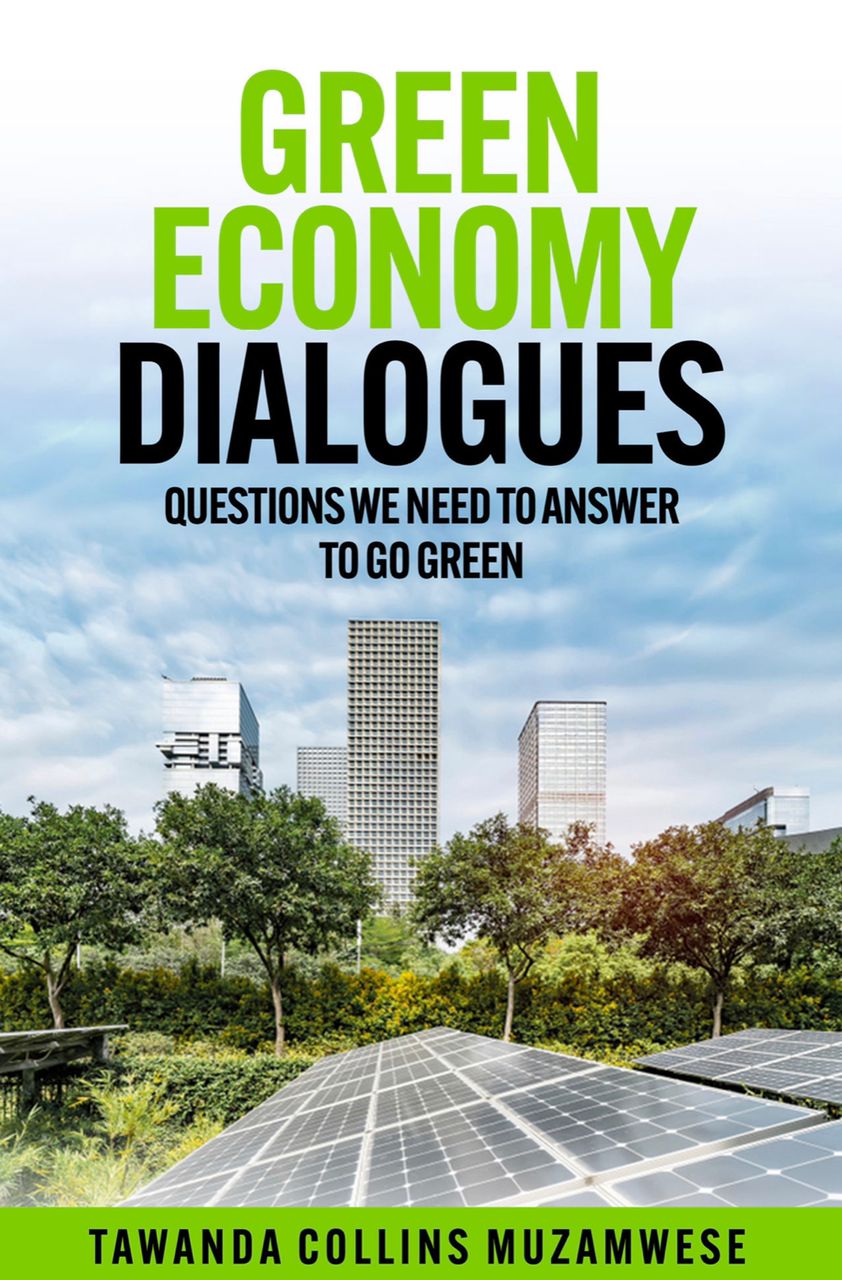
Book Review
Edmore Zvinonzwa
AS the world inches closer to the 27th United Nations Climate Change Conference (COP 27) in Sharm El Sheikh, Egypt, environment, health and energy expert Tawanda Collins Muzamwese has released a kindle edition of “Green Economy Dialogues: Questions We Need To Answer To Go Green”.
The conference will be held between November 6 and 18 this year.
Exclusively available on Amazon for now, the book is a collection of 30 expert articles aimed at enlightening readers on the importance of greening our economies to mitigate the impact of climate change. Using real life examples, the book is practical in approach and relevant to the modern-day stakeholder yearning for a green economy and this includes individuals, corporates and other organisations.
The author, who is also an international sustainability consultant, says of the collection: “The book is made up of 30 questions which must be answered on the path to a green economy. Each chapter is a question. It’s for us to develop a green strategy, technology, policy, regulation and standardisation.”
The issues need to be addressed at policy level first so that every effort henceforth becomes legit. As the impact of climate change becomes more and more visible, Zimbabwe, like other countries, has experienced more droughts and devastating tropical cyclones, including Cyclone Idai in 2019. Cyclone Idai led to the death of many people across Zimbabwe, Mozambique and Malawi.
The articles in the book address different concerns, which are aimed at making the world a better place for everyone by ensuring we play our part, no matter how small, in mitigating the impact of climate change.
Industry and business, for instance, can adopt policies that are environmentally friendly such as the use of renewable energy, including solar power.
It is well-known that highly industrialised economies contribute the most to greenhouse gas emissions. However, developing economies such as Zimbabwe – which are desperately waiting for climate financing – should play their part towards making their environments safer for future generations.
It is hoped that the country and, of course, the rest of Africa and the world at large, will be in a position to provide sustainable transport, waste recycling, the transition to clean energy, sustainable cities and adaptation measures in the water and agriculture sectors, among other things.
Muzamwese has other titles under his belt and these include “Leading Consultant: How to Become an Authority in Your Professional Field”, “Step-by-Step Guide to Implementing Safety, Health, Environment and Quality Management Systems”, “Stepping on Higher Perspectives: Greatness Tips Motivational Series”, “Sustainability Guidebook for Boards and CEOs: Leading From the Front” and “How to Develop a Side-Hustle into a Viable Business: Overcome Salary Dependency”.
Currently, he is working on another title, “How to Manage Your Boss”, which will be out soon.
In producing “Green Economy Dialogues: Questions We Need To Answer To Go Green”, Muzamwese, who currently runs Toxiconsol, a firm that offers consultancy in sustainable business development, has remained within the field of sustainability.
He has previously served as executive director of the Business Council for Sustainable Development Zimbabwe and also lectured at the University of Zimbabwe and the Zimbabwe Institute of Management.
Muzamwese started off at Chitakatira School in rural Mutare, Zimunya communal lands, then moved to David Livingstone Junior School in Harare. Later, he spent six years at St Augustine’s Mission in Penhalonga.
He then proceeded to the University of Zimbabwe, where he obtained a BSc in Applied Environmental Science degree.
After that, he enrolled with the University of Twente in The Netherlands for a Master’s of Environment and Energy Management degree. He is currently a PhD student with the same institution.
Muzamwese is an international consultant in sustainable business development with massive experience in training, consulting and auditing.
He is the editor-in-chief of the “Green Business Gazette”.



 Bongani Ndlovu
 Online Reporter