Online Reporter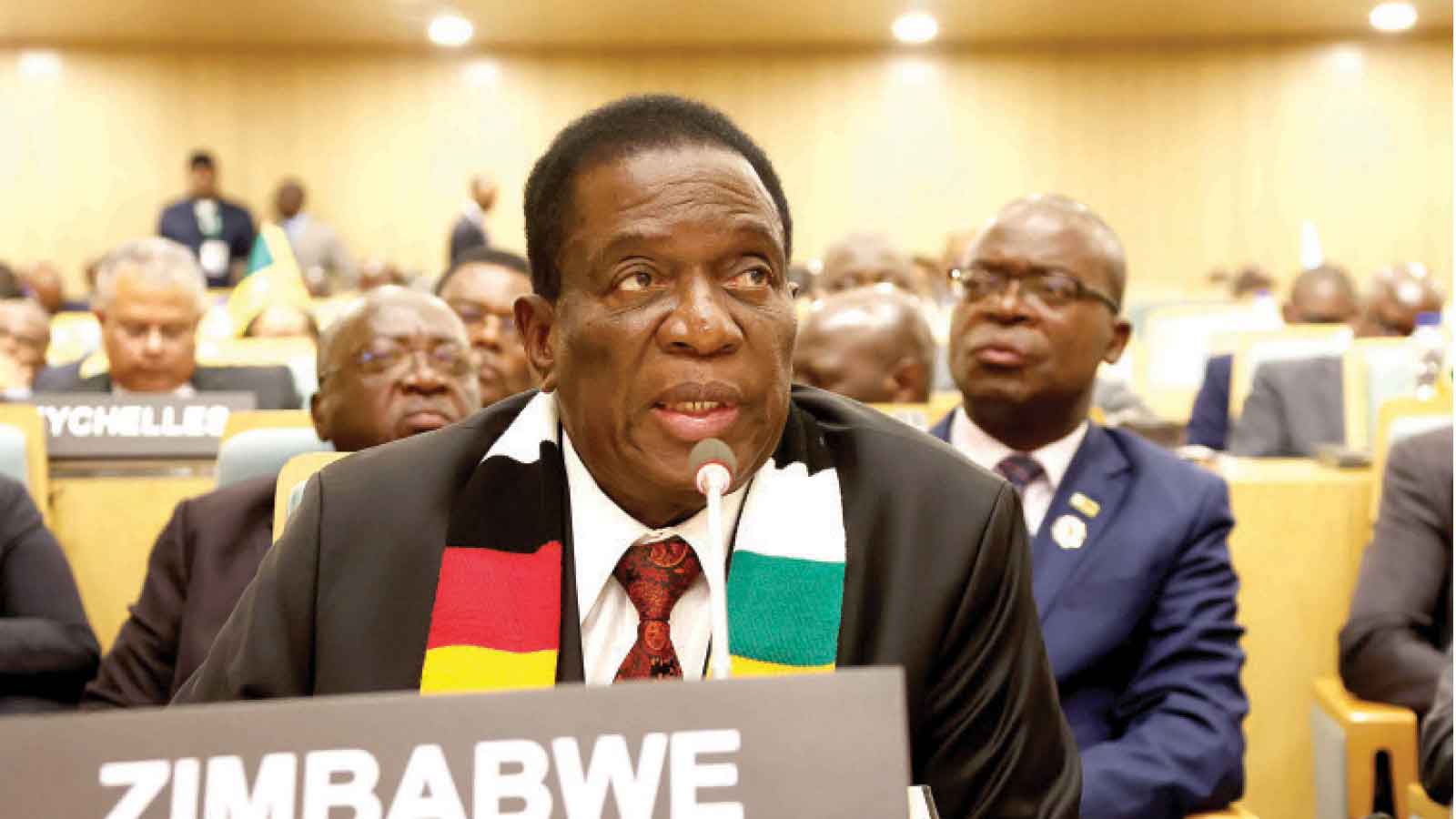
Kudakwashe Mugari in ADDIS ABABA, Ethiopia
PRESIDENT Mnangagwa has applauded the Southern African Development Community and other African countries for their solidarity and relentless calls for the unconditional removal of illegal sanctions imposed on Zimbabwe by Western nations.
The support, he said, strengthened the country’s resolve to stay the course on reforms and development.
Addressing fellow Heads of State and Government at the African Union African Peer Review Mechanism (APRM) session held on the sidelines of the ongoing African union Summit here, the President said Zimbabwe deeply appreciated the solidarity.
He said sanctions dented strides made towards economic reforms, negatively affecting ordinary citizens in the process. “Excellencies, it is regrettable that for over two decades, Zimbabwe’s economic performance has been constrained by harsh unilateral, coercive measures imposed by some Western countries following the Land Reform Programme, which we do not regret,” he said.
“These measures have undermined policy effectiveness, restricted access to investment, technology and international credit markets, and negatively affected ordinary citizens of our country.
“Zimbabwe deeply appreciates the solidarity shown by Sadc and African Union member States in calling for the unconditional removal of these unilateral sanctions.”
Through the “Nyika inovakwa nevene vayo/Ilizwe lakhiwa ngabanikazi balo” development philosophy, and “Zimbabwe is open for business” mantra, President Mnangagwa said the country had been able to push through major infrastructure projects despite the sanctions.
“The drive is to modernise, industrialise and grow our economy and accelerate its growth ourselves, the owners of the country,” he said.
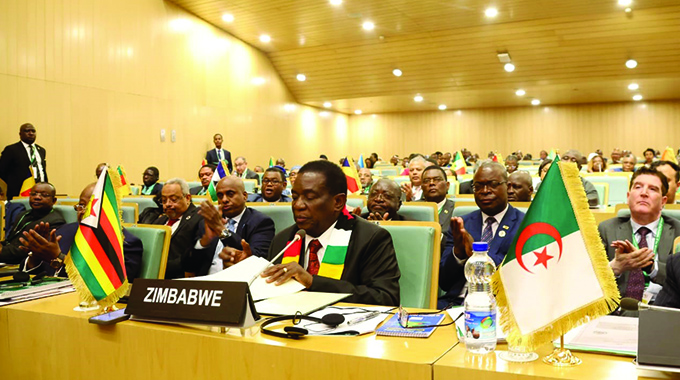
Addressing fellow Heads of State and Government at the African Union African Peer Review Mechanism (APRM) session held on the sidelines of the ongoing African union Summit here, the President said Zimbabwe deeply appreciated the solidarity. – Picture: Presidential Photographer Tawanda Mudimu
President Mnangagwa reaffirmed Zimbabwe’s commitment to embrace and implement recommendations made by the APRM team, which undertook a targeted review on the country’s governance and economic management in November last year.
The targeted review was undertaken by a team led by Chairperson of the APRM Panel of Eminent Persons, Ambassador Aly El-Hefny.
President Mnangagwa said Zimbabwe remains steadfast in abiding by the principles and objectives of the APRM framework, which embodies African solidarity, peer learning and mutual accountability.
He expressed his honour to be part of the APRM, which he said is of significant importance to the Government and the people.
“We take note of the detailed recommendations contained therein,” he said.
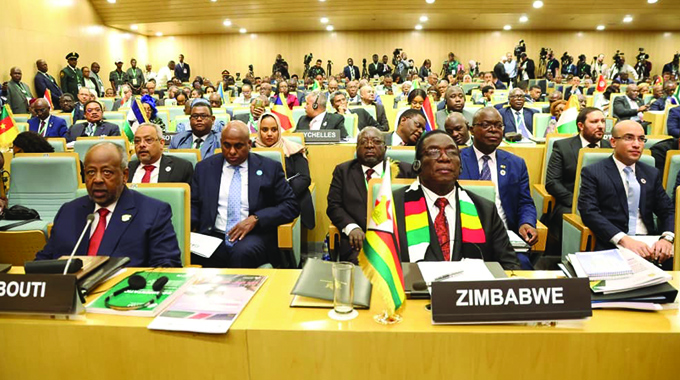
President Mnangagwa said Zimbabwe remains steadfast in abiding by the principles and objectives of the APRM framework, which embodies African solidarity, peer learning and mutual accountability. – Picture: Presidential Photographer Tawanda Mudimu
President Mnangagwa added that the Second Republic has made notable strides in all sectors of the economy since he acceded to the APRM, which is a self-assessment mechanism.
“Since the advent of my administration and Zimbabwe’s subsequent accession to the APRM, notable strides are evident throughout all sectors.
“The multiplicity of reforms we are undertaking are enhancing economic governance, fiscal discipline and public sector accountability.
“This is also in line with Section 13 of the Constitution of the Republic of Zimbabwe,” he said.
President Mnangagwa said Zimbabwe’s current drive is to modernise, industrialise and grow the economy. “Zimbabwe’s vision of a knowledge-driven economy has led to the adoption of a Heritage-Based Education 5.0 model. “This system aligns our education, training and human capital development with our national development agenda, leveraging on local heritage, resources and indigenous knowledge for innovation, as well as rural industrialisation, value addition and digital transformation,” he said.
President Mnangagwa said in the context of the APRM benchmarks and the targeted review, Zimbabwe reaffirms its resolve to strengthen fiscal discipline and macroeconomic stability and enhance transparency in public finance management.
He also reaffirmed Zimbabwe’s drive to promote inclusive growth that leaves no citizen and no place behind, and aligns national policies with continental and global best practices, in line with the Constitution.
Highlighting objectives outlined in the targeted review, regarding design, implementation and coordination of economic policies that promote sustainable development, President Mnangagwa said to date, sectoral strategies under his administration dovetail with national medium and long-term development frameworks towards the attainment of an upper-middle-income society.
He said in the mining sector, comprehensive reforms are strengthened in governance as part of broader efforts to modernise the industry.
Artisanal and small-scale miners have been formalised, resulting in a detailed database of operators as well as their access to finance, training and modern technology, said President Mnangagwa.
“This alignment has further improved safety standards, with mining now among the top contributors to broader-based empowerment, community development, and inclusive socioeconomic transformation.
“Along with the responsible mining initiatives for the large mining firms, we are ensuring sustainable mining practices and requisite environmental stewardship,” he said.
Regarding the APRM targeted review on facilitating participation and ownership of key stakeholders in economic policy formulation, President Mnangagwa said Government has broadened dialogue platforms to encompass stakeholders across the socio-economic spectrum, which has embedded participatory governance at both the national and the sub-national levels.
Additionally, he said, digital platforms and e-government tools are improving access to information, promoting transparency and citizen feedback as they track policy outcomes.
“Such mechanisms have gone a long way to reinforce evidence-based decision-making, unity of purpose, trust and social cohesion.
“Through the Whole-of-Government and the whole-of-society approach, our people-centred national development trajectory is leaving no one and no place behind.
“This thrust dovetails with Chapter 14 of our national Constitution,” he said.
On the objective of promoting sound public financial management, the President said far-reaching reforms by the Government saw the introduction of a robust integrated financial management information system and enhanced public sector audits have been embraced.
Regarding the objective of combating money laundering and illicit financial flows, he said Government has instituted comprehensive measures, including enactment of the private voluntary organisations’ legislation to combat money laundering and terrorist financing.
“Currently, we are compliant with 37 of the 40 Financial Action Task Force recommendations, thereby safeguarding the integrity of the financial system.
“Further, our country now ranks third in sub-Saharan Africa on the Open Budget Survey, which demonstrates our progress in transparency and public finance management,” he said.
On the objective of accelerating and deepening regional economic integration, the President emphasises the importance of partnerships and collaboration.
“My Government continues to constructively engage with regional international partners, including SADC and the African Union, the United Nations System and international financial institutions.
“In line with the Zimbabwe Investment Development Act, ZIDA, my Government has put in place policies aimed at balancing the attraction of foreign direct investment with empowerment of domestic investors and communities, promoting inclusive and sustainable development.
“Internationally agreed standards and course of practices; my country continues to leverage technical assistance, knowledge exchange and best practices from regional and international partners as we are increasing local capacities and skills, capabilities and skills,” he said.
President Mnangagwa indicated that Zimbabwe took note of some identified gaps, which may require further improvement.
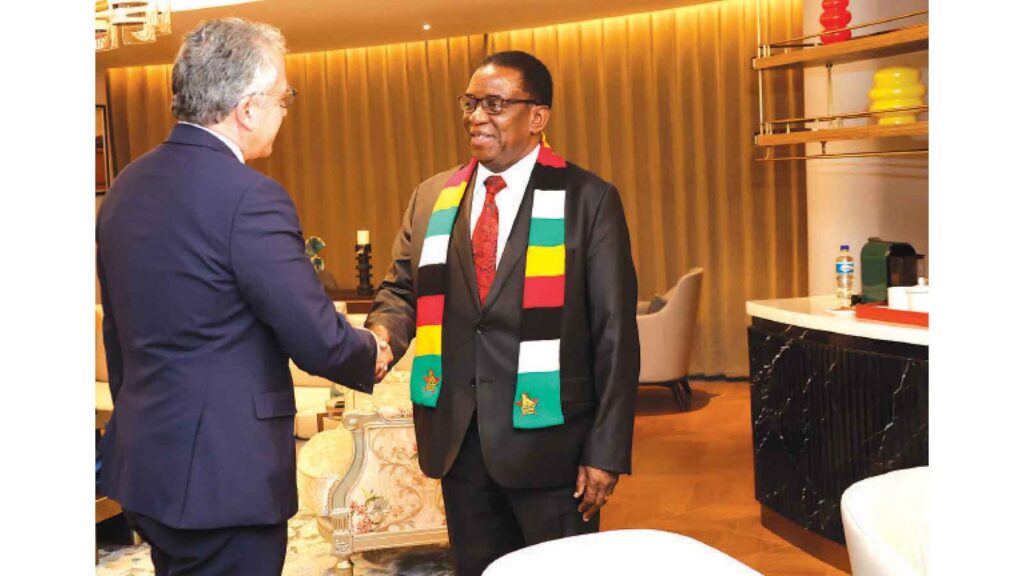 The President meets Unesco director-general Mr Khaled Ali at the AU Headquarters in Addis Ababa, Ethiopia, yesterday. — Picture: Presidential Photographer Tawanda Mudimu.
Zimbabwe is committed to comply with the United Nations and African union standards and the course of practices, whose effective implementation is important to strengthen economic governance and management, he said.
The President said Zimbabwe reaffirms that the APRM embodies African solidarity, peer learning and mutual accountability.
“We are unwavering in our commitment to the principles and objectives of the APRM framework and undertake to implement the recommendations of the review towards advancing transparency, inclusivity and sustainable development for the benefit of all people of Zimbabwe,” he said.
Zimbabwe’s engagement with the APRM began when President Mnangagwa acceded to the voluntary self-monitoring framework of the AU during the 29th Session of the APR Forum of Heads of State and Government in Addis Ababa, in 2020.
Since then, Zimbabwe has demonstrated its commitment to transparency, accountability and sustainable development.
In March 2024, Cabinet approved the establishment of the National Institutional Framework for the Zimbabwe APRM, with a focus on economic governance and management.
In November last year, the country signed a Memorandum of Understanding with the Committee of Heads of State and Government participating in the APRM, paving the way for an assessment mission by the review team.
The MoU was signed by Foreign Affairs and International Trade Minister, Professor Amon Murwira, and APRM Eminent Person and Panel Lead member for Zimbabwe, Ambassador El-Hefny.
After signing the MoU, Prof Murwira handed Ambassador El-Hefny Zimbabwe’s self-assessment report compiled by a technical team from the University of Zimbabwe.
Through the review, the country sought to strengthen institutional frameworks, enhance accountability and align national development strategies with continental and global governance standards.
Zimbabwe was also looking forward to foster transparency, citizen participation and sustainable socio-economic growth.
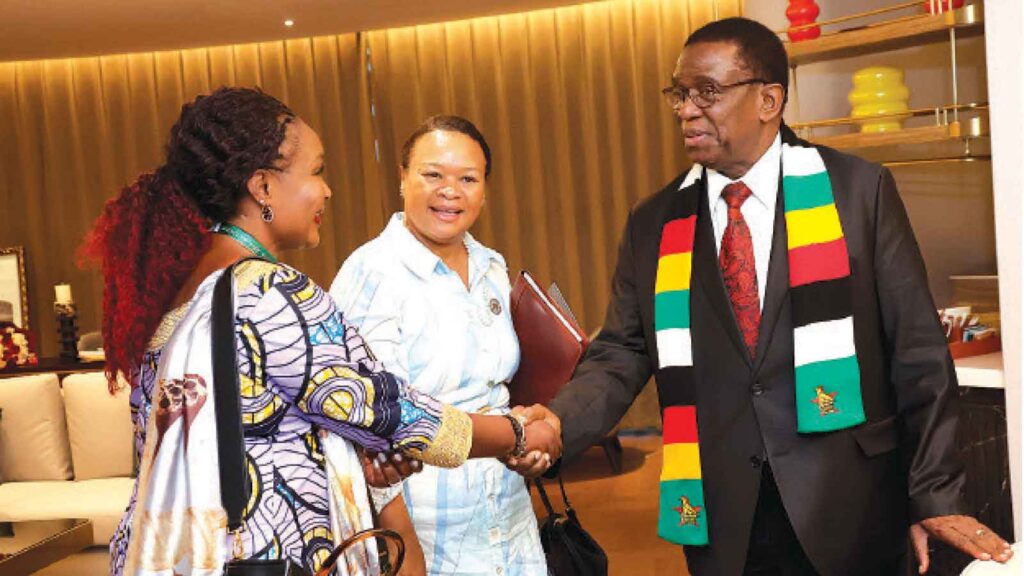
President Mnangagwa welcomes African Peer Review Mechanism Forum CEO, Ambassador Marie-Antoinette Rose-Quatre (centre) and Director of Country Reviews and Assessments Dr Rachel Mukamunana in Addis Ababa yesterday.— Picture: Presidential Photographer Tawanda Mudimu.
Meanwhile, APRM chief executive officer Ambassador Marie-Antoinette Rose Quatre presented the group’s report of their findings to President Mnangagwa after moving around all the country’s 10 provinces gathering information.
“The Government of Zimbabwe approached us to produce report. Zimbabwe, despite sanctions, it is a case study of African solutions to African problems.
“We went to all the 10 provinces of the country, and the report is reflecting the reality of the country. So, once the report is launched by the Government, then it will be made public and we will support the country in any way towards the implementation of the recommendations,” she said.