

 admin
admin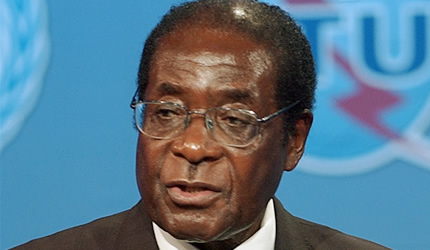
billion to the economy, but the money rarely finds its way into the formal banking system,
a Government commissioned survey has revealed. The scientific survey was conducted with the assistance of the World Bank and its data was validated by
Zimstat.Launching the Finscope Zimbabwe 2012 Small and Medium Enterprises Survey report in Harare yesterday, President Mugabe expressed joy over the growth of the sector, but was disturbed by its failure to bank the money.
“The study revealed that a total of 5,7 million jobs were created within the SMEs ministry and that there are 2,8 million small business owners of 3,5 million small businesses,” said President Mugabe.
“Eight hundred thousand of the small business owners employ 2,9 million people (excluding the business owners themselves). The statistics indicate that the majority (72 percent) of the owners do not employ anyone and only 28 percent (800 000) of the owners employ 2,9 million people.
“Of the estimated 5,7 million jobs, 66 percent are found in the rural areas and 34 percent in urban areas. Such statistics are a clear demonstration that our own people have the power to create their own jobs and wealth. Government should, therefore, provide an enabling environment for such businesses to thrive.”
President Mugabe said he was disturbed that money generated in the informal sector was not being banked. He attributed the development to lack of trust in the banking sector by potential depositors after some unscrupulous financial institutions diverted depositors’ money to their own use.
“I am, however, disturbed by the fact that the report talks of the SME’s contribution of approximately US$7,4 billion to the economy that is not banked,” said President Mugabe.
“Let me urge all SMEs to bank their money before withdrawing it for both business and own use. We should formalise all operations in order to compete with developed economies.
“The banking sector should design products and schemes that attract these SMEs to bank with them.
“It is necessary to mop up liquidity from small businesses which, in turn, is used to increase cash flows. Part of creating the necessary environment to attract these SMEs to bank is to lower bank charges.”
The Head of State and Government and Commander-in-Chief of the Zimbabwe Defence Forces took a swipe at some indigenous banks for squandering depositors’ money and for not providing an enabling environment for the growth of the sector.
“Sometimes no interest is given or sometimes your money is deducted and it loses its quantity and of course its quality,” he said.
“Kwete. We also want banks to realise that when people deposit their money they are lending the bank that money. The bank can use the money as it lends others to create wealth for itself.
“Take and grow the facility. Lend it out so that the country can prosper . . . people even fear to put their money in the banks. Vana vakanyatso funda accounting nemanagement vanorangana kuti toita bank vanhu vouya vachiti vanhu vakafunda voisa mari imomo. Chisingazivikamwe nevadiki ndechekuti kupfuma hakubve kuhope warara . . . aiwa hazvizi zvezuva rimwe chete. Take your time and you will get there.”
President Mugabe said some indigenous bank owners used depositors’ money to buy luxuries, leading to the liquidation of the financial institutions.
The President urged SMEs to formalise their businesses by registering them.
“The report also highlighted that only 15 percent of the SMEs owners have their businesses registered, and 71 percent of these are registered with local authorities and other statutory bodies,” he said.
“Only two percent are registered with the Zimbabwe Revenue Authority. These figures indicate that 85 percent of the SME business are not registered showing the high level of informality — not a very desirable situation.”
President Mugabe said formalisation of operations by SMEs was of paramount importance and must be viewed as part of the SMEs development process.
“It is necessary to come up with packages and incentives meant to encourage the SME players to formalise through registration. This way, they will meaningfully contribute to the fiscus. SMEs registered with the Zimbabwe Revenue Authority for instance, will eventually benefit from public procurement schemes and should develop their businesses,” he said.
President Mugabe urged all line ministries and relevant organisations to prioritise issues to do with SMEs into their strategic planning processes in order to facilitate provision of the necessary infrastructure and support services.
He said the broad recommendations from the survey should set the platform and pave the way in terms of the development of strategic policy interventions for the development and growth of SMEs.


 Online Reporter