

 admin
admin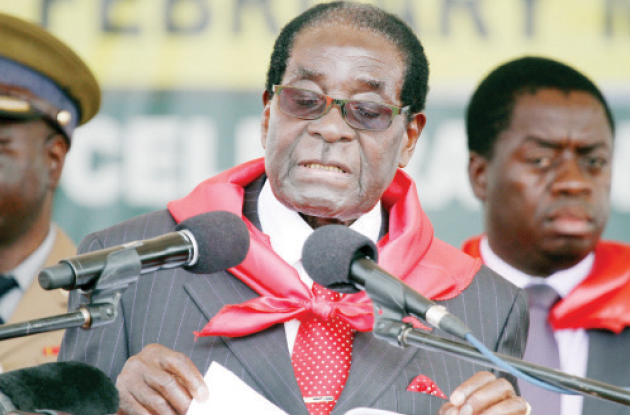
From Nduduzo Tshuma in Japan
PRESIDENT Robert Mugabe yesterday arrived in Sendai, Japan, for the Third United Nations World Conference on Disaster Risk Reduction that kicks off today.
The conference will be held at the Sendai International Centre, about 400km from Japan’s capital Tokyo.
The President was accompanied to the conference by Foreign Affairs Minister Simbarashe Mumbengegwi, Health and Child Care Minister David Parirenyatwa, Local Government Minister Ignatius Chombo and Environment Water and Climate Minister Saviour Kasukuwere.
The conference has proposed nine plenary sessions and five ministerial round tables held in parallel to the plenary sessions.
The topics of the ministerial round tables include Governing Disaster Risk: Overcoming Challenges; International Cooperation in Support of a post-2015 Framework for Disaster Risk Reduction; Reducing Disaster Risk in Urban Settings; Reconstructing after Disasters: Building Back Better and Public Investment Strategies for Disaster Risk Reduction.
The United Nations General Assembly Resolution adopted in 2013 on International Strategy for Disaster Reduction envisions that the World Conference will result in a concise, focused, forward-looking, and action-oriented outcome document while also completing an assessment and review of the implementation of the Hyogo Framework for Action.
On Friday, the conference preparatory committee will meet for its third session and adopt the agenda and other organisational matters, draft the post-2015 framework for disaster risk reduction and political declaration.
According to the draft post-2015 framework for disaster reduction, there has been progress since the adoption of the Hyogo Framework for Action in 2005 in reducing disaster risk at local, national, regional and global levels by countries, leading to a decrease in mortality in the case of some hazards.
However, over the same 10-year frame, the draft says, disasters have continued to exact a heavy toll, and as a result the well-being and safety of communities and countries as a whole have been affected.
The draft says in the period under review, more than 700,000 people lost their lives while over 1.4 million were injured with an estimated 23 million left homeless as a result of the disasters.
Overall, the draft says, more than 1.5 billion people were affected by disasters in various ways.
“Women, children and vulnerable groups were disproportionately affected. The total economic loss was more than $1.3 trillion. In addition, between 2008 and 2012, 144 million people were displaced by disasters.
“Disasters, exacerbated by climate change, are increasing in frequency and intensity, significantly impeding progress towards sustainable development,” reads the draft.
The draft says evidence indicates that exposure of people and assets in all countries has increased faster than vulnerability has decreased, “thus generating new risk and a steady rise in disaster losses with a significant economic, social, health, cultural and environmental impact in the short, medium and long term, especially at the local and community level.”
“All countries, especially developing countries where the mortality and economic losses from disasters are disproportionately higher, are faced with increasing levels of possible hidden costs and challenges to meet financial and other obligations.”



 Online Reporter