admin
admin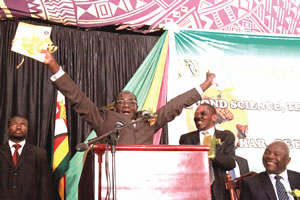
The President said the Second Science, Technology and Innovation Policy was coming at a time when Government was implementing the Medium Term Plan.
“Science and technology, being cross-cutting and pervasive, must, of necessity, harmonise with and complement other policies in areas of energy, industry, health, agriculture and education,” he said.
President Mugabe also noted that biotechnology was opening up new opportunities that should increase food production, stem environmental degradation, fight diseases like malaria, HIV and Aids and tuberculosis.
For the policy to achieve its aims, it has been designed to revolve around achievable and measurable goals, the “smart goals”.
These are capacity development, which focuses on the creation, improvement and mobilisation of human skills in science and technology.
Emerging technologies target biotechnology, ICT and nanotechnology and space sciences emphasise on meteorological applications, land use and aeromagnetic surveillance for mineral exploration.
The policy also seeks to achieve nanotechnology, an emerging technology which revolutionises approach to agriculture, energy production and utilisation, health care and national defence.
Indigenous knowledge systems focus on knowledge of indigenous fruit, animal breeding, herbal medicine and soil cultivation while research is aimed at development.
“As a country, the Second Science and Technology Policy should see Zimbabwe collaborate with other countries regionally and internationally,” said President Mugabe.
“We have signed or are negotiating to sign collaborative agreements with countries that wish to share technology with us. While we are very happy with the linkages that we have with friendly countries round the world, we are aware that some countries are hostile to our interests as manifested in the abrupt cutting of collaborative linkages in the past. I remain hopeful that our continued negotiations with the international community will result in the total removal of illegal sanctions,” the President said.
He thanked the Research Council of Zimbabwe and Unesco for providing some of the funding for the development of the STI Policy.
Prime Minister Morgan Tsvangirai and Deputy Prime Ministers Arthur Mutambara and Thokozani Khupe were part of senior Government officials who attended the launch.
PM Tsvangirai said Zimbabwe has not benefited sufficiently from vast knowledge on science and technology due to unco-ordinated research and innovation efforts.
He said he was enlightened on the essence of technological advancement during his recent trip to China.
DPM Mutambara underscored the need for Zimbabwe to learn and utilise technology to quicken socio-economic development.



 Online Reporter