Online Reporter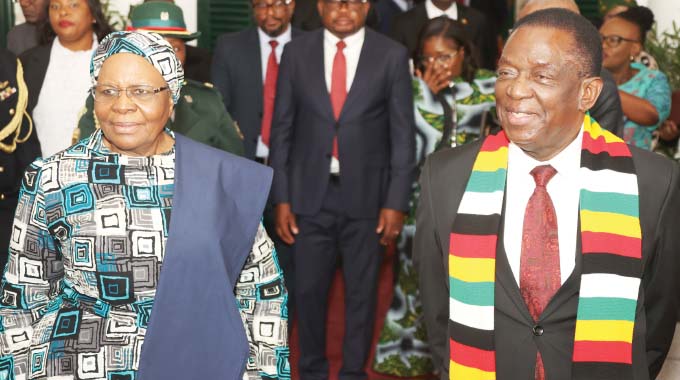
Blessings Chidakwa
SADC Chairperson President Mnangagwa yesterday met visiting Namibian President Netumbo Nandi-Ndaitwah, with shared priorities in regional trade, diplomatic relations and co-operation taking centre stage.
The two Presidents, who met at State House in Harare, emphasised that regional trade would improve livelihoods and create jobs, thereby maintaining peace and stability.
It was a packed day for President Nandi-Ndaitwah, who first met President Mnangagwa during her introductory working visit, before touring the National Heroes Acre and the Liberation City, which houses the Museum of African Liberation.
Speaking after the meeting, President Mnangagwa, who began by congratulating President Nandi-Ndaitwah on her recent election victory, said he was grateful for the visit, which allowed reflection on areas of mutual interest that should be deepened.
“I acknowledge the excellent historical relations that have existed between Zimbabwe and Namibia. These have led to increased bilateral co-operation and high-level business exchanges over the years.
“The Government of Zimbabwe is committed to further strengthening and deepening these relations across all sectors of our economies,” he said. President Mnangagwa welcomed the elevation of the Joint Commission on Co-operation to a Bi-national Commission, which is expected to consolidate collaboration and accelerate the implementation of joint projects and programmes.
“Zimbabwe is keen to join the Trans-Kalahari Corridor. This transport and trade route will harmonise trade between Zimbabwe, Namibia, and the broader Southern African region. I would like to assure you, my dear sister, that we have taken measures to ensure the Walvis Bay Dry Port, generously donated by Namibia, becomes fully operational,” he said.
The Trans-Kalahari Corridor connects Walvis Bay through Namibia and Botswana to South Africa but can easily be extended through existing road networks to include a connection to Zimbabwe.
President Mnangagwa noted that the two countries, and their revolutionary parties Zanu-PF and Swapo, shared a common ideology rooted in the liberation struggle.
The SADC Chairperson expressed his commitment to continued close co-operation and consultation on important shared issues at international forums such as the United Nations.
“The discourse around reforming the Security Council, strengthening multilateralism, and promoting international law remains a priority for Zimbabwe. We thank SADC and the AU for supporting Zimbabwe’s bid for a non-permanent seat on the UN Security Council for the 2027–2028 period,” he said.
President Mnangagwa wished President Nandi-Ndaitwah wisdom, favour, and protection as she leads Namibia towards continued peace and prosperity, assuring her of Zimbabwe’s enduring support and solidarity.
President Nandi-Ndaitwah, accompanied by First Gentleman Lieutenant General (Retired) Epaphras Denga Ndaitwah, said the purpose of her visit was to introduce herself and reaffirm Namibia’s commitment to ongoing co-operation.
“What we are discussing is how best we can facilitate trade between our two countries. The Trans-Kalahari Corridor is critical infrastructure for such trade.
“In developing this corridor, we are calling on business people from Namibia, Zimbabwe, and the region to collaborate and make use of the infrastructure we are developing,” she said.
President Nandi-Ndaitwah said to facilitate regional trade, Namibia had provided all its neighbours with dry ports.
“These dry ports are managed by governments, but meant for the private sector to use for business. The goal is to grow our economies together and create much-needed jobs.
“In doing so, we fight poverty and reduce inequality, maintaining peace and stability in our region and countries,” she said.
President Nandi-Ndaitwah also highlighted the importance of other investments apart from the Trans-Kalahari Corridor.
“Namibia is also investing in the Trans-Caprivi Corridor with our neighbours, as part of our regional trade promotion efforts,” she said.
President Nandi-Ndaitwah said there was a need to operationalise the Bi-National Commission, chaired by the Heads of State and review its framework, as legal instruments have evolved and require auditing.
“In Namibia, one of our main challenges is youth unemployment, currently at 44,4 percent. We believe working together with our neighbours can help address such issues.
“We are focusing on sectors such as agriculture for food security, mining given Namibia’s mineral-based economy and energy, because without energy, industrialisation is not possible,” she said.
President Nandi-Ndaitwah said Namibia had discovered oil and gas, and had placed the sector under the President’s Office for close monitoring.
“It’s a new industry with unique dynamics, so it requires careful oversight. But we believe success lies in working with our neighbours and friends, Zimbabwe being one of them. In mining, we are emphasising value addition,” she said.
President Nandi-Ndaitwah said her task is to implement the SWAPO election manifesto, which won the people’s mandate, and she has integrated it into government policy and the national strategic plan.
Like Zimbabwe, President Nandi-Ndaitwah said Namibia is prioritising infrastructure investment, particularly in transport and logistics, as a testament to its commitment to strengthening trade.
One such priority is rehabilitating the railway line from Walvis Bay to Gobabis, in collaboration with the Government of Botswana, as it is a vital lifeline for the Trans-Kalahari Corridor.