admin
admin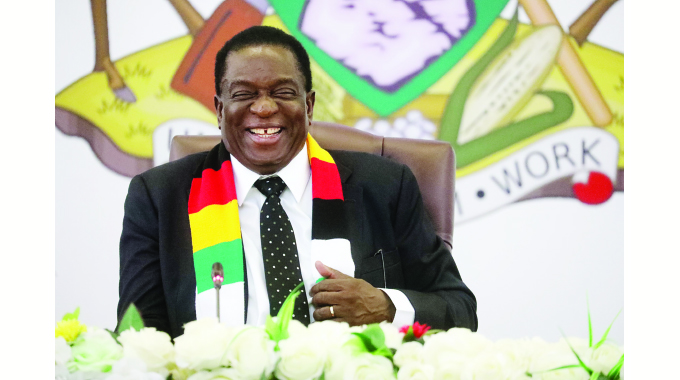
Kudzanai Sharara, recently in Malabo, Equatorial Guinea
President Mnangagwa is a man with a great sense of humour, and according to research it’s a quality that great leaders have as it benefits them and their teams.
A research done in 2016 by Michael Muthukrishna titled Humour at Work — Do leaders enjoy using humour as part of their leadership style? notes that humour shapes culture and positively impacts morale, productivity and group cohesiveness.
Humour can be used to defuse tension and leaders who naturally use humour show that they are human and signal that they have high emotional intelligence.
Leaders also use humour to enjoy their work more and when they use humour in their leadership skills, it builds deeper relationships, increase their personal likeability and improves their job satisfaction.
Humour also minimises status differences and can defuse certain tensions, which also helps everyone enjoy their work.
President Mnangagwa’s ability to use humour as a leadership skill was in full display during his recent State visit to Equatorial Guinea.
Soon after touring the Punta Europa (Oil Facilities), which generates electricity to power the entire city of Malabo, President Mnangagwa and his delegation went for lunch and when the hosts offered some alcoholic drinks at the bar, the President joked and said, unfortunately “my ministers are weak”, when it comes to such drinks and the whole room burst into laughter.
Accompanying him were Finance and Economic Development Minister Mthuli Ncube and Foreign Affairs and International Trade Minister Frederick Shava.
Leaders use humour as part of their leadership skills to humanise themselves in the eyes of others.
After visiting the Roman Catholic Church (Basilica) in the city of Mongomo, which he described as “beautiful”, President Mnangagwa jokingly said “but none of my delegation are good Christians. But I know occasionally they go to church”.
This got the whole room into stitches.
Laughter, according to Naomi Bagdonas, a management lecturer at Stanford’s Graduate School of Business, accelerates feelings of trust, closeness and comfort.
As reported by CNBC, Bagdonas said in a TED talk: “We can do serious things without taking ourselves too seriously. And in fact, often we can do them better and more fashionably.”
Commenting about being given the key to the City of Mongomo, President Mnangagwa said pressure was now on Finance Minister Mthuli Ncube to build a house in the City.
“I have my Minister of Finance, so we were saying that you can’t be given a key and go away for good, Ministry of Finance must find a way of building a house here, because the municipality gave me a free stand, free water, free electricity.”
Humour can be seen as a window into a group’s norms, values, freedom of expression and what people deem acceptable.
President Mnangagwa also spoke about opportunities for Zimbabwe and Equatorial Guinea to benefit from cooperation and collaboration in various areas, including wildlife management. “We have so many wild animals, we don’t know who to give, there are so many and my dear brother if you want elephants, buffalos, giraffes, they are there.”
Speaking at the farewell meeting between the two leaders in the City of Djibloho, before heading home, President Mnangagwa said Zimbabwe had a huge appetite to grow agriculture products in the west African country.
He jokingly said he had to caution his delegation for showing keen interest in working with Equatorial Guinea to grow its agriculture sector.
“I warned them not to be colonialists. They have very huge appetite to grow agriculture products in this country. I said be careful, my brother might think you want to be colonialists,” joked President Mnangagwa.
The study by Muthukrishna says a leader that uses humour in their leadership skills shows that they have things under control enough to prioritise humour and happiness.
When President Mbasogo thanked Zimbabwe for foiling the coup d’état plotted by Simon Mann and his contingent of mercenaries in Equatorial Guinea, President Mnangagwa jokingly said what made him confess the whole plot was the threat to feed him to the crocodiles at farms in Kariba.
He said they told Mann that: “In Zimbabwe we have several crocodile farms, so we will take you ten at a day, putting you into crocodile farms. Crocodiles will eat you and there is no stress. Everyday there would be ten of you.
“Initially he resisted, so we put a programme, which we showed him that from tomorrow we shall begin with you, and put you into a crocodile farm where we have hundreds and hundreds of crocodiles, if we put you there, if you look side to side, by the time you look back there is nobody. He then explained everything.”



 Online Reporter