admin
admin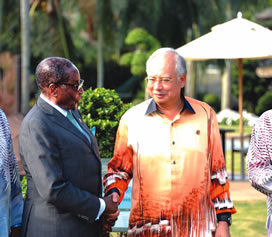
was a tremendous success which should inspire Zimbabwe and other developing countries to draw valuable lessons from Malaysia’s miraculous economic transformation programme.
Speaking to Zimbabwean journalists after meeting LID pioneer and former Malaysian Prime Minister, Dr Mahathir Mohamad, at the end of the summit, President Mugabe said the issues that had been chosen for discussion were relevant and well covered by the participating leaders and their partners from the private sector.
He said the Malaysian experience had demonstrated the importance of promoting Smart Partnerships between governments and the private sector to expedite economic transformation in countries involved in the dialogue process.
“When we come here, we are not only coming to assemble but we will be coming also to study the experience of Malaysia looking at how they got where they are, how they partnered themselves and which groups came together. We will also be learning how the government here partnered the private sector as business, with labour, the academia and yourselves, the media also coming in to promote it.
RELATED STORIES
“It is that whole concept of partnership which we must always allow to play a role in our development to enable us to transform. When all is said and done, we also need a political environment which can sustain the transformation process.”
Asked whether the 9th edition of LID had fulfiled his expectations, President Mugabe said although the quality of presentations was generally very good, he would have wanted more interaction between leaders and other partners who included captains of industry and commerce, youths, labour representatives and academics.
“One would have really wanted greater interaction. There wasn’t much interaction between the ordinary groups and the Heads of State as we normally do. We used to share tables and discuss issues as groups with the results from each group being reported back. The format differed slightly this time where we had more of conferencing than dialoguing.
“I would prefer dialoguing to conferences because we have conferences all the time. We would have loved to do dialoguing with the ordinary people,” said Cde Mugabe, who is the Head of State and Government and Commander-in-Chief of the Zimbabwe Defence Forces.
Asked which specific sectors he thought should be the centre of focus going forward, President Mugabe said areas such as manufacturing, agriculture and mining remained key, particularly in Zimbabwe’s case, adding the information communication technology sector was becoming increasingly important in the development process.
“We didn’t get to visit Cyberjaya (Malaysia’s ICT development hub). Perhaps you managed to visit it to see for yourself, the development there and also to benefit from the experience. ICTs are playing a bigger role in promoting development policies but we should be able to discern policies which are inimical to the country. They can’t be promoted through ICTs so we should watch out for that,” said President Mugabe.
Dr Mohamad, who met President Mugabe at his offices situated at the apex of one of the famous Petronas Twin Towers in central Kuala Lumpur, agreed with President Mugabe that LID 2011 had been a success overall despite the slight change in the dialogue format.
“The format may have been a little different this year but the objective remained the same; to promote closer economic co-operation between the participating Smart Partners. LID has been a success because we have managed to bring in so many people to discuss ideas. Trade has also increased but not to the level we would have wanted because some countries are facing internal problems and they have been able to focus much on external trade.
As we look into the future, there is a lot of scope to work together and I have suggested that we should have intensive exchanges of ideas,” Dr Mohamad told the Zimbabwean journalists.
He urged Zimbabwe to take up an offer for some of its technocrats in the civil service to get training in Malaysia on implementing development policies saying: “They should come to look at what we have done because getting briefings or listening to presentations at conferences is not sufficient.”
In a parting shot, President Mugabe wished Dr Mohamad a speedy recovery from a bout of pneumonia that had seen his health deteriorating.
After the end of the dialogue, President Mugabe met senior Zimbabwean Government officials, businesspeople, and heads of parastatals at the conference venue where he implored them to put what they had learnt from the Malaysian experience into practice.
He said Dr Mahathir had previously told him that the Malaysians themselves had learnt a lot from the highly industrialised Japanese economy especially in the automotive industry, a process that had led to the country moving from merely assembling cars to manufacturing its own model, the Proton.
Time had come for business and political leaders to stop treating LID as a talk shop and begin implementing some of its recommendations: “Takavambaka (We started this dialogue) in 1995 and we are just going around in circles. We say Malaysia has done this, Malaysia has done that but experience yacho, where possible, should become our experience also. The Malaysians themselves had Japan to look at, they had
Singapore to look at because they were ahead of them and they just wanted to be also like Japan and Singapore.
“You can see what they have done in regard to their infrastructure, what they have also done in regard to social services and the resultant yield that comes from the transformation of their economy,” said President Mugabe.
Among the business figures who attended the meeting were Confederation of Zimbabwe Industries president Mr Joseph Kanyekanye, Grain Marketing Board chief executive Mr Albert Mandizha and NetOne chief executive Mr Reward Kangai while Deputy Prime Minister Arthur Mutambara, Cabinet Ministers Simbarashe Mumbengegwi, Sithembiso Nyoni, Professor Heneri Dzinotyiwei and Deputy Minister Samuel Undenge were among the senior Government officials who attended.
Veteran trade unionist Mr Isdore Zindoga was also in attendance while Professor Christopher Chetsanga represented the academia.
Speaking just before the conference ended DPM Mutambara also stressed the importance of the ICT sector saying Zimbabwe would soon send a technical team to Malaysia to learn global best practices in information and communication technology (ICT).
He said the technical team would stay in the country for a month to understand the ICT business model and the impact on economic growth.
“We want them to return and document the plan to implement ICT to foster economic growth. We are now learning how to use science and technology to leap-frog Zimbabwe into the information and knowledge economy, particularly in agriculture, mining and manufacturing,” said Mutambara.
Meanwhile, Malaysian Prime Minister Mr Najib Razak says his country is ready to help African countries undertake economic transformation is willing to send one of its top economic strategists Mr Idris Jala, who is the Minister in the Prime Minister’s Office and the Chief Executive Officer of the Performance Management and Delivery Unit or PEMANDU, to help them with the mammoth task. In his remarks at the closing ceremony, Mr Razak said Malaysia was willing to share with and learn from African countries in transforming and developing socio-economic smart partnerships. “We can even send Datuk Idris to your country for a while, but don’t keep him for too long as we need him here. He is not transferable and there is no transfer fee for him,” he said in jest.
Mr Razak described transformation as a journey saying: “Transforming Africa from a food deficit continent to a food surplus continent is transformation and increasing production from one tonne per hectare to six tonnes per hectare is also transformation. Changing from agro to agro-business is transformation, evolving from poor governance to good governance is also transformation.”
He announced that Tanzania would host the next Southern Africa International Dialogue (SAID) in 2013, after which LID would return to its birthplace Langkawi in 2015. Tanzanian President Mr Jakaya Kikwete said it was an honour for him to host the next Smart Partnerships dialogue series.
“We didn’t come prepared for that, but when requested, we thought it is our duty to play our part,” he said.
Mr Kikwete said he had fruitful discussions during the three-day LID and lauded the Mr Razak for giving the leaders “a breath of fresh air” during the leaders’ retreat and field visits.



 Online Reporter