

 admin
admin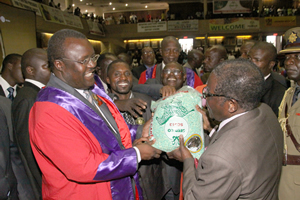
countrywide, 940 tonnes of which have been set aside for traditional leaders.
Chiefs will receive Compound D fertiliser donated by a company called Broad Haven Investments plus an additional 14 tonnes carryover from last year’s stocks.
Maize seed will be distributed according to agro-ecological regions.
Best maize belts such as all the Mashonaland provinces will get 650 tonnes each while Manicaland, Masvingo and the Midlands will each receive 600 tonnes.
Matabeleland North and South will each receive 425 tonnes, while Harare and Bulawayo provinces will get 200 tonnes each for the peri-urban farmers.
ALSO SEE
The second category of inputs is the cottonseed pack consisting of 10kg seed and 25kg Ammonium Nitrate worth US$20.
A total of 964 tonnes of cottonseed will be distributed countrywide with the bulk going to cotton producing provinces such as Midlands.
The third category is of small grains whose packs include millet, sorghum, cowpeas, groundnuts and sugar beans.
Under this option, each beneficiary receives 5kg of each of the crops with a value of US$40 each.
There are 400 tonnes of small grain crops that will be distributed countrywide.
The fourth category pertains to the two Matabeleland provinces – North and South – that will receive dipping chemicals and other veterinary remedies worth US$1 million.
This will be US$500 000 for each province.
Matabeleland North province has 551 858 cattle while the South has 530 478 cattle. The two provinces will also get seed packs.
Areas that normally receive normal to above normal rainfall will get more maize crop seed packs, while drought-prone areas will get more of the small grains.
Cottonseed inputs will go to all provinces except Harare and Bulawayo.
Speaking before the handover of the inputs to traditional leaders and provincial governors, President Mugabe urged the beneficiaries to use manure or carryover basal fertiliser stocks to supplement the little they would receive from scheme.
“I am informed that in future we will also need to focus on lime, which increases plants’ uptake of nutrients from the soil thereby increasing yields. The programme will therefore undergo scientific and technical developments as we move forward,” Cde Mugabe said.
He appealed to those who will distribute the inputs to do so timeously.
“The inputs should be distributed in a transparent manner without political considerations. They must reach the intended beneficiaries, the small-scale farmers,” he said.
President Mugabe said Zimbabwe must reclaim its breadbasket status once again saying it was also part of Sadc’s 2004 Dar-es-Salaam Declaration on Agriculture and Food Security where member states pledged to allocate 10 percent of their national budgets to agriculture and rural development yearly.
The illegal economic sanctions, he said, had hampered such efforts on the part of Zimbabwe with lack of budgetary support and grants due to the embargoes.
President Mugabe said Zimbabwe had remained resolute regardless of the sanctions forging ahead with various interventions to empower its people.
Some of the measures included the recent reviewing of the 99-year leases to allow them to be used as collateral for A2 farmers while the A1s are scheduled to get resettlement permits.
“In terms of infrastructure development, we have embarked on rehabilitation of irrigation schemes. All these are endeavours towards the actualisation of our vision of a food secure country.
“We want agriculture to contribute significantly towards the provision of raw materials to the manufacturing sector and must also contribute towards the development of the national economy,” President Mugabe said.
During the 2008/9 season, the Presidential Well Wishers Special Agricultural Inputs Scheme channelled US$3 million towards the programme and in the 2009/10 season secured inputs worth US$9,7m for 209 400 households.
For the 2010/11 season, 522 000 households received inputs worth US$33 035 785 under the scheme.
The inputs are procured from local seed houses such as Seed Co, Pannar, Pioneer and Agriseeds, while the local fertiliser industry supplies fertilisers.
Local leadership in the various provinces will distribute the inputs.
President of the Chiefs Council Chief Fortune Charumbira lauded President Mugabe for the scheme.
“Only a leader who has his people at heart can undertake such programmes. Those who do not care about the welfare of the citizens are on record as saying that farmers should do it on their own,” he said.
President Mugabe later left for an official visit to China.
His spokesperson, Mr George Charamba, said President Mugabe will meet China’s political and business leadership.
The President was accompanied by the First Lady Amai Grace Mugabe and senior Government officials.
Vice President John Nkomo will be Acting President.



 Online Reporter