admin
admin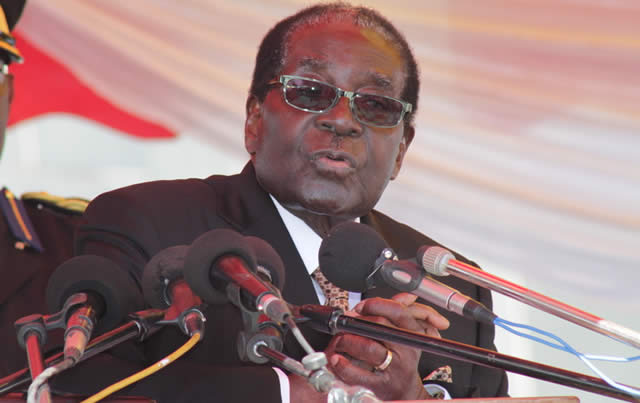
Prosper Ndlovu in Victoria Falls
PRESIDENT Mugabe yesterday took over as the Southern African Development Community (Sadc) chairman for the next 12 months with a poignant vow to “foster regional cooperation and integration”.President Mugabe’s regional honour marked Zimbabwe’s complete rehabilitation after being placed on the Sadc agenda at various times since 2007 over alleged human rights abuses.
He said he “felt honoured, and yet greatly humbled,” adding: “Being Sadc chair is an honour to me personally, and to the government and people of Zimbabwe.”
Watched by 10 presidents, three prime ministers and two vice presidents of the 15 Sadc countries, Cde Mugabe wasted no time in laying the agenda for the regional trade bloc with an urgent call to stop the export of raw minerals.
Sadc, President Mugabe said, should “wean itself from exporting raw materials” but instead seek to create “value chains that lead to the exportation of finished goods”.
Speaking for slightly over 32 minutes after taking over the Sadc chair from Malawian President Arthur Peter Mutharika, President Mugabe said focus on beneficiation and value addition had “potential to drive both our short-term and long-term objectives”.
He added: “Our region has abundant resources, which resources, instead of being sold in raw form, at very low prices, must instead be exploited and beneficiated, in order to add value and cost to those products which we eventually export.
“This process should assist us in our efforts to industrialise, and in turn, increase employment opportunities for our people. I’m confident that in our discussions we will lay a foundation for the necessary strategies, as well as a plan of action on the beneficiation and value addition of our natural resources.”
Mineral resources were “capable of playing a pivotal role in the development of all Sadc member states”, the Zanu-PF leader told his audience in a giant tent pitched in the gardens of a Victoria Falls hotel.
Under his chairmanship, he said, Sadc would also strive for increased integration as a model for steering development in a globally-competitive economic environment.
“As Sadc, we should not lose sight of our regional integration agenda, our focus and priorities. We also should not be tempted to introduce, or embrace, too many programmes which, in the end, we fail to fund from our own resources,” said President Mugabe.
“We therefore feel that the current process underway to review the Regional Integrated Strategic Development Programme, should not be a mere academic exercise, but a reality check which should redirect us.”
He said continued over-reliance on the generosity and goodwill of Western countries has an effect of compromising ownership and sustainability of Sadc programmes. “How can we proudly claim Sadc to be our own organisation when close to 60 percent of our programmes are externally funded?” he asked amid applause from hundreds of delegates, among them diplomats and ministers”.
He said the review of the Regional Indicative Strategic Development Programme (RISDP), a development blueprint adopted in 2003, should result in a Sadc having fewer and focused programmes that are core to the regional vision of regional integration, which is aimed at strengthening economies and improved lives for citizens.
The two-day summit, which opened yesterday and ends today, is being held under the theme “Sadc Strategy for Economic Transformation: Leveraging the Region’s Diverse Resources for Sustainable Economic and Social Development”.
President Mugabe bemoaned the slow pace of market integration, which has seen focus being turned mainly into consolidation of the Sadc Free Trade Area amid concerns over a skewed trade imbalance amongst member states.
Pursuance of robust industrialisation policies across the region, said the President, was key towards creating jobs and curbing labour migration. He said the continuing development of the Tripartite Free Trade Area under the framework of the Tripartite Trade Negotiating Forum, launched in Sandton, South Africa, in June 2011 was inspiring.
“The prospect of an expanded market and the exploitation of our comparative advantage within the tripartite arrangement, can only stimulate intra-Africa trade and lend itself to a multiplier effect on our earnings,” said President Mugabe.
He added the implementation of the 2010 Sadc industrial policy framework was envisaged to enable the region to have goods to sell in the expanded market.
The President also said the 2012 infrastructure development policy should be urgently implemented and be used to actively engage targeted investors and financiers with celebrated track records.
“Emphasis should therefore be on cooperation in the implementation of cross-border infrastructure projects. It is our view that the proposed Sadc declaration on infrastructure development shall underpin our efforts in rolling out the Sadc infrastructure development master plan,” said President Mugabe.
The plan includes major road works, the standardisation of road signs and expansion of border posts.
In an emotional sign-off, President Mugabe said Sadc should “beat its chest” for managing to find peace where instability and strife appeared imminent — highlighting the case of Madagascar, and even Zimbabwe.
The region remained one of the most peaceful and stable on the continent, he said, crediting the Sadc Organ on Politics, Defence and Security.
The organ troika worked tirelessly and provided rapid response to emerging challenges on peace and security notably the mediation process in Madagascar, which he described as “a shining example of Sadc’s characteristic resilience and patience”.
“The long time we took to try and settle the situation in Madagascar shows how patient we are when it comes to the need for us to search for peace and stability in our region. There was a time people might have given up but no, we tried this and that solution and finally we got elections,” he said.
“Our patience has yielded results of what we see as Madagascar’s presence here. Sadc must beat its chest to say we have done it. As incoming Sadc chair, I say well, never never never must we give up hope when it comes to search for peace in our region.”
He was particularly grateful for Sadc’s refusal to be stampeded into a regime-change agenda in Zimbabwe where the Western-backed Movement for Democratic Change (MDC) hoped to force a change of government riding on “debilitating” and “illegal” sanctions imposed by the European Union and the United States.
He thanked Sadc for “standing by Zimbabwe at a time when we faced serious challenges”, adding: “We thank Sadc for consistently calling for the removal of EU and Western illegal sanctions on Zimbabwe, whose effects are debilitating to our economy and our people. Without your support, we would not be standing on our feet today.
“We will remain eternally grateful for that. I say, once again, thank you Sadc.”
He congratulated South Africa, Madagascar and Malawi for holding democratic elections and said he hoped the forthcoming elections in Botswana, Namibia and Mozambique would also pass smoothly in line with Sadc electoral standards, principles and guidelines.
President Mugabe reiterated the need for Africa to supervise its own election to avoid meddling by external forces with vested interests.
“We, the people of Sadc and Africa, know what the truth is, but there are others who think they know… Why do they come here if they are not objective?” he said.


 Online Reporter