Online Reporter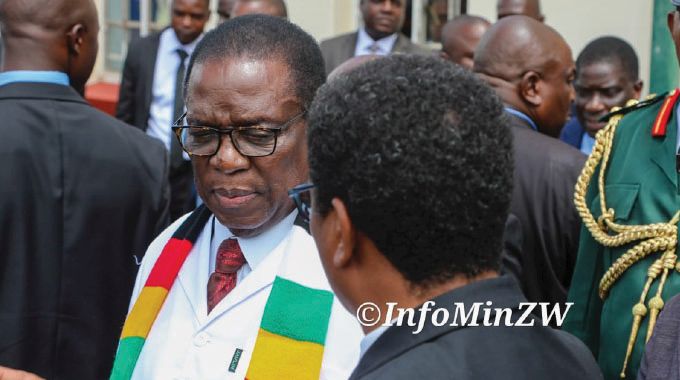
Gibson Mhaka, [email protected]
PRESIDENT Mnangagwa’s enduring philosophy — “Nyika inovakwa nevene vayo/Ilizwe lakhiwa ngabanikazi balo” — was on full display in Bulawayo on Friday last week, as a high profile fundraising luncheon raised over US$2 million for the rehabilitation of Ingutsheni Central Hospital.
The event, held at the Zimbabwe International Exhibition and Smart City Centre, was not merely a fundraising exercise, but a practical demonstration of a governance doctrine that places Zimbabweans at the centre of their own development.
Leading by example, the President donated US$1 million, farm inputs and equipment, and further committed to repairing all hospital vehicles in need of attention.
“As the President, I am availing US$1 million and I am also going to avail farm implements requested, with immediate effect. I understand there are vehicles which require to be repaired, let them be repaired at the expense of the President’s Office,” he said.
Philosophy translated into action
President Mnangagwa’s mantra — loosely translated as “a country is built by its own people” — has become a defining pillar of the Second Republic’s governance approach. It underscores self reliance, national pride and the mobilisation of domestic resources as the backbone of sustainable development.
Friday’s event demonstrated that this philosophy is not rhetorical but a guiding framework for policy and implementation.
A broad cross section of stakeholders from Government, the private sector, academia and the health sector responded to the call, contributing significant resources towards the refurbishment of one of the nation’s key mental health institutions.
Vice President Dr Kembo Mohadi donated US$100 000, while businessman Mr Kudakwashe Tagwirei gave US$350 000. Mr Paul Tungwarara pledged US$250 000, and Mr Obey Chimuka contributed US$150 000. Zanu PF pledged US$100 000, the Ministry of Health and Child Care US$10 000, and the Ministry of Defence US$5 000.
Deputy Minister of Defence Brigadier General (Rtd) Levi Mayihlome donated US$500, while Deputy Minister of Local Government and Public Works Albert Mavunga contributed 1 000kg of rice and an Artificial Intelligence specialised chatbot for the hospital.
Deputy Minister of Health and Child Care Sleiman Kwidini pledged 500kg of beef.
Institutions also participated, with ZITF Company donating US$10 000, Cde Brian Samuriwo US$10 000, and universities — including the University of Zimbabwe, the National University of Science and Technology and Great Zimbabwe University — contributing US$15 000 each. AMAFILIMU donated 10 laptops.
A national response to a national challenge
The fundraiser, organised by the Office of the Vice President in partnership with the Ministry of Health and Child Care, was prompted by the dire state of Ingutsheni Central Hospital.
VP Mohadi said his visit to the institution last year exposed severe challenges.
“I observed that the facility operates well beyond its intended capacity. I was deeply appalled by the state of the hospital, considering its importance in society and what is expected of it. The conditions I observed were truly heartbreaking. Healthcare workers, though dedicated and resilient, face enormous challenges, lacking the essential resources to deliver the level of care that our people deserve,” he said.
Rising cases linked to drug and substance abuse have further overwhelmed the institution, placing additional strain on limited resources.
Against this backdrop, the fundraising initiative represents far more than infrastructure rehabilitation — it is a collective national response to an urgent public health and social challenge.
From dependency to self determination
The Ingutsheni initiative reflects a broader policy shift under the Second Republic: a move away from dependency on external aid toward internally driven solutions.
President Mnangagwa has consistently argued that Zimbabwe must rely on its own resources and capabilities, particularly under the weight of sanctions and external economic pressures. This philosophy is increasingly shaping high level decision making.
In this context, the President’s recent decision to block a proposed US$367 million health deal with the United States has drawn mixed reactions — interpreted by some as controversial, and by others as a firm assertion of sovereignty.
Rather than a missed opportunity, the move has been framed as a principled stance against arrangements that could compromise national interests. By rejecting what he described as attempts to turn Zimbabwe into a “bio colony”, the President underscored that national health data is a strategic asset.
This stance aligns with the doctrine “Nyika inovakwa nevene vayo/Ilizwe lakhiwa ngabanikazi balo”, which insists that development must not come at the expense of independence.
Reclaiming national agency
The emphasis on self reliance is not unique to Zimbabwe, but it carries heightened significance in a global environment where financial assistance often comes with restrictive conditions.
If Zimbabwe is to pursue a sustainable development path, reliance on aid that undermines sovereignty must be reduced.
By prioritising internal resource mobilisation — as demonstrated at the Ingutsheni fundraiser — Zimbabwe is signalling a shift towards economic independence and resilience. This approach strengthens national ownership of development and ensures solutions are aligned with local realities rather than external agendas.
Building resilience in a globalised world
In an interconnected global economy, the President’s emphasis on self reliance may appear counterintuitive to some. However, experts argue it is a necessary strategy to shield the country from external shocks.
By strengthening domestic capacity — in healthcare, agriculture and industry — Zimbabwe reduces vulnerability to global disruptions and geopolitical pressures.
The Ingutsheni initiative demonstrates how local resources, when mobilised effectively, can deliver meaningful results.
It also highlights the importance of partnerships between Government, the private sector and communities in driving national development.
Leaving no one and no place behind
The rehabilitation of Ingutsheni Central Hospital aligns with the Second Republic’s broader development philosophy of inclusive progress. Mental health, long neglected, has become a pressing area for investment, especially in light of rising drug and substance abuse cases among young people.
By prioritising the institution, the Government is addressing both a public health need and a wider social imperative.
A model for future interventions
Friday’s fundraising luncheon may serve as a template for future national development efforts. It showed that when leadership sets the tone, citizens and institutions are willing to contribute meaningfully towards national priorities.
The overwhelming response reflects growing confidence in home grown solutions and collective action.
More importantly, it signals a shift in mindset: from waiting for external assistance to taking responsibility for shaping national development.
President Mnangagwa’s actions in Bulawayo reaffirm the core tenet of his leadership philosophy — that Zimbabwe’s future lies in the hands of its people.
The successful mobilisation of over US$2 million for Ingutsheni Central Hospital demonstrates what is possible when that philosophy is put into practice.
As Zimbabwe navigates economic and social challenges, the message remains clear: sustainable development will not be imported — it will be built by Zimbabweans themselves.
In the words of the President’s guiding mantra: “Nyika inovakwa nevene vayo/Ilizwe lakhiwa ngabanikazi balo.”