Online Reporter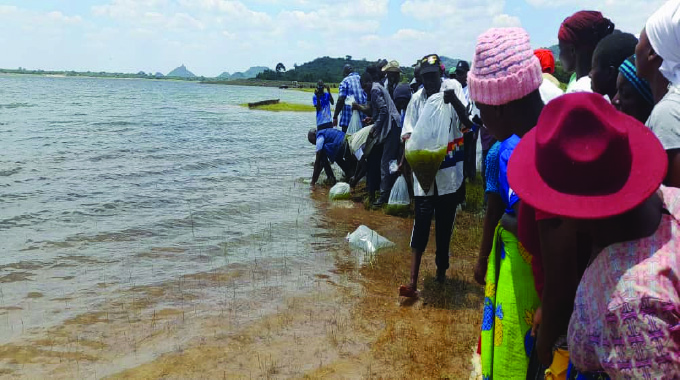
Patrick Chitumba, Midlands Bureau
OVER 80 000 fingerlings have been stocked in dams and ponds across the Midlands Province under the Presidential Community Fisheries Programme, with beneficiaries harvesting about six tonnes of fish for both household consumption and the local market.
The programme, launched by President Mnangagwa in 2021, is part of the Government’s push to strengthen rural industrialisation, boost food and nutrition security, and create employment in line with Vision 2030. It seeks to close Zimbabwe’s fish supply gap, with the country currently producing about 31 000 tonnes annually against a national demand of 60 000 tonnes. By providing free fingerlings, training and market access, the initiative is empowering rural communities to turn water bodies into productive assets.
Speaking during the launch of an aquaculture training programme and the construction of two fish ponds at Manzini Garden in Shurugwi South, Midlands Provincial Affairs and Devolution Secretary Dr Edgar Seenza said the province is fast embracing fish farming as a viable livelihood.
“In 2025, the Government stocked 58 000 fingerlings in dams and 30 500 in ponds, bringing the total to 88 500 fingerlings in the Midlands. Already, 4,04 tonnes have been harvested from dams and 2,5 tonnes from ponds,” said Dr Seenza in a speech read on his behalf by Mr Albert Gomwe.
Midlands now boasts 535 fish ponds serving 571 farmers, with Shurugwi District alone accounting for 106 ponds and 164 active fish farmers. Dams such as Totonga and Impali have also been stocked with thousands of fingerlings to support co-operatives.
Dr Seenza said the initiative is a major step towards rural industrialisation and nutrition security.
“This training and pond construction in Manzini is aimed at empowering the community. Fish farming is proving to be a reliable source of income and a steady supply of protein, particularly for rural households,” he said.
Dr Seenza added that the initiative is a significant milestone in the journey towards achieving the 2030 aspirations of an empowered and prosperous upper-middle-income society as advanced by President Mnangagwa.
Shurugwi South legislator Cde Wilson Mhuri commended the Government’s support, saying the constituency has 22 village business units, eight of them solar-powered, which will integrate fish ponds into their operations.
He said they are also providing materials for ablution facilities and perimeter fencing to protect the ponds.
“These projects show that President Mnangagwa’s vision of leaving no one and no place behind is being realised on the ground. Fish farming continues to prove itself as a reliable source of income and livelihood support, especially for rural households,” said Cde Mhuri. Aquaculture has become one of the fastest-growing agricultural sectors in Zimbabwe, particularly in rural areas where smallholder farmers are adopting fish farming alongside crops and livestock. The Government says scaling up the programme will not only boost household incomes but also contribute significantly to narrowing the country’s protein deficit while stimulating rural economies.