Vusumuzi Dube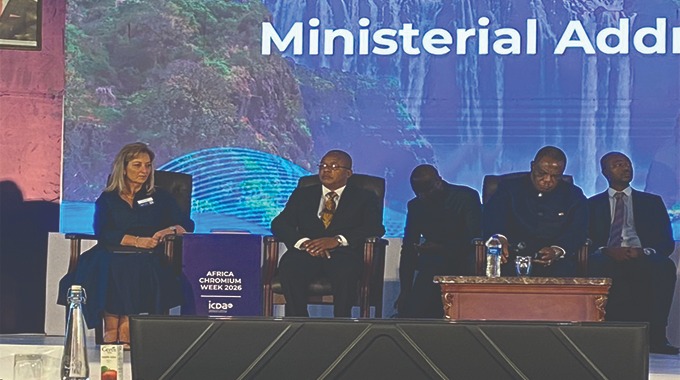
Rutendo Nyeve, [email protected]
PRESIDENT Mnangagwa’s bold decision to reinstate the chrome ore export ban in 2022 is yielding tangible results, with the country now operating 17 ferrochrome smelters and recording a 19 percent surge in ferrochrome exports to 433,000 metric tonnes in 2025.
Furthermore, the country is now ranked fourth globally in chromite production and sixth in high-carbon ferrochrome.
Vice-President Constantino Chiwenga revealed this yesterday while officially opening the Africa Chromium Week Conference in Victoria Falls on behalf of President Mnangagwa.
The conference is being held under the theme: “From Resource Endowment to Value-Driven Industrialisation: Africa’s Moment in the Global Chromium Ecosystem.”
Since the coming in of the Second Republic, President Mnangagwa has pivoted to value addition and beneficiation of minerals as a critical economic stance, riding on increased local capacity around science, technology and innovation.
“It is indeed through greater focus on mining value chains that we will derive maximum value from our mineral resources for sustainable development.
“As you are aware, everything we depend on is either made from minerals or relies on minerals for its production,” said President Mnangagwa, speaking at the Mine Entra expo in 2024.
Addressing delegates from across the globe in Victoria Falls yesterday, VP Chiwenga reflected on the 2022 policy decision to reinstate the chrome ore export ban, saying critics had questioned the country’s smelting capacity and power supply.
“We did not retreat. Instead, we invested and scaled capacity. Today, Zimbabwe operates seventeen ferrochrome smelters. In 2025, ferrochrome exports reached 433,000 metric tonnes, reflecting a 19 percent year-on-year growth,” he said.
“We are now ranked fourth globally in chromite production and sixth in high-carbon ferrochrome. This is measurable progress,” said VP Chiwenga.
Beyond these gains, he said, flagship projects are redefining the industrial landscape, including the US$3.6 billion Palm River Energy Metallurgical Special Economic Zone, which will anchor a two-million-tonnes-per-year ferrochrome smelter, a coking plant, a 1,200-megawatt power complex and an integrated industrial park, creating 10,000 direct jobs.
“It’s set to become Zimbabwe’s largest ferrochrome producer and rank among the world’s largest. At the same time, the Manhize Steel Plant is delivering tangible industrial output with production reaching 146,000 metric tonnes in 2025, representing 450 percent value growth over the previous year,” said VP Chiwenga.
“These are realised results, not projections. I commend our investors for translating this vision into reality.”
Vice President Chiwenga said in February 2026, the Government implemented a decisive policy shift, suspending all raw and semi-processed mineral exports across all sectors.
“Lithium, platinum group metals, nickel and chrome concentrates will no longer exit Zimbabwe unprocessed. This was a deliberate and purposeful decision to accelerate Zimbabwe’s transformation into an Empowered and Prosperous Upper-Middle-Income Society,” he said.
Addressing the longstanding challenge of power constraints in ferrochrome smelting, Vice President Chiwenga said Government is offering subsidised electricity tariffs to ferrochrome producers during the transition period while mandating captive power development.
“Zimplats’ 110-megawatt solar plant at Selous is progressing, thermal power units at Hwange are being rehabilitated and we intend to develop gas-to-power once the Muzarabani hydrocarbon project in the Zambezi Valley becomes a reality,” he said.
“Let me highlight that Government’s policy is straightforward: chrome smelters that invest in their own captive power will receive commensurate mining titles and fiscal support. We are building a new energy architecture to underpin a new industrial Zimbabwe,” he added.
Vice President Chiwenga further commended the International Chromium Development Association (ICDA) for choosing Zimbabwe as host for the second time in Africa.
“We commend the International Chromium Development Association for choosing Zimbabwe as host to this important gathering for the second time in Africa.
“This decision reflects the Association’s recognition of Government’s strides in the mining sector, particularly across the chrome value chain,” he said.
“We appreciate this endorsement and call upon industry stakeholders to respond decisively with capital deployment, technology transfer, skills development and long-term partnerships that are aligned with Zimbabwe’s industrialisation agenda.”
The Vice President said the global chromium landscape is rapidly transforming, saying China’s industrial expansion continues to anchor demand while India is emerging as the next major frontier for stainless steel consumption.
“In Europe, the Carbon Border Adjustment Mechanism is redefining trade flows to reward cleaner and more sustainable production. Concurrently, the global automotive sector is undergoing structural transformation and the green hydrogen economy is unlocking new applications for chromium in advanced materials,” he said.
“These converging dynamics are generating unprecedented momentum for global chromium demand and present a generational opportunity.”
He stressed that Africa must not remain peripheral to this transformation but must lead and drive it, highlighting the continent’s vast critical mineral endowments, including cobalt in the Democratic Republic of Congo, copper in Zambia, graphite in Tanzania, and platinum group metals in South Africa and Zimbabwe, which together account for over 80 percent of global supply.
“We must maximise value within our countries, build resilient industries and convert natural capital into lasting economic infrastructure,” he said.
On sustainability, VP Chiwenga noted that with carbon pricing regimes taking effect in 2026, particularly in Europe, the global market is shifting toward low-emission supply chains.
“Through positioning our ferrochrome as a low-carbon, responsibly sourced product, deployment of cleaner technologies and integration of renewable energy, we can command a premium in environmentally conscious markets,” he said.
“This is Zimbabwe’s roadmap, not an aspiration, but a deliberate plan in motion.”
The Vice President also called upon investors, industry leaders, financiers and technology partners to move beyond dialogue into decisive execution.
“Zimbabwe offers a clear value proposition, resource certainty and a Government fully committed to value addition and industrial transformation. The opportunity before us is immediate and scalable: to deploy capital into beneficiation, to co-develop energy solutions, to establish downstream industries and to embed innovation across the chromium value chain,” he said.
The 2026 ICDA-African Chromium Week has attracted visitors from Africa, Europe, Asia, the Americas and beyond.



 Online Reporter