admin
admin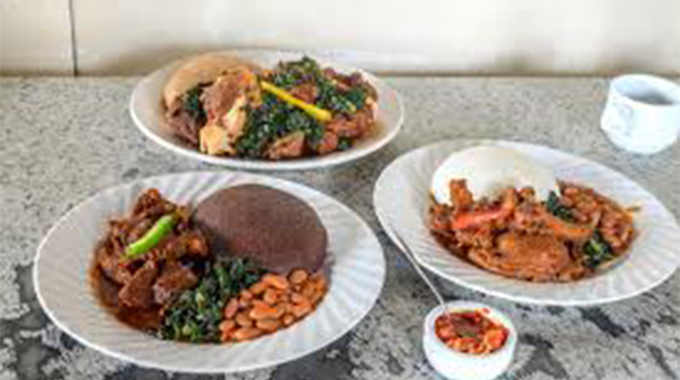
Charles Dhewa, Herald Correspondent
Although many Africans live in rural areas, a lot of people still think what comes from the city is superior.
On the contrary, however, demand for indigenous food grown in the countryside is increasing in many African cities.
Triggered by rising consumer awareness about the value of eating health and natural remedies, this trend is an opportunity for enterprising Africans to globalise indigenous food.
However, in order to successfully exploit this trend, the promotion of indigenous food should move beyond festivals to building strong supply chains, complete with systems for retaining knowledge and indigenous business models.
Every African city has a number of restaurants specialising on indigenous cuisine, but these are too few to cause full-scale transformation that gives the entire food system an African identity.
What has given western food systems and fast foods a foothold are strong supply chains.
So, what is preventing indigenous food from being promoted the same way if not better?
From scarcity mindset to abundance approach
Aggressive indigenous food entrepreneurship demands a shift from a scarcity mindset to an abundance approach because indigenous food is more abundant than foreign food.
Emphasis should now switch from events like cooking competitions and food festivals to fluid knowledge sharing platforms and supply chains in production areas.
While such local supply chains have existed for decades, they have lacked systems of converting raw commodities into products through intentional product development driven by modern science and Government support.
The supply chains have largely been driven by African territorial mass markets that are also revealing dynamic trends through which indigenous food systems are growing. There should be systems that specifically focus on building supply chains by following trends in terms of what is happening to indigenous food systems in the market and why.
If trends are showing increased consumption by age, area and gender, that reveals how indigenous food systems are competing for sustainability.
Embedding indigenous food into education curricula
Systematically building community resilience by supporting the production knowledge base and supply chain actors and ensuring community self-sustainability.
When properly introduced, the knowledge sharing platforms can become part of the formal education system, so that holders of indigenous knowledge become part of curricula developers, with indigenous food being inserted into mainstream syllabuses.
Grandmothers and grandfathers, who are part of the community indigenous knowledge holders, can be certified to support the local knowledge-driven curricula different from the current formal one, which is fast becoming irrelevant.
Such a knowledge base will have elements of resilience, livelihoods, business angles, potential for income earning, and risk mitigation around climate change.
That kind of focus on all critical facets will ensure food security for everyone, including business models connected to the market. Efforts to promote consumption can target the young generation, most of whom find indigenous food alien.
This important thrust is more about building blocks for competitive entrepreneurship around indigenous systems in response to the skyrocketing demand for homegrown food from local urban consumers and Africans in the diaspora.
Some indigenous products are being packaged for the global market by a few Africans in the diaspora, who are setting up restaurants in Australia, the United Kingdom, and the US, for African and western consumers, who feel honoured by a competitive food market.
All this has to be buttressed with systems that support knowledge production and diverse forms of value addition beyond just processing. Each African country’s trade promotion board like ZIMTRADE, in the case of Zimbabwe, can play a bigger role of taking indigenous food to the globe, where real businesses can be established not just periodic exhibitions that are difficult to convert into viable deals.
At exhibitions, consumers can taste food, and it ends there without concrete deals.
Power of documenting existing knowledge, practices
Efforts are being made to promote African indigenous food, but in a fragmented manner, and would benefit more from documentation and consolidation.
Promotion and consumption processes are already happening through relationships and several silent channels. Much can be learned from the many ways through which Africans promote their food systems that may be different from what happens in other parts of the world.
Several undocumented methods are being used to promote African food. Given that most communities are built around core food systems, less effort may be required to promote indigenous cuisine in certain communities.
The fact that food is part of people’s identity implies there might be no real need to campaign, but just document and show the world what exists in particular communities. Such knowledge includes how food is exchanged between relatives, households, markets, rural to rural, urban to rural, and many other channels.
Feedback: [email protected]/ [email protected]/



 Online Reporter