admin
admin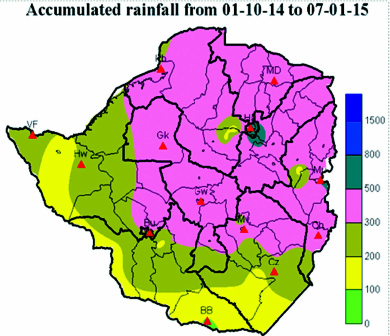
The 2015 /6 rainfall forecasts as provided by the Meteorological Services Department show that the water year ahead provides extremely unfavourable conditions for water resources managers such as ZINWA, local authorities and sub-catchment and catchment councils. The forecast shows that by the end of the current wet season in March 2016, the national average dam levels would be between 65,1 percent and 84 percent.
These statistics mean that there would be water stress in a lot of areas around the country and therefore the need for properly coordinated and managed water use arises.
The year ahead requires both water managers and water users to work hand in hand to ensure that the available water is optimally used for the benefit of the country on the economic and social fronts.
In this age of climate change, it is important for water users, especially irrigating farmers to participate in and contribute to sustainable management of water resources by ensuring that they regularise their utilisation of water as provided for in the Water Act (Chapter 20:24).
According to the Met Department forecast and the ZINWA Hydrological outlook, Gwayi Catchment, which covers most parts of Matabeleland North and some parts of Matabeleland South and Midlands Provinces, is expected to have an average dam level standing at 44,5 percent.
What this means is that water available for domestic and irrigation purposes in the catchment after the rain season would be very limited, hence the need for water users to utilise the available water resources efficiently and take all measures to conserve supply.
Manyame Catchment, which covers large parts of Mashonaland West and some parts of Mashonaland Central, is expected to close the rain season with 85,3 percent as its average dam level.
This means the catchment will have adequate water available for both irrigation and domestic use.
Mazowe Catchment, which covers mostly Mashonaland Central, parts of Manicaland and Mashonaland East, will close the rain season with its dam level averaging between 83, 5 percent and 95,9 percent.
This means that the water supply situation in the catchment would be fairly adequate for both domestic and irrigation purposes. Water supply challenges may however, arise from water supply stations with limited storage capacity such as Mutoko.
Water supply challenges are also expected for Mzingwane Catchment which covers largely Matabeleland South Province and some parts of the Midlands Province.
By March 2016, dam levels in the catchment are expected to be between 60,4 percent and 80,3 percent. This will be unfavourable to the catchment water supply dams which will remain relatively low, compromising the water security in the region and particularly for the City of Bulawayo.
The same will apply to Runde Catchment whose dam levels would be below 40 percent on average. Runde Catchment covers most parts of Masvingo Province.
Such conditions are unfavourable for the catchment’s key irrigation dams such as Mutirikwi as the dams need significant water inflows for them to be able to satisfy demand for irrigation water.
Most parts of Midlands Province, which fall under Sanyati Catchment, will however have adequate water for both irrigation and domestic use while in Save Catchment, covering Manicaland Province, parts of Mashonaland East and Masvingo, the general forecast is not very favourable for irrigation. The catchment’s dam levels are expected to be between 57,8 percent and 78,3 percent.
These forecasts point to a great need for ZINWA and water users such as local authorities, farmers and agricultural estates, especially in catchment areas expected to have water stress, to work together in the protection of available water and efficient utilisation of the same.
It is against this background that farmers, as they plan for the coming irrigation season, should ensure that they have proper water use documents.
Farmers should enter into water use agreements in time for the season so that ZINWA can make appropriate arrangements with regards to the allocation of water from dams.
Under the circumstances, water users especially farmers, should do proper water use forecasts that will guide them in applying for allocations.
Those without agreements stand to lose the irrigation season since water allocation preference would be accorded to those using water in terms of the law.
For more information please contact the ZINWA Corporate Communications and Marketing Department on [email protected] mailto:[email protected] or visit the ZINWA website on www.zinwa.co.zw You can also visit the Zimbabwe National Water Authority Facebook Page.



 Online Reporter