Online Reporter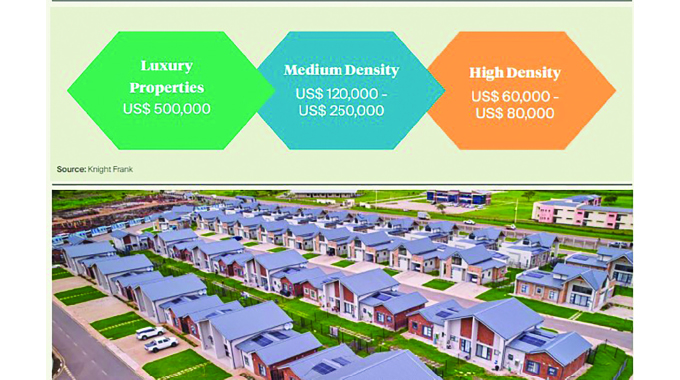
Tapiwanashe Mangwiro
Zimbabwe’s property market continues to navigate a complex interplay of economic headwinds and evolving tenant preferences.
Knight Frank reports that: “Vacancy rates in Harare and Bulawayo’s CBDs have reached 60 percent and 40 percent, respectively.”
This striking oversupply is underscored by ageing infrastructure, security concerns and prohibitive parking costs: “A reported 13 percent increase in crime within the CBDs between the second half of 2023 and the second half of 2024” (Source: Safeguard Crime Report 2024), combined with “limited and expensive parking options, with average casual parking costs in the CBD reaching US$1 per hour compared to free parking in most suburban locations.”
The relocation exodus is well underway. According to Knight Frank, “30 percent of businesses previously located in Bulawayo’s CBD have relocated to suburban areas such as Suburbs and Khumalo between the second half of 2020 and the second half of 2024.”
“In Harare, a similar trend has been observed, with all the major banks having relocated, planning, or are in the process of building head offices in the northern suburbs such as Highlands, Newlands and Borrowdale during the same period.”
Traffic congestion and rental economics further exacerbate CBD challenges. Congestion within the Harare CBD has increased by 30 percent in recent years, contributing to tenant dissatisfaction. Average rental rates in the CBDs are currently US$6 per square metre, compared to US$10 per square metre in suburban locations.
With parking typically charged at US$1 per hour in the CBD versus free customer parking in suburban parks, the cost-benefit balance has decisively shifted toward fringe and peri-urban business districts.
In the face of steep borrowing costs, mortgage finance remains largely absent from the market. Knight Frank highlights that, “No mortgages are extended towards real estate because of the high cost of borrowing.”
Instead, “the residential property market is driven by cash sales, mostly through diaspora remittances and small-scale miners.”
Current pricing bands underscore demand at all density levels: High-density properties in Harare are priced between US$60 000 – US$80 000; medium-density at US$120 000 – US$250 000; and low-density ones at US$500 000. This cash-led market suggests liquidity is concentrated among overseas Zimbabweans and artisanal mining stakeholders, leaving traditional finance institutions on the sidelines.
The retail sector is undergoing decentralisation, with large-format department stores giving way to informal, SME-focused spaces. Knight Frank notes that, “The large boxes remain in the form of supermarkets and hardware stores. The department stores are closed and space has been converted to micro shops.”
Such real estate adjustments reflect broader consumer shifts. “The division of large retail spaces into smaller units targets small-to-medium business enterprises (SMEs), reflecting the retail sector’s rapid shift towards informal and decentralised operations,” the estate agency said.
Retail leases generally follow a hybrid model, with a basic rent and turnover rent basis, with an average percentage of 2 percent. However, exposure to the Zimbabwe Gold (ZiG) dominates cash flows.
Knight Frank added, “National retailers in Zimbabwe typically receive revenue in a mix of ZiG and US dollars, with a current estimated ratio of 90:10 ZiG to USD.”
SMEs occupy units as small as around 9 sqm on average under short-term leases. Rental rates vary considerably.
“In secondary towns, monthly rates are typically between US$20 and US$30 per square metre, whereas in Harare’s CBD, rates can reach as high as US$50 per square metre,” the real estate company said.
The premium for prime central locations comes with a turnover penalty: a high tenant turnover rate of approximately 40 percent annually, indicating a competitive market with short-term leases. Tenants often sell the same merchandise and compete with cheaper retailers, driving churn.
Yield compression in the industrial sector remains muted but stable. Knight Frank observes that, “Industrial sector rental yields are currently averaging 13 percent, compared to 11 percent in the second half of 2023.”
The uptick signals cautious optimism, as warehouses and logistics space await traction from agriculture and mining.
“These subdued yields are expected to persist in the short term until the positive effects of increased activity in primary production sectors, such as agriculture and mining, translate into increased demand for industrial space and related services.”
Financing constraints continue to hamper development. The debt market delivers 5,84 percent through mortgages and 1,17 percent through construction projects, highlighting the scarcity of project capital and the preference for cash investments in housing via diaspora remittances and mining revenues.
Knight Frank’s comprehensive snapshot reinforces a clear narrative: cash liquidity, safety and convenience are reshaping Zimbabwe’s real estate landscape. For office landlords, suburban parks and northern precincts offer immediate relief from central vacancies.
Property developers in the residential space must remain attuned to cash buyers’ pockets, while retail landlords should pivot toward flexible, micro-unit configurations to service SMEs. Industrial investors, meanwhile, should monitor primary sector forecasts closely, as incremental yield gains hinge on upticks in agricultural and mining output.
As the second quarter progresses, stakeholders who align their portfolios with these Knight Frank insights, emphasising security, accessibility and currency diversification, will be best positioned to capitalise on emerging opportunities and mitigate systemic risks.
For more property stories visit: https://epapers.zimpapers.news/37b7c63b0d.htmlziProperty