Online Reporter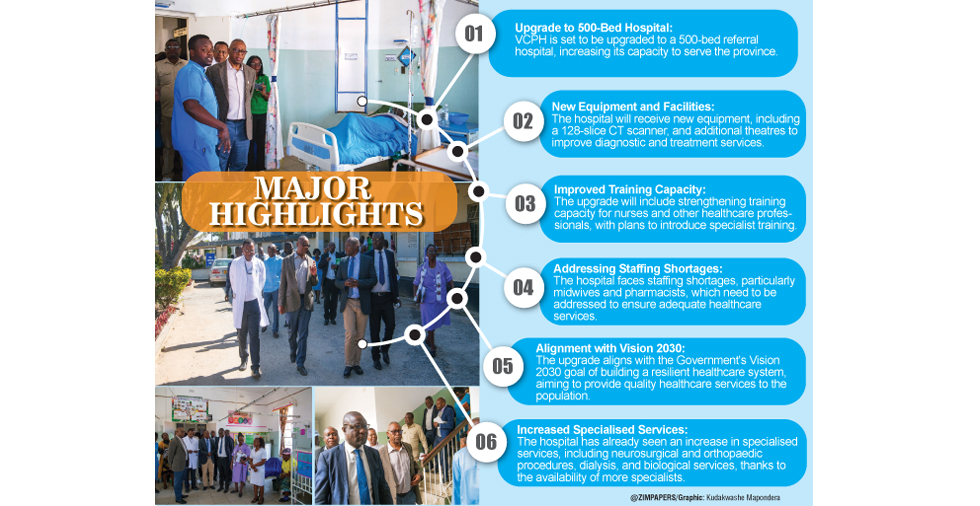
Tendai Gukutikwa
Health Reporter
VICTORIA Chitepo Provincial Hospital is poised for a major transformation into a state-of-the-art 500-bed referral medical institution as Government ramps up efforts to enhance healthcare infrastructure in line with Vision 2030.
During a tour of the hospital on Tuesday, Health and Child Care Minister, Dr Douglas Mombeshora outlined plans to expand the hospital’s bed capacity, add new theatres, improve training facilities and broaden enrolment, bolster diagnostic and laboratory services.
Minister Mombeshora also emphasised that the upgrade will align VCPH with its status as Manicaland’s referral hospital.
Currently, the provincial hospital has 300 beds — which are 50 less than Rusape General Hospital, which has 350 beds — and this should not be the case as it caters for the entire province with over two million citizens.
Minister Mombeshora stressed that the upgrading of VCPH will benefit not only Manicaland but also the country’s broader healthcare sector as it will contribute to the national goal of building a resilient healthcare system under Vision 2030.
“We are prioritising Victoria Chitepo Provincial Hospital for upgrading. This is a provincial hospital, and it should look like
a provincial referral hospital; but as you may know, it has fewer beds than Rusape General Hospital. We want to see it upgraded to a level that will see it have at least 500 beds or so. Currently, we need to add more beds and wards.
The hospital is currently a 300-bedded, while Rusape General Hospital is 350-bedded, making it the largest in the province,” said Minister Mombeshora.
“Upgrading Victoria Chitepo Provincial Hospital to a state-of-the-art facility is a clear step in the direction towards Vision 2030, which is about ensuring that no one and no place is left behind. Whether someone is in Mutare, Buhera, Nyanga or Chipinge, they should know that their provincial referral hospital has the capacity, equipment and skilled personnel to meet their health needs.
This hospital will be transformed into a state-of-the-art medical institution. It is, not only VCPH, but all provincial referral hospitals will be upgraded to state-of-the-art medical institutions with adequate and appropriate infrastructure and medical services. We are glad that VCPH now has more specialists, with two in each department. That is a positive improvement, and we hope that with the coming upgrades, more specialists will be stationed at this hospital,” said Minister Mombeshora.
The hospital now boasts specialist obstetricians, anaesthetists, neurosurgeons, and an orthopaedic surgeon, which have enabled it to conduct neurosurgical and orthopaedic procedures, as well as offer dialysis and biological services.
Minister Mombeshora said the planned expansion will be factored into the 2026 national budget.
“We will present all this for the national budget so that the resources are availed, and ensure we build this hospital to match referral hospital standards. The space is there, so it is now a matter of allocating resources to achieve that,” he said.
Minister Mombeshora was also impressed by recent developments at VCPH, including the arrival of new theatre equipment.
He said Government is set to install a 128-slice CT scanner at the hospital. The hospital is currently using a 16-slice model.
A 128-slice CT scanner is a high-end medical imaging device that captures detailed, three-dimensional images of the body, and commonly used in specialty practices like cardiac departments or research facilities, where high-volume patient throughput is necessary. Compared to the 16-slice model, the 128-slice CT scanner offers several advantages.
It can capture images of the whole body in just seconds, whereas the 16-slice model takes longer. It also provides more detailed images, making it easier to diagnose complex conditions as well as better suited for advanced imaging procedures like cardiac exams, which require higher slice counts to deliver sufficient image quality. In contrast, the 16-slice CT scanner is more suitable for general studies and smaller facilities with lower patient volumes.
The upgrade, Dr Douglas Mombeshora said, will improve diagnostic accuracy and speed to boost healthcare services in line with Vision 2030.
“I am glad that there is new equipment in the theatre, including a specialised electric bed. However, there are a few theatres here, and we are hoping to add two more theatres as we upgrade the hospital,” he said, adding that training capacity would also be strengthened as part of the expansion drive.
“We want to increase the number of trainee nurses at this institution. Currently, there are only two intakes instead of the three hat other training institutions are offering. We are only training registered general nurses, but we want to see if we can also introduce specialist training of nurses and increase the intake of RGNs. We also want to increase the capacity in terms of training other cadres,” he said, also acknowledging progress in the availability of drugs at the hospital pharmacy; though more still needs to be done.
“I have gone through the wards and the pharmacy. I am happy with the stock levels, which have increased from 48 percent to around 61 percent; but we are still far from where we should be. Optimal levels should be about 80 percent in our pharmacies,” he said.
Staffing shortages were also highlighted as an urgent issue.
“We have also seen that there are not enough midwives in the maternity ward. We also need to increase the number of pharmacists at the hospital so that each pharmacy is manned by qualified personnel. These are some of the challenges we have seen, and we hope to go back to the drawing board and address them,” said Minister Mombeshora.
VCPH medical superintendent, Dr Hilary Makiwa said the hospital’s upgrading is expected to reduce pressure on Harare and Parirenyatwa hospitals as it will ensure that patients in Manicaland access advanced treatment closer to home.
He said the hospital has already seen remarkable growth in service provision over the past few years, especially after the Covid-19 period.
“We have seen remarkable growth at the hospital. We had a limited number of specialists before, but now we have 12 specialists compared to six previously, which is a big improvement for service provision in the province,” he said, adding that the increase in specialists has transformed its capacity to serve as a provincial referral medical centre.
“The hospital is geared to provide specialised services throughout the province, servicing all the districts. With the availability of more specialists, we are now able to offer services that were previously unavailable. It is a very notable improvement,” said Dr Makiwa, adding that new procedures are now being performed at the hospital; thanks to Government support and new equipment. “We now have specialist obstetricians, anaesthetists, neurosurgeons, and an orthopaedic surgeon. We are doing neurosurgical procedures, orthopaedic procedures, and we also have dialysis and biological services. These are services we could not offer before. With
Government’s support, we have received a lot of equipment which has enabled us to expand our services,” said Dr Makiwa.