Online Reporter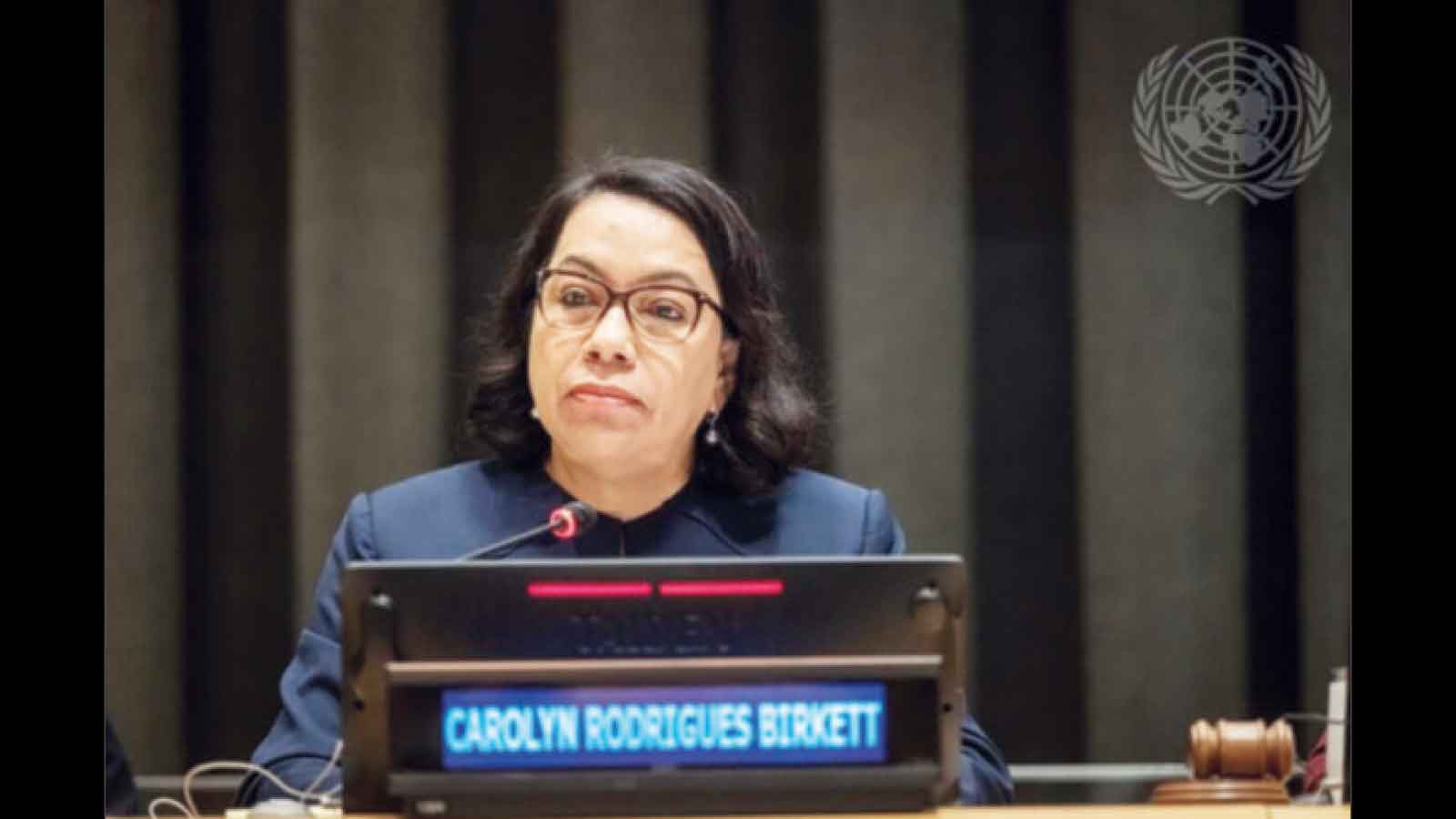
Gibson Mhaka-Zimpapers Politics Hub
THE race to succeed United Nations Secretary-General António Guterres has entered a new and intriguing phase, with Guyana’s Ambassador to the United Nations Carolyn Rodrigues-Birkett emerging as the latest frontrunner after a second informal Security Council straw poll produced a markedly different picture from the first vote.
Rodrigues-Birkett secured eight “encourage” votes in the latest secret poll held on August 21, putting her one vote short of the nine required for the 15-member Security Council to recommend a candidate to the UN General Assembly.
Her rise is particularly significant because she had finished second in the first straw poll held on July 30, when Costa Rica’s former vice-president Rebeca Grynspan emerged as the early favourite with 10 “encourage” votes. Rodrigues-Birkett had received nine at the time.
The latest ballot, however, has demonstrated why the UN leadership contest cannot be reduced to a simple popularity contest. Grynspan slipped to seven “encourage” votes, while Argentina’s Rafael Grossi, director-general of the International Atomic Energy Agency, also received seven.
Rodrigues-Birkett’s latest tally was eight “encourage”, three “discourage” and four “no opinion”, according to diplomats familiar with the results. Grynspan had seven “encourage”, four “discourage” and four “no opinion”, while Grossi recorded seven “encourage”, six “discourage” and two “no opinion”.
The figures tell a more complicated story than the headline numbers suggest.
The Guyanese diplomat may be leading, but she has not yet established the commanding position enjoyed by Grynspan in the first round. More importantly, the eight votes do not reveal whether Rodrigues-Birkett has secured sufficient support from the five permanent members of the Security Council — China, France, Russia, the United Kingdom and the United States — each of which possesses veto power.
That is the real arithmetic of the UN succession battle.
A candidate requires at least nine favourable votes to secure a Security Council recommendation, but nine votes alone are not enough. A candidate must also avoid a veto from any of the five permanent members. The ballots in the early straw polls do not identify which countries cast the “encourage” or “discourage” votes, making it impossible to determine publicly whether any of the P5 powers has already signalled opposition.
In other words, Rodrigues-Birkett is currently closest to the formal threshold, but the race remains wide open.
Behind her, Grynspan remains a formidable contender despite losing ground. Her first-round performance of 10 favourable votes had established her as the candidate to beat. The fall to seven in the second poll, accompanied by an increase in “discourage” votes from one to four, represents a setback, but not necessarily the end of her campaign.
Indeed, in UN diplomacy, early leads can be deceptive.
The straw polls are designed primarily to test the temperature within the Security Council and facilitate negotiations towards a consensus candidate. They are not formal elections and do not bind any member to a final vote. The secrecy surrounding the process means candidates and their backers must constantly work behind the scenes to build the broad coalition required to survive the final stages.
Grossi presents another interesting case.
The Argentine diplomat has retained his seven “encourage” votes from the first poll, suggesting a degree of stability in his support base. But the number of “discourage” votes against him has jumped from two to six. That is potentially more worrying than his failure to gain additional support because opposition from even one permanent member could ultimately kill his candidacy.
The remaining candidates are further behind, but the second poll also produced a movement that should not be dismissed.
Former Senegalese president Macky Sall received six “encourage” votes, seven “discourage” votes and two “no opinion” votes. His numbers were unchanged from the first poll, when he also received six favourable votes, but his seven negative votes underline the resistance facing his candidacy.
Ugandan diplomat and former UN under-secretary-general Olara Otunnu improved from two “encourage” votes in the first poll to five in the second, alongside five “discourage” votes and five “no opinion” votes. That makes him one of the clearest movers between the two ballots.
Former Ecuadorian foreign minister and former UN General Assembly president María Fernanda Espinosa received four “encourage” votes, three “discourage” votes and eight “no opinion” votes. Her comparatively low number of negative votes means that, although she is not presently near the top, there remains a potentially sizeable pool of undecided support.
Former Chilean president Michelle Bachelet suffered the sharpest decline among the established candidates, falling from six “encourage” votes in the first poll to just two. She received six “discourage” votes and seven “no opinion” votes in the second round.
At the bottom of the latest table is Ecuadorian diplomat Ivonne A-Baki, whose candidacy was only recently added to the race after Tonga nominated her on August 17. She received no “encourage” votes, eight “discourage” votes and seven “no opinion” votes.
The latest figures, therefore, leave the field of eight candidates in a hierarchy that is beginning to emerge, but has not yet produced a decisive winner.
Rodrigues-Birkett leads with eight favourable votes, followed by Grynspan and Grossi on seven each. Sall is on six, Otunnu on five, Espinosa on four, Bachelet on two and A-Baki on zero. But the “discourage” figures show that the race is much more fluid than the favourable vote column suggests.
The bigger political story, however, is the growing prominence of women in the contest.
Five of the eight candidates are women — Rodrigues-Birkett, Grynspan, Bachelet, Espinosa and A-Baki — meaning the 2026 contest has produced an unprecedented concentration of female candidates for the UN’s top job.
That matters because, in the organisation’s 80-year history, no woman has ever served as Secretary-General.
The possibility of finally breaking that glass ceiling has, therefore, become one of the defining political questions surrounding the succession battle. Two women now occupy the top two positions in the latest straw poll, with Rodrigues-Birkett leading Grynspan.
But symbolism will not be enough.
The next Secretary-General will inherit a United Nations confronting perhaps its most difficult political environment in decades. The organisation is grappling with wars, humanitarian crises, geopolitical rivalry, declining confidence in multilateral institutions, financial pressures and deep divisions among the major powers.
That means the eventual choice will be less about who can generate the loudest campaign and more about who can command confidence across the competing interests represented on the Security Council.
The process itself is deliberately designed to force that reality upon the candidates.
The General Assembly formally appoints the Secretary-General, but the decisive first step lies with the Security Council. Once the council reaches agreement on a candidate, it recommends that person to the 193-member General Assembly for appointment.
That gives the P5 enormous influence.
A candidate may enjoy widespread support among the wider UN membership and still fail if one of the permanent members decides to exercise its veto. This is why the number of “discourage” votes is being watched almost as closely as the number of “encourage” votes.
The latest poll, therefore, should not be interpreted as Rodrigues-Birkett having “won” the election. She has not.
Rather, she has won an important round in a contest whose decisive stages are still to come.