admin
admin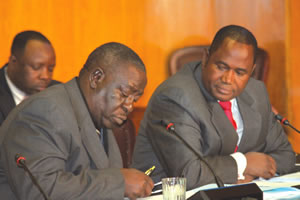
Bank, placed under curatorship by the central bank after revelations of financial irregularities.
RBZ governor Dr Gideon Gono told of the “trap” to a Parliamentary Portfolio Committee on Budget, Finance and Investment Promotion on Monday. It was in response to an inquiry from the committee chairman, Mr Paddy Zhanda.
He had asked if the central bank had been exposed to the beleaguered merchant bank.
The committee also asked whether any of RBZ’s workers had been exposed to Renaissance Bank and how much the apex bank owed local banks.
“The Reserve Bank has exposure to Renaissance of US$7 million constituted by US$3 million statutory deposits and the balance is held as gold bonds,” said the governor.
Dr Gono said the RBZ owed banking institutions a total of US$83 million for statutory reserves it used to finance State obligations.
He said in terms of the banks’ statutory reserves used by the RBZ the central bank would use proceeds from disposal of non-core assets to settle the debts.
But he indicated he was not aware of any direct exposure of RBZ workers to Renaissance. He said while the workers could be exposed indirectly this was certainly not the cause of the financial crisis that rocked the bank.
Dr Gono said the RBZ was working on the wholesale disposal of non-core assets, companies and investments to settle part of its US$1,1 billion liabilities.
These include stakes in Astra, Tractive Power, Thuli Coal, Cairns, Carslone Enterprises, Fidelity Printers and Refinery and the Venture Capital Company.
He said the apex bank could have easily settled the debts had Government paid the US$1,5 billion it owes it.
Asked how the bank contracted the huge debts, which are now hampering its operations, Dr Gono said only 40 percent of this debt was accrued during his governorship.
Fifty-five percent of the US$1,1 billion debt was inherited at independence in 1980.
A large part of the debt contracted when Dr Gono had taken charge at the RBZ, emanated from the harmonised elections held at the height of the economic meltdown when Government had little resources to fund the plebiscite.
The bank also accrued huge debts when it funded farm mechanisation to enhance agricultural productivity after the land reform programme, as former white farmers removed their equipment when they left.
Funding was also extended to the Ministry of Finance for vehicle purchases, the Grain Marketing Board for grain and Noczim for fuel procurement.
The funds form “part of the US$1,1 billion that we owe”, he said.
“If Noczim pays, we could pay off the Equatorial Guinea debt and it would square off,” he said.
Most of the undertakings of the central bank in the debt contraction followed directives from the Ministry of Finance, which had to be followed in terms of provisions of Section 8 of the old Reserve Bank Act.
Dr Gono implored Zimbabweans to put their heads together to come up with a holistic debt clearance strategy for the country’s US$8 billion liabilities.
The debt is an impediment to external lines of credit from multilateral institutions, thus stifling efforts to turn around the economy after a decade of instability.
“Dealing with the RBZ debt alone is just to scratch on the surface,” he said.


 Online Reporter