Nqobile Bhebhe [email protected]
THE Reserve Bank of Zimbabwe (RBZ) is moving to address cash distribution bottlenecks in the economy, with a new monitoring system expected to improve the availability of ZiG in underserved areas and support business transactions.
The central bank says while the country has adequate ZiG cash in circulation, challenges persist in ensuring that the money reaches the public efficiently, particularly in areas with limited banking infrastructure.
“The central issue is not only how much cash is in circulation, but where it is held and how quickly it reaches the public,” the RBZ said in its ZiG Cash Distribution and Availability report published today.
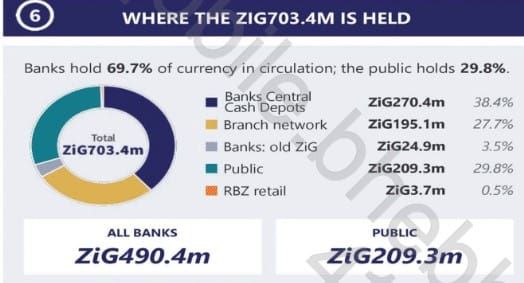
The report shows that the country has ZiG703,4 million in circulation against a deposit base of ZiG32 billion, representing a cash-to-deposit ratio of 2,2 percent.
The ratio is slightly below the three percent optimal benchmark, with the central bank indicating that the existing cash position is adequate to meet demand.
However, the report identifies geographical disparities in cash distribution, with banking infrastructure and cash availability concentrated in major economic centres.
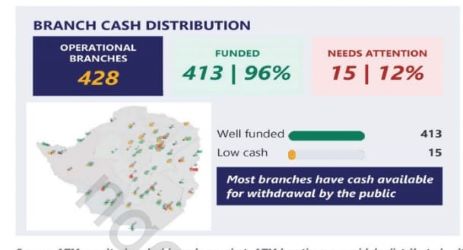
Harare accounts for 54.2 percent of the country’s 428 banking locations, while Bulawayo and Harare have the highest institutional coverage, each having 20 banks.
The concentration of banking infrastructure in major centres presents challenges for businesses and consumers in areas with limited access to financial services.
“Public consultations highlighted persistent challenges in cash access, availability and distribution, particularly in remote areas,” the RBZ said.
The report shows that Matabeleland South and Mashonaland East have the lowest institutional coverage, with seven banks each.
The RBZ said the distribution of cash was influenced by differences in banking activity, branch presence and demand for cash across the country.
To address these disparities, the central bank is developing a Cash Distribution and Availability System (CDAS), which will use monitoring insights to support faster and more equitable cash deployment.
The system is expected to help banks prioritise underserved provinces, accelerate last-mile distribution to branches and ATMs, and monitor cash availability in real time.
Under the proposed framework, banks will consider minimum branch-level cash thresholds and escalation triggers to reduce excessive concentration of cash in central depots.
The report indicates that banks hold Zig490.4 million (69,7 percent) of ZiG in circulation, while the public holds 29,8 percent (ZIG209.3 million.
“Importantly, Zig195.1 million (27.7 %) is already positioned withing bank branch networks and is therefore more ready accessible for public withdrawals while Zig 270.4 million (38.4%) is held at CCDs for onward distribution to branches as demand arises.
“This indicates substantial cash capacity within the banking system to support continued public access to ZiG cash.”