Siphakeme .Mnindwa
Sikhulekelani Moyo, [email protected]
RESERVE Bank of Zimbabwe (RBZ) has announced that it will widen its ongoing blitz on businesses across the country, defying the Government directive to accept the use of multicurrency, which also includes embracing the local currency, the ZiG, as a legal tender at the official rate when pricing products.
The operation, which was hitherto confined to Harare and its environs, will be extended to other provinces during the first quarter of the year as part of enforcing financial laws.
This comes at a time when some businesses in Bulawayo among other cities and towns, continue to defy Government directives to accept ZiG as the legal tender, with the informal sector, continuing to give flimsy excuses, among them network hurdles on their point-of-sale (POS) machines, forcing consumers to use foreign currency.
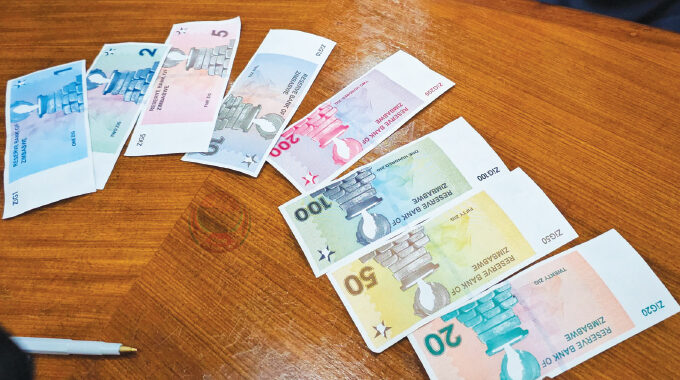
The Statutory Instrument (SI) 81A of 2024, promulgated by the Government after the successful launch of the structured currency in April last year, compels businesses to use the official exchange rate when pricing products.
Also, in 2022, the Government gazetted SI 218 of 2023, which effectively extends the use of the multiple currency system to December 2030.
However, regardless of all these statutory instruments, some businesses continue to frustrate consumers as they refuse to accept the local currency, with some businesses opting to accept it using the black-market rate, which erodes consumer’s purchasing power.
In an interview, RBZ Governor Dr John Mushayavanhu said when the Government enacts policies, it expects businesses and the general public to comply with the regulations.
On the financial side, these policies are enforced by the Financial Intelligence Unit (FIU) and other Government units that have instruments to deal with such malpractices.
“It should be noted that FIU monitoring and compliance operations have hitherto been concentrated in Harare and its environs, but beginning the first quarter of 2025, the FIU is expanding its enforcement operations into Bulawayo and other provincial capital cities,” said Dr Mushayavanhu.
“Some of the measures include heavy penalties for organisations that violate the exchange control regulations, and this will greatly improve compliance across the board. The FIU continues to urge the public to report issues of non-compliance, and they will swiftly respond as necessary.”
Dr Mushayavanhu said in promoting compliance, efforts by the FIU are beginning to bear fruit as some areas witness increasing levels of compliance in the smaller shops that are now accepting the local currency.
“Compliance is a confidence issue, and the RBZ continues to refine its monetary policy to achieve and maintain price and exchange rate stability, and confidence will be restored in the transacting public,” he said.

Dr Mushayavanhu noted that while the informal sector compliance levels are still far below the formal sector, it is encouraging to note that the trend is improving.
“The Government is working towards increasing usage of local currency in all parts of the country including for settlement of taxes, purchase and sale of goods and services in local currency.
“It is, however, important to take cognisance of the increased reliance on digital or electronic payment methods over cash, which has, to an extent, seen a reduction in the demand for cash and resultantly lower the proportion of cash in circulation to broad money,” he said.
Dr Mushayavanhu said the foreign exchange market has been liberalised to reflect free market forces, adding that there should be no incentive for trading on the parallel market.
“It has been noted that cases of exchange control-related violations have significantly declined over the last quarter of 2024, aligning with the exchange rate stability that has been obtained,” he said.
“RBZ will continue to implement measures to augment the current stability and will remain mindful of balancing currency and price stability with economic growth.”
Consumer Council of Zimbabwe (CCZ) director, Mrs Rose Mpofu, said the refusal by some shops to accept ZWG as legal tender is an offence as it violates consumers’ right to choose currencies to use.

“Consumers that are formally employed, especially those in the public sector, earning a portion of their incomes in the local currency are disadvantaged. It creates a huge demand and appetite for foreign currency thus pushing the alternative market rate high, and creating a lucrative market for the US dollar in the informal sector,” she said.
Mrs Mpofu said the Government should build market confidence in ZiG acceptance by businesses, urging consumers to report any business unethical tendencies.
In a snap survey yesterday, the Chronicle news crew observed that some businesses in Bulawayo were refusing to accept the ZiG.
“We are not accepting ZiG because our suppliers are refusing transactions in local currency, which makes it difficult for us to trade in ZiG,” said an informal trader operating at the market
Some selected foreign-owned shops and informal shops visited by the news crew in the city centre had displayed an exchange rate of US$1:28 ZWG, purportedly indicating that they accepted ZiG transactions.
However, they had no POS machines preferring cash.
Confederation of Zimbabwe Industries President Mr Denford Mutashu said it is illegal for retailers not to comply with exchange regulations.
“However, while most major retrial outlets are complying by accepting the ZiG, unfortunately, some have found the going tougher due to unfair competition from the informal shops,” said Mr Mutashu.
@SikhulekelaniM



 Online Reporter