Online Reporter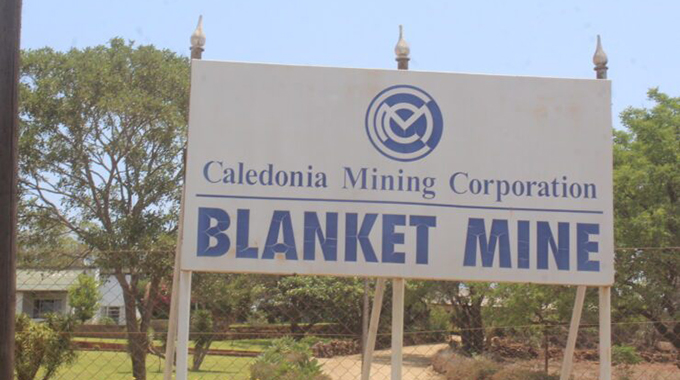
Judith Phiri, Zimpapers Business Hub
CALEDONIA Mining Corporation Plc said the reinvestment of profits has driven strong mineral resource growth, from approximately one million ounces in 2016 to nearly seven million ounces to date.
This resource stock comprises measured, indicated and inferred mineral resource categories, which have secured the long-term benefits for Caledonia’s shareholders, employees, the Government and other key stakeholders.
Gold is crucial to Zimbabwe’s economy as its biggest foreign currency earner, helping to stabilise the local currency (ZiG) and boost foreign currency reserves. Zimbabwe has surpassed its annual gold production target for 2025, reaching 41,4 tonnes by November, exceeding the 40-tonne goal. The final year-end total is projected to be even higher, potentially reaching 44-46 tonnes.
This was revealed by Blanket Mine (a subsidiary of Caledonia Mining), head of finance, Mr Duncan Mpofu at a Community Economic Empowerment Trusts (CEETs) Policy Dissemination Workshop in Bulawayo recently.
Mr Mpofu said Caledonia Mining had seen an impressive consolidated resource and gold production growth from 2015 to 2025.
“We are an established Zimbabwe gold producer with a multi-asset development strategy. Reinvestment of profits has delivered mineral resource growth from approximately one million ounces of gold resource in 2016 to almost seven million ounces of gold resource to date,” he said.
“On our growth focus, we are targeting over 200 000 ounces annual production when Bilboes becomes a producing mine, supported by a stable current production profile. We are uniquely positioned with a high-quality project pipeline and significant in-country presence as a major employer and social contributor.”
He said the group was recording strong financial returns and declaring consistent quarterly dividends since 2012, which have totalled over US$60 million.
Mr Mpofu said Caledonia was the first Zimbabwean gold mining company to fully comply with Zimbabwe’s indigenisation laws.
At Blanket Mine, 51 percent shareholding was transferred to Zimbabwean entities, demonstrating a strong commitment to empowering local stakeholders and fostering economic development within the community.
“This achievement created a model for responsible resource development, which includes local participation and sustainable growth. Ten percent goes to Blanket Employee Trust Services (Bets), which is direct employee ownership with board representation, ensuring workers benefit from the mine’s success,” he added.
“Ten percent goes to Gwanda Community Share Ownership Trust (GCSOT) for funds of community development projects; improving quality of life in surrounding areas. 16 percent is for the National Indigenisation and Economic
Empowerment Fund (NIEEF) as Government commitment to distributing mining benefits nationally and supporting entrepreneurship.”
He said 15 percent was for the Zimbabwean Investor Group, which originally held Blanket shares, now converted to Caledonia shareholding for broader portfolio exposure.
Mr Mpofu said from 2012 to 2013, Blanket provided US$4 million in advance dividends to establish GCSOT’s operations and initial project capacity.
“For the repayment method, GCSOT repaid by sacrificing future dividend entitlements rather than cash payments, preserving funds for community projects. Initially, 100 percent dividend sacrifice and later reduced to 80 percent sacrifice,” he said.
“September 29, 2021, Blanket paid a dividend that completely repaid the advance dividend account. The result is that GCSOT now receives a full ten percent dividend entitlement with no deductions.”
He said that since 2022, dividends attributable to GCSOT have shown consistent growth, with a notable surge recorded in 2025 year-to-date, driven by the rally in global commodity prices.
Mr Mpofu said this trend underscores how the local community was also benefitting from the rise in gold prices.
“Blanket Mine’s Corporate Social Responsibility (CSR) initiatives are designed to address community-identified needs. These needs are articulated through formal written submissions, requests from community leadership, and broader input from community members. Each request is assessed and prioritised based on its potential reach and the criticality of the service provided.”
Mr Mpofu said CSR projects are implemented under defined thematic pillars: Education, Health, Women and Youth Empowerment, Agriculture, Environment, Conservation and Charity.
He said notable CSR projects by Blanket Mine include the Sitezi project covering the clinic, the secondary, and the primary schools, construction of a football stadium at Sabiwa High School, as well as renovation of Insimbi Primary School and the computer laboratory.
While renovations were also undertaken to Sabiwa Primary School and the refurbishment of the science block.
On sharing the economic pie, Mr Mpofu said quarterly distributions to Zimbabwe stakeholders increased by 260 percent from $6,1 million to $22,2 million over the last seven quarters, during which the average received gold price has increased 70 percent from $2 000 to $3 400 per ounce.